Dr Nick White is a healthcare leader with over twenty-five years of clinical and leadership experience. He has held four consecutive medical director posts for the last ten years: one in the NHS (one each at national, regional, and local level) and one in the independent healthcare sector. Throughout his career, he has held significant positions such as National Clinical Lead at NHS Improvement working to turnaround struggling providers, Regional Medical Director for Commissioning where he led both strategic and operational responses during the COVID-19 pandemic, and an ICB Chief Medical Officer as executive director of a £1bn turnover public sector statutory body. As well as continuing to practice as a consultant surgeon in the NHS, he is currently using his breadth and depth of subject matter expertise to support the development of new healthcare facilities and health tech start-ups.
Glossary
ALB: Arm’s-length body
API: Aligned Payment and Incentive
DHSC: Department of Health and Social Care
ICB: Integrated Care Board
ICS: Integrated Care System
IR35: Intermediaries legislation tax rules
MoG: Machinery of government
NHSE: NHS England
OBR: Office for Budget Responsibility
OECD: Organisation for Economic Co-operation and Development
ONS: Office for National Statistics
PbR: Payment by Results
SME: Small or medium-sized enterprise
Executive summary
Britain’s healthcare system presents one of the greatest challenges any incoming government will face. The NHS remains among the public’s top three concerns, in part because satisfaction has collapsed: only 26 per cent were satisfied in 2025, a slight rise from the record low of 21 per cent the year before and far below the historic peak of 70 per cent in 2009. The incoming Secretary of State’s own verdict after the 2024 election was that “the NHS is broken.” Polling now shows a growing willingness to consider alternative models of provision once they are explained, rather than simply more of the same.
The fiscal picture is as stark as the political one. The DHSC budget is £214bn and is set to reach £246bn by 2028/29. Including private care, healthcare spending is already around 11 per cent of GDP. The Office for Budget Responsibility projects that, without substantial policy changes, total public spending could rise from around 45 per cent of GDP in the mid-2020s to over 60 per cent by 2073–74, with government health spending alone heading toward 14.5 per cent, driven substantially by the burden of an ageing population. Real-terms NHS funding has risen by about 20 per cent since 2019, yet output has grown by only around 1 per cent a year and a large productivity shortfall is projected by 2028. The United Kingdom spends a similar share of national income to many peers but lags them on treatable mortality and has seen life expectancy stall and years lived in good health decrease.
Internal tweaks and recycled elective-recovery programmes have left the deeper problem untouched: a state-mandated monopoly in which managers and institutions do not face the same feedback as organisations that can lose custom. Apparent hospital choice on the NHS App is often five similar public providers. The move away from payment by results toward block and blended contracts has weakened the incentive to do more work. Individual clinical awards are poorly linked to daily throughput. During COVID, parts of the service were given autonomy and innovated successfully, but costs overran. By contrast, GP partners cannot run deficits without personal consequence, and so operate with both autonomy and accountability, providing an example for the rest of the health service.
The acknowledgement is universal among the public and the NHS: the status quo cannot carry on. Therefore, the healthcare policy platform contained in this paper seeks to deliver strategic, ambitious, yet practically and politically viable reforms to liberate the public and private healthcare sectors from their politically imposed malaise.
This paper does not give exhaustive policy detail. That will follow in the coming year, in individual pamphlets for each policy. Instead, this paper lays out our assessment of the current state of the healthcare system, the nature of its dysfunction, and the three themes which must underlie the substantial yet achievable reforms needed to ensure that Britain prospers.
Our three principal themes and associated policies are:
Health of the nation
Make enabling most people to finish education, gain employment, get married, and raise children a core mission across the whole government.
Replace ‘life expectancy’ with ‘healthy life expectancy’ as the key performance indicator for healthcare.
Focus on tertiary prevention as the correct interpretation of the shift from hospital to community.
Make better use of digital technology and data.
Reforming healthcare
Reintroduce tax relief on medical insurance.
Lower barriers to new entrants who want to provide medical insurance.
Improve support for small and medium healthcare enterprises to encourage different ownership models among providers.
Bring all arm’s-length bodies back into the DHSC.
Improving NHS management
Streamline governance and reduce bureaucracy.
Introduce performance-related pay.
Incentivise productivity through revising fiscal policy.
Undertake local not national pay bargaining.
Introduce co-payments for GP appointments.
Rebuild the NHS clinical workforce through training, recruitment, and retention.
These policies will maintain universal coverage; use genuine choice as the engine of improvement; and grow a mixed economy of public, private, mutual, and charitable purchasers and providers so that successful organisations can expand and failing ones decline. This platform does not need to be taken wholesale—an incoming government could take up any number of individual policies. However, the transformation that British healthcare needs will never be achieved by mere tinkering or one-off successes.
Delivery should be incremental over a parliamentary term, with leadership and terms settled early and large machinery-of-government upheavals avoided. The prize is not another plan for the same system, but a financially sustainable system that improves outcomes, returns people to work and restores public confidence without abandoning universal coverage.
Introduction
The need for change
Healthcare remains one of the greatest challenges for any incoming government. It has always been a matter of importance to the British public. When a new government takes the helm, it must confront a litany of deep-rooted challenges such as unsustainable financial cost, poor outcomes, operational inefficiencies and cultural inertia.
The NHS is consistently in the top three issues for voters and our own recent Prosperity Institute polling, The Health of the NHS, confirms this.[1]
Figure 1 (Source: The Health of the NHS)
This is underscored by public satisfaction with the NHS plummeting to its lowest levels ever and the increasing appetite for genuine healthcare reform. The British Social Attitudes survey began asking about NHS satisfaction in 1983. The most recent results revealed one of near record lows showing “very or quite satisfied” ratings at just 26 per cent in 2025, which was a marginal improvement of 6 points from 2024, down from an all-time high of 70 per cent in 2009.[2] The lowest ever was the previous year at just 21 per cent. When broken down to individual core services, GP satisfaction is 35 per cent, A&E 22 per cent, and hospital services 37 per cent. Satisfaction is skewed across age groups with a clear trend between older and younger respondents. People aged 65+ are the most satisfied at 35 per cent, under-35s are at just 20 per cent. When asked “are things likely to improve?” the situation is unnerving: when asked if the standard of NHS care would improve over the next five years, only 16 per cent said yes while 53 per cent said they expected care to get worse.
Figure 2 (Source: The King’s Fund and Nuffield Trust)
This was recognised by the current government, when in his inaugural statement following the 2024 General Election, the Secretary of State for Health and Social Care declared that “the NHS is broken”.[3] When solutions to this are offered in a poll it becomes apparent that there is a clear preference for reform, with a growing appetite for alternative approaches to healthcare provision.
Figure 3 (Source: The Health of the NHS)
There is a need for a balanced budget for long-term national prosperity and a key aspect of this is making NHS spending sustainable. The DHSC budget is currently £214bn and is predicted to rise to £246bn by 2028/29. When UK-wide healthcare spend is taken into account (including private healthcare) this equates to 11 per cent of GDP. The present disconnect between public expectations, what the NHS currently delivers, and its ever-increasing strain on public finances is a core problem for any government.
Figure 4 (Source: Prosperity Institute 2026)
This is due to continue to rise, not only in absolute terms but also as a percentage of GDP and as a percentage of the total government budget. Predictions by the Office of Budget Responsibility estimate that total public spending is projected to rise from around 45 per cent of GDP in the mid-2020s to over 60 per cent of GDP by 2073-74 (under unchanged policy settings).[4] This is driven primarily by demographic pressures (ageing population), rising healthcare and social care costs, state pensions, and debt interest. Government health spending is projected to rise to 14.5 per cent of GDP by 2073-74. This makes healthcare one of the largest single drivers of the overall increase in government spending. Considering Britain’s already high tax burden, this is an increasingly unsustainable trend.
Increasing government spending when the economy is operating at near full capacity can add inflationary pressures. There is a clear need to control government healthcare spending in the medium and long term.
This paper offers policy proposals that an incoming government could adopt to improve outcomes and deliver financial stability. We lag behind our international peers in key health outcomes despite spending an equivalent proportion of GDP on healthcare.
Figure 6a (Source: The Health of the NHS)
Figure 6b: Life expectancy and health expenditure 2023 (Source: OECD)
This is also reflected in other data, with the UK lagging behind peers on avoidable deaths.
Figure 7 (Source: Institute for Public Policy Research)
Although there have been improvements in life expectancy since the 2010s, these stalled in 2018. (see figure 8). Healthy life expectancy is an official measure, produced by the Office for National Statistics, which is defined as the average number of years a person can expect to live in “very good” or “good” general health based on how individuals perceive and self-report their own health. It is particularly important for two reasons: 1) the large number of out of work people of working age with health problems and 2) the cost of care for people with multiple medical conditions.
Figure 8 (Source: Prosperity Institute 2026)
By transforming healthcare, we can enhance national prosperity: balancing the national budget, returning people to the workforce and decreasing the cost of chronic illness. This is reflected in the health pillar of the development domain of the Legatum Prosperity Index.[5] To succeed, priorities must be limited and focused. If everything is a priority then nothing is, as scattering efforts dilutes impact. The NHS has drowned in overlapping plans since the 1990s, breeding fatigue through constant reinvention. There is no reason why the current government’s “three shifts”—from hospital to community care, treatment to prevention, and analogue to digital—cannot be kept. They have, in one form or another, existed for the last 40 years. Any future administration should adopt them without launching grand new schemes. Instead, enforce fewer, clearer strategies from each part of the NHS such as Trusts and Integrated Care Systems (ICSs) so they align with one national framework, allowing local variations but tying performance metrics to these shifts.
According to recent opinion research conducted by Prosperity Institute, public satisfaction in the health service continues to decline. Now, many Britons are open to alternative types of provision from outside the NHS. This cuts across traditional political allegiances, which suggests that there is growing public interest in meaningful reform. This reflects the repeated failure of multiple governments to deliver material improvements in the health service with a succession of tweaks and new priorities over the years. The current government exemplifies this approach, which can be described as doing the same as before but slightly better, as if a change in governing party was all that was required to fix things. The Government’s elective reform plan, aimed at reducing waiting times from 18 months to 18 weeks, recycles existing initiatives without linking them to structural overhaul, despite manifesto pledges of “no new money without reform”. While cutting waiting times is laudable, given their ripple effects on the system, this internal focus continues to miss the mark.
Compounding these issues is the NHS’s performance. Healthcare management is balancing the three pillars of finance, performance, and quality. Despite a 20 per cent real-terms increase in funding since 2019, productivity has fallen over the same period. Output has grown by just 1 per cent annually, leading to a projected £20bn shortfall by 2028 if trends persist. Such inefficiency is unsustainable, especially amid calls for a balanced budget to secure national prosperity. Public spending on the NHS must be fiscally responsible, yet the current disconnects between tax revenues spent and the actual service being delivered highlights a classic principal-agent problem inherent in large state monopolies. Here, the interests of managers and bureaucrats diverge from those of patients and taxpayers, fostering complacency and waste. This is where the principles of choice driving improvement, autonomy and accountability are needed.
An alternative vision can be developed with three guiding principles:
A commitment to universal coverage,
A genuine choice providing incentives as the means to improve, and
A more mixed model of healthcare.
Political discussions about the NHS revolve around two extremes: commitments to ever increasing amounts of taxpayer’s money going into the NHS or accusations of the implementation of an American style healthcare provision with the suggestion of privatisation. The policy proposals described in this publication are designed to deliver financial sustainability and improve outcomes whilst maintaining universal coverage which is the case in the vast majority of healthcare systems across the developed world.
Britain has the opportunity to open up a wide-ranging discussion about the future of the health service from first principles. The fragmentation of the two-party system may lead to the possibility of a majority government with only 35 per cent of the vote, which makes easier debate of difficult issues such as healthcare reform. It will be made easier still if the current Labour government does not make demonstrable improvements in healthcare, particularly in the waiting list reduction goal it has set itself.
This is ultimately about how we preserve and maintain financially sustainable universal coverage by having an honest conversation about wider healthcare reform rather than just NHS reform. True transformation requires external reform: introducing accountability, incentives, and choice to drive efficiency. A mixed model of healthcare provision is supply-side reform with incentives to make more efficient use of resources. We must shift from reforming just the NHS to reforming British healthcare more broadly. By prioritising prosperity through better health outcomes, delivered by embracing choice and a more mixed model of provision, we can forge a sustainable system that serves patients, taxpayers, and the nation alike. Elements of how this can work have been demonstrated in the 2026 Legatum Prosperity Index.[6]
Our three central themes
The health of the nation: a central cross-government approach to public health
Reforming healthcare: providing better outcomes and financial sustainability
Improving NHS management: ensuring taxpayer value for money
These themes will be divided into separate policy proposals. The policies recommended will be based on the principles of choice, incentives, and accountability to enhance national prosperity. The reason government programmes are inefficient is that, unlike a commercial company, the feedback loop for improvement is broken because they have a state-mandated monopoly and can’t go out of business if customers are unhappy. No matter how bad the service is with the NHS, people still have to use the NHS because it is a monopoly provider. We reject the notion that the NHS, other state-backed entities, the private sector and third sector organisations such as charities and mutual associations cannot coexist, complement, and support each other.
Choice should be used as a driver for improvement. This would work well if the NHS was responsive to change. The current situation of being offered a selection of five different providers on the NHS App is an illusion of choice, akin to being allowed to go to only one restaurant and there being five identical dishes on the menu. There are no meaningful incentives in place to reward organisations doing more work or consequences for those doing less work. In fact, counterincentives exist around not having big waiting lists and not attracting in work. Productivity thrives on incentives, but the NHS lacks them at both organisational and individual levels. These issues have been worsened by the transition away from Payment by Results (PbR) which were created for trusts to encourage activity by paying per unit of activity. The NHS Payment Scheme is currently funded through block allocations and API contracts. Transitioning to blended payment structures have weakened marginal activity incentives. This is because, Trusts are no longer paid per unit of activity, abolishing any incentive to do more or impose any penalty for doing less work. Therefore, providers are no longer encouraged to expand capacity or take on new work, as there is no added income for treating extra patients while draining fixed budgets at the same time. Unless there is a reform to the system, any promise of patient choice cannot drive the necessary improvements the NHS needs.
Meanwhile, frontline staff, particularly doctors, face no meaningful financial or professional rewards for daily efficiency. The local Clinical Excellence Awards (CEAs) which has been reformed into the National Clinical Impact Awards (NCIAs) for doctors were retrospective, disconnected from organisational goals, and failed to incentivise forward-looking performance. The modernised scheme does not focus on daily operational throughput, but on regional and national contributions instead.
Contrast this with General Practitioners, whose financial accountability as partners in doctor-owned practices drives better decision-making. GPs cannot run deficits without personal consequences, so they innovate and optimise. Extending this owner-delivered model to hospitals—where clinicians have a stake in success—could foster a sense of ownership absent in the current system.
During COVID-19, frontline teams thrived when given autonomy to innovate, but this came with relaxed budgetary controls, leading to spiralling costs. True autonomy must pair responsibility with accountability, including the risk of dismissal for overspending. Productivity may never rise significantly without a mixed model of provision. More commissioners and providers—public, private, mutual and charitable—would foster genuine choice. Failing organisations would exit, and successful ones would grow, unlike today’s stagnating status quo.
Benevolent funds, doctor-owned SMEs, and other new entrants could emulate the GP model, where ownership ensures accountability and drives efficiency. This approach is about providing something additional to support the NHS, not replacing it.
Approach
The core components for the Prosperity Institute’s healthcare platform are:
a strategy consisting of over a dozen policy proposals centred around our three themes
a transition roadmap to get this strategy delivered
a people plan to detail all the roles which would need to be filled to deliver this platform
Following on from this publication, a series of policy pamphlets will be published at regular intervals, and they will then all be incorporated into the final version of this document due in 2027, which will include the roadmap and people plan.
They will be accompanied by a series of face-to-face seminars and roundtables hosted by the Prosperity Institute, including panels at party conferences.
Section 1. The health of the nation
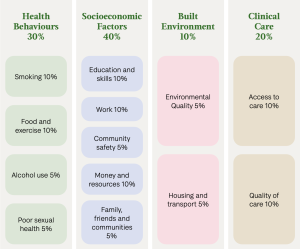
The health of a nation extends far beyond the confines of hospitals and GP practices. It is shaped by the wider determinants of health; the social, economic, and environmental factors that influence individual well-being from cradle to grave. Factors such as education, employment, housing, community cohesion, and crucially strong personal relationships play pivotal roles in preventing illness and promoting longevity.[7]
Figure 9: Wider determinants of health (Source: The Marmot Review)
Evidence from the Harvard Study of Adult Development, the longest-running longitudinal study on human flourishing (established in 1938) with an initial cohort of 724 Boston men, shows a stronger correlation between social connections such as close, supportive relationships and long-term health and happiness than social class, IQ, cholesterol levels, or even genetics.[8] Thus, relational markers may be just as necessary as physical markers in an individual’s overall health outcomes.
By addressing these broader determinants, we can foster a healthier, more resilient population, reduce the burden on the public finances, and empower individuals through personal responsibility and choice. Education and economic opportunity stand as foundational pillars among these determinants, directly correlating with healthier lifestyles and better health literacy. Individuals with higher educational attainment are more likely to adopt preventive behaviours, such as balanced nutrition and regular exercise, while stable employment provides the financial security needed for quality housing and nutritious food. Conversely, poverty and unemployment exacerbate risks of chronic conditions like obesity, mental health disorders, and cardiovascular disease, perpetuating cycles of dependency on state services. Environmental factors, including air quality and access to green spaces, further compound these effects, particularly in deprived urban areas. The Harvard Study reinforces this by showing that warm relationships buffer against life’s stresses, delaying physical and mental decline more effectively than isolated material or biological factors.
There is very similar recognition of problems and headline goals for this across the political spectrum. However, the means to achieve the ends is very different from left-of-centre and right-of-centre perspectives.
The left-wing approach to healthcare reform in Britain, best exemplified by the Marmot Report and the Institute for Public Policy Research, advocates upstream interventions, government spending, and equity to achieve health gains through redistribution and regulation. Examples include enforcing living wages, mandated employer wellness initiatives, and government-led job creation with reformed sick pay and additional employment rights. Some go as far as to suggest introduction of a minimum income guarantee and subsidised essentials like food and energy. They also suggest the implementation of anti-discrimination laws in housing, employment, and services, with mandatory equity training for public sector workers, along with integration of health into climate policies by establishing a cross-sector Health Mission Board and an independent accountability body (akin to the Climate Change Committee) for five-year plans. Policies that have already been implemented by the current Labour Government include the provision of universal free school meals and abolition of the two-child benefit cap.
A right-of-centre perspective would advocate for policies that enhance social mobility through vocational training, tax incentives for businesses, and deregulation to stimulate job creation, all while nurturing community ties to tackle root causes rather than merely treating symptoms. To improve the nation’s health, policymakers must prioritise incentives that encourage personal agency and strong social connections over bureaucratic overreach.
By integrating these wider determinants into healthcare strategy, drawing on insights like those from the Harvard Study that good relationships keep us happier, healthier, and help us live longer, we can achieve sustainable gains in life expectancy and quality of life. The Prosperity Institute’s vision is one where economic freedom, individual empowerment, and thriving relationships converge to build a healthier, wealthier Britain for generations to come. It is clearly reflected in the Legatum Prosperity Index 2026, which also shows which overseas approaches are worth considering.[9]
A word on social care and the Casey Report
This publication focuses on healthcare not social care. The government is currently awaiting the Casey Report (formally the Independent Commission on Adult Social Care). The first phase is due sometime in 2026, and the second had been planned for 2028. However, final publication has now been brought forward to 2027 and will include recommendations on funding.
We will not make specific policy recommendations on adult social care; however, we need to highlight some key points.
Social care is co-dependent on many factors including local government organisation and funding, minimum wage legislation, and immigration rules. We cannot continue with national government giving local government statutory open-ended spending commitments.
The main difference between healthcare and social care is the nature of provision and optimal delivery mechanisms. Healthcare is concerned with acute medical needs requiring professional expertise and technical capability, while social care addresses functional limitations in family support and the local community care system. Conflating both creates perverse incentives in both domains.
We would anticipate a mixed model funded by national tax, local tax, private insurance, social insurance, and cash payments. This would also be supported by a cap on costs and a floor below which assets are protected; along with a decision on how much protection is given to an individual’s primary residence as opposed to all other assets.
Recommendations
Our recommendations for the health of the nation are:
Make enabling most people to finish education, gain employment, get married, and raise children a core mission across the whole government
This would make the wider determinants of health a central test of policy across government, with departments expected to show how decisions on tax, housing, education, welfare, energy, and immigration support educational attainment, stable employment, family formation, and long-term wellbeing.
Replace ‘life expectancy’ with ‘healthy life expectancy’ as the key performance indicator for healthcare
Healthy life expectancy would shift the central goal from simply extending life to increasing the number of years lived in good health, independence, and productive activity, aligning healthcare strategy with prosperity rather than narrow acute-care targets.
Focus on tertiary prevention as the correct interpretation of the shift from hospital to community
The community shift should focus on preventing deterioration among people already diagnosed with long-term conditions, using GP-led, outcome-linked interventions to reduce repeat unplanned admissions; and stopping younger adults with chronic illness progressing to more severe disease.
Make better use of digital and data
Digital reform should be treated as a practical tool for decentralised improvement, accountability, and innovation, with modern cloud and software services funded appropriately and frontline teams given rapid-cycle data while robust metrics support public transparency and research.
We will be producing detailed policy pamphlets on each of these recommendations in the next year.
Section 2. Reforming healthcare
This chapter does not propose replacing or fundamentally changing the NHS. Its reforms are explicitly designed to support and strengthen it. The goal is to expand genuine patient choice and introduce a greater range of provision within a genuine mixed economy of healthcare.
Consumer choice and provider competition are the proven building blocks of value creation. Value is best understood as outcomes delivered divided by the cost of achieving them. Where organisations fail to create value they lose revenue and, in a normal market, fail. The NHS has been largely insulated from that discipline, with predictable results. To break the cycle, we must grow the total capacity of Britain’s healthcare ecosystem, both NHS and independent sector alike. This requires attracting substantial new capital investment from non-NHS sources and increasing the number and variety of both purchasers and providers. Repeated raids on capital budgets to plug operational deficits—the “missing billions” identified by Lord Darzi—have starved the system of modern facilities and infrastructure.[10]
The Beveridge and Bismarckian models represent two approaches to organising universal or near-universal healthcare systems, each with distinct origins, structures, and characteristics.
The Beveridge model, named after William Beveridge and introduced in the United Kingdom through the creation of the NHS in 1948, relies primarily on general taxation as its funding source. Revenue comes from income tax, VAT, and other government taxes, allowing the state to act as a single payer. In this system, the government typically owns and operates most hospitals, clinics, and other facilities, while many doctors and healthcare workers are directly employed by the public sector. Coverage is provided as a universal right to all citizens and residents, independent of employment status or ability to pay. This centralised approach enables strong government control over budgets, pricing, and service capacity, which can help keep overall healthcare spending relatively low as a percentage of GDP but may lead to longer waiting times and potential rationing of services. Patients generally have limited choice of insurer, as there is only one system, and services tend to be highly standardised.
In contrast, the Bismarckian model, originating from Otto von Bismarck’s social insurance reforms in Germany in the late nineteenth century, is funded through mandatory payroll contributions or premiums. These are shared between employers and employees and paid into non-profit sickness funds or insurers. Multiple competing or regulated insurers act as payers rather than a single government entity, creating a multi-payer structure. Healthcare providers, including hospitals and doctors, are predominantly private, though the government heavily regulates benefits, prices, and standards. Coverage was originally linked to employment and contributions, but modern versions of the model mandate participation for nearly everyone, often with government subsidies for those unable to contribute. This system tends to offer patients greater choice of insurer and, in many countries, faster access to services or additional options due to competition among funds. It often achieves effective cost control through regulation and negotiation rather than direct government budgeting.
When comparing the two, the Beveridge model is generally simpler to administer, with lower administrative costs and a strong emphasis on equity and universal access from taxation. However, it faces criticism for underfunding, long queues, and limited innovation. The Bismarckian model, used in a larger number of countries, frequently performs well in terms of patient satisfaction, speed of access, and responsiveness, thanks to its pluralistic structure and regulated competition. On the other hand, it can involve higher administrative complexity and costs due to the presence of multiple payers.
Examples of Beveridge-style systems include the UK, Spain, Italy, Sweden, Norway, Denmark, New Zealand, and Cuba. Bismarckian systems are found in Germany (with its many sickness funds), France, Belgium, the Netherlands, Japan, Switzerland, Austria, the Czech Republic, and South Korea. Some countries blend elements of both approaches, and performance rankings vary depending on whether the focus is on equity, efficiency, outcomes, or patient experience.
International evidence shows what is possible. Australia has fashioned a successful hybrid Beveridge-based model with private insurance incentives that combines universal, tax-funded coverage with meaningful patient choice and regulated competition between private insurance providers. The results rank among the best in the OECD: outstanding healthy life expectancy achieved at a sustainable share of GDP. This is reflected in our recent polling, The Health of the NHS, which shows an appetite for alternative healthcare systems when they are explained to people.
Figure 10 (Source: The Health of the NHS)
The measures set out in this chapter—centred on wider choice, stronger accountability, and expanded capacity—will place value creation at the heart of healthcare delivery. They form the essential bridge between improving the underlying health of the nation (chapter one) and delivering more effective operational management of the NHS itself (chapter three). To get choice we need an increase in capacity, particularly in the three headline areas of capacity constraint: elective waiting lists for diagnosis and treatment, GP appointments (particularly same-day appointments), and emergency department waiting times.
This is not privatisation by another name. It is intelligent modernisation: using competition and choice to make healthcare more dynamic, responsive and sustainable so that it can once again deliver world-class care for a prosperous Britain.
Recommendations
Our recommendations for reforming healthcare are:
Reintroduce tax relief on medical insurance
Tax relief would make private medical insurance more affordable for households and employers, increasing voluntary uptake and directing additional private funding into healthcare capacity while preserving universal NHS access.
Lower barriers to new entrants who want to provide medical insurance
Encouraging mutual, charitable, co-operative, and locality-based insurers would reduce domination by a small number of incumbents, broaden the range of policies available, and place downward pressure on prices through genuine purchaser competition.
Improve support for small and medium healthcare enterprises to encourage different ownership models among providers
This would develop a broader mixed-provider market by supporting owner-run, clinician-led, mutual, charitable, and SME healthcare organisations, drawing on the GP partnership model and international examples such as Japan’s clinician-owned medical corporations.
Bring all arm’s-length bodies back into the DHSC
Bringing arm’s-length bodies back into DHSC would restore direct ministerial accountability; reduce duplicated governance and back-office functions; and allow budgets, HR, policy priorities, and delivery to be managed through a single accountable departmental chain.
We will be producing detailed policy pamphlets on each of these recommendations in the next year.
Section 3. Improving NHS management
The National Health Service is trapped in a vicious cycle. More than seven million cases, affecting approximately six million individual patients, sit on elective waiting lists. These backlogs spill directly into primary care, where roughly 30 per cent of GP appointment requests come from patients seeking relief for conditions already on a waiting list. The same proportion of emergency department attendances stems from the same source. Greater severity, longer assessment times, and repeated diversion of beds and staff from elective to emergency work then squeeze elective capacity still further. The outcome is poorer patient results, worse experience for all and mounting pressure on staff.
The two previous themes around the health of the nation and reforming healthcare are external policies to support and run alongside the NHS. This theme deals with how the NHS can be run better (internally). Running the NHS better needs to be underpinned by improvements in choice, incentives, and accountability. The arguments for choice imply that successful organisations will prosper and unsuccessful ones will wither. What little choice is available is not linked to incentives of the people running the service. Choice creates discipline only when decision-makers face consequences. The lack of accountability in the NHS means that neither prospering nor withering really happens. For genuine reform to take place, there must be the requirement that successful organisations prosper while unsuccessful ones lose market share, face redundancies and lose revenue. There have been 25 major reorganisations in the NHS’s 75-year history, and we do not advocate another.
We propose a series of steps which can be performed sequentially or together to improve outcomes and control costs. These need not be implemented as part of a major reorganisation but could be introduced incrementally over the course of a parliamentary term. Many are already happening and need to be encouraged such as the increasing use of shared appointments at Chair and CEO/executive director level across provider trusts.
Recommendations
Our recommendations for improving NHS management are:
Streamline governance and reduce bureaucracy
This would simplify the NHS’s overlapping governance structures by extending joint leadership appointments, clarifying budgetary responsibility, writing off historic deficits in exchange for strict future breakeven requirements, and reducing top-heavy senior management layers.
Introduce performance-related pay
Performance-related pay would link individual and organisational rewards to measurable objectives such as reducing emergency admissions, improving safety, maintaining financial discipline, and spreading best practice, replacing blanket pay rises with clearer incentives for productivity.
Incentivise productivity through revising fiscal policy
Fiscal reform would remove tax and pension disincentives that discourage senior clinicians from taking on extra NHS or independent-sector work, including by smoothing the personal allowance taper, reforming pension allowances, and excluding medical services from IR35 where appropriate.
Undertake local not national pay bargaining
Local and regional pay bargaining would let trusts and Integrated Care Boards respond to real labour market conditions, rewarding scarce skills, hard-to-fill roles, unsocial hours, and local retention needs without raising pay nationally by default.
Introduce co-payments for GP appointments
Modest, means-tested co-payments (e.g. £5 per appointment, with a 40/60 split between the surgery and a national pool) would give general practice an additional revenue stream, create a small demand-management signal, and make sterner measures such as charging for missed appointments more practical while protecting vulnerable groups through exemptions and redistribution.
Rebuild the NHS clinical workforce through training, recruitment, and retention
Workforce reform would prioritise domestic training pipelines, expand medical school and specialty places, give British graduates priority for training posts, and use retention incentives such as tax breaks or debt forgiveness to reduce reliance on overseas recruitment.
We will be producing detailed policy pamphlets on each of these recommendations over the coming year.
Section 4. The way forward
The healthcare platform outlined thus far consists of a clear set of policy proposals organised around the three core themes set out in the preceding chapters. Yet strategy alone is not enough. Successful delivery requires two further pillars:
a disciplined operating process (i.e. a transition roadmap); and
a people plan identifying precisely who will carry the work forward.
The current government’s approach has been characterised by an initial election pledge of “no major reorganisation”, followed by a rapid tightening of central control from DHSC over NHS England, culminating in the surprise announcement of NHS England’s abolition. This reversal has created confusion, wasted political capital, and distracted staff from urgent tasks such as cutting waiting lists. A Health Bill, to enable these changes, was only introduced in May 2026, nearly two years after the start of the parliamentary term.
The lesson is clear: operational management tweaks and headline-grabbing structural announcements are no substitute for genuine reform. A credible platform must therefore set out not only what to do, but how and by whom it will be delivered. A roadmap and people plan needs to be designed which avoid the pitfalls of rushed change while building a sustainable mixed-market health service over a single parliamentary term.
Timeline
Policy delivery requires a number of sequential steps. This is well described in the 2013 World Class Policy tests document from the Department of Education which is still in regular use today within the civil service.22
It describes five steps:
Purpose: Are you absolutely clear what the Government wants to achieve?
Role: Are you absolutely clear what the Government’s role is?
Evidence: Are you confident that you are providing world leading policy advice based on the very latest expert thinking, data and analysis?
Creativity: Are you confident that you have explored the most radical and creative ideas available in this policy space, including doing nothing?
Delivery: Are you confident that your preferred approach can be delivered, and in the timescales proposed?
The preceding chapters of this publication deal with the first four of these. With regard to delivery, the Westminster system still allows major reform but requires a government to identify blockers, make trade offs and have a clear plan.
It is important to approach this with clarity of purpose and some basic principles. These include focusing on clear authority being more important than a perfect process, with the speed of decision-making being more important than making perfect decisions. Risk must be owned with clearly accountable named individuals and not dispersed across large teams. Continuity is key with the same staff holding the risk for the length of a parliamentary term.
Finally, large projects should be avoided, as should major reorganisations (sometimes referred to as “machinery of government” changes) which lose six months to a year as staff undergo change processes. This has been clearly demonstrated by the current government’s merger of DHSC and NHSE. An incremental approach of sequential steps is more likely to succeed than big changes and the separation of individual policies in this publication aims to help deliver on that.
A comprehensive plan needs to be worked out in opposition, ready to go on day one of a new government. An example of this which is regularly held up as having been successful are the education reforms of the 2010-2015 coalition government.23
This approach has already been started to be used in healthcare reform with a good example being the Policy Exchange paper How to Save the NHS in 1000 Days.24
Reforms need to be deliberately sequenced over a five-year term to move from the current single state purchaser/provider model toward a genuinely mixed market which offers a choice of purchasers and providers while maintaining universal access.
Year one reforms
Initially, an incoming government should focus on foundational stability in the NHS. Principally, this would mean
new terms and conditions for senior staff;
a managed transfer of key talent;
a recruitment freeze across senior DHSC/NHS leadership posts until the incoming new leadership is firmly embedded. Non-critical vacancies would remain unfilled; critical roles would need to be recruited for by the new political leadership.
This mirrors the successful approach taken by former Health Secretary Steve Barclay, who reduced the DHSC’s own headcount from 3,978 to 3,316—exceeding Spending Review targets 21 months early—without additional funding. Parallel to this, Integrated Care Boards (ICBs) were required to deliver a 30 per cent headcount reduction in corporate functions, but only after the national operating model was finalised so that local leaders were not distracted by repeated reorganisations.
Statutory consultation periods (currently six months) and notice periods (up to six months) would be shortened through revised contracts agreed in advance, reducing redundancy costs that would otherwise fall on existing budgets and efficiency savings.
Subsequent years
Following years would accelerate provider and purchaser diversification outside of the NHS. Independent-sector and third-sector providers would be invited and supported to expand, and patient choice would begin to embed itself at all levels in the system.
Finally, once a mixed healthcare system is growing, funding flows would increasingly follow the patient, with patient choice directing where they go.
Personnel to deliver the platform
This needs to be divided into two parts:
what staff need to be brought into the new administration; and
what changes need to be made to existing staff structures.
The number of new personnel needed is large and they need to be committed to both the programme of reform and a five-year delivery timescale. Churn of new staff will disrupt continuity and hinder reform being kept on track.
Delivery ultimately depends on the quality and structure of the leadership cadre. The people plan therefore will need to limit numbers, clarify accountability, and attract top external talent while controlling costs.
The necessary senior level personnel can be broken down as follows:
The political leadership is currently a secretary of state, two ministers of state, two undersecretaries of state and two parliamentary private secretaries and a Lords minister, which is 8 in total.
Across the DHSC and Downing Street there are on average six health specialist advisors.
Within the DHSC there are two permanent secretaries, eleven director general level staff and 5 non-executive directors.
Then within the department there are 250 staff at senior civil service levels.
There are another 23 arms– length bodies with boards of executive and non-executive directors of similar sizes.
Finally, there are more than 250 NHS trusts and Integrated Care Boards again with similar board arrangements.
This totals approximately 2,000 senior level directors across the entire health system. Even bringing in 10 per cent of this number to deliver a new healthcare platform would require 200 highly motivated, skilled people, from a number of different backgrounds, who are available and willing to lead the change.
It will be critical to identify the best civil servants in the system in advance or early in a new parliamentary term and persuade them to sign up to the new platform In addition, it will be imperative to recruit from outside and have a substantial number of these outsiders identified early on, ready to join from day one.
Changes to existing staff structures need to be kept to an absolute minimum to minimise disruptions, prevent drift and loss of focus, and control costs. Much of this can be done within the DHSC by using vacancy freezes as discussed above. The policies described earlier in this publication around streamlining governance and reducing bureaucracy, and bringing all ALBs within the DHSC, will begin to do this.
Section 5. Conclusion
Britain’s healthcare system stands at a crossroads. Decades of monopoly provision, bureaucratic inertia, and misaligned incentives have produced unsustainable costs, stagnant outcomes, and record-low public satisfaction. The NHS remains a cherished symbol of universal coverage, yet it increasingly fails to deliver the timely, high-quality care citizens expect. Demographic pressures, rising chronic disease, and fiscal reality demand a bolder approach: not the abolition of the NHS, but its transformation within a genuine mixed model of provision.
The platform outlined in this paper seeks to achieve exactly that, resting on three pillars.
First, a cross-government commitment to the wider determinants of health—education, employment, marriage, and family formation—as the foundation of a healthier, more prosperous nation.
Second, supply-side reform through expanded patient choice, lowered barriers for new providers, and incentives that reward efficiency and innovation across public, private, mutual, and charitable sectors.
Third, rigorous internal modernisation of the NHS itself: streamlined governance, performance-related pay, local bargaining, and genuine accountability that links autonomy with consequences.
These measures reject both endless tax-funded expansion or crude privatisation. Instead, they harness choice and competition to drive value while preserving universal access. International evidence—from Australia’s hybrid system, to Switzerland’s compulsory private insurance model, to clinician-owned models in Japan—shows that pluralism, when properly regulated, improves outcomes, shortens waits, and attracts private capital without burdening taxpayers.
The opportunity is historic. Fragmented politics and public openness to reform create space for honest debate. An incoming government that embraces the principles of personal responsibility, fiscal discipline, and patient choice; can deliver a sustainable, prosperous healthcare system worthy of the twenty-first century. By prioritising healthy life expectancy over mere longevity, and outcomes over activity, Britain can once again lead in health as it has in so many other fields. The prize is not merely balanced budgets or shorter waiting lists, but a healthier, wealthier, and more resilient nation for generations to come.
The time for genuine reform is now.
References
[1] Prosperity Institute, The Health of the NHS: The National Mood on Healthcare in Britain’s New Politics (London: Prosperity Institute, 2026). (link)
[2] The King’s Fund and Nuffield Trust, Public satisfaction with the NHS and social care in 2025: Results from the British social attitudes survey, March 2026, 3, 20. (link)
[3] Wes Streeting, “The NHS is broken: Health and Social Care Secretary statement”, Department of Health and Social Care, 5 July 2024. (link)
[4] OBR, “Public debt projected to exceed 270 per cent of GDP by the mid-2070s”, 12 September 2024. (link)
[5] Prosperity Institute, “Legatum Prosperity Index: Seventeenth Edition”, July 2026. (link)
[6] Prosperity Institute, “Legatum Prosperity Index”.
[7] See Michael Marmot, Jessica Allen, Peter Goldblatt, Tammy Boyce, Di McNeish, Mike Grady, and Ilaria Geddes, Fair Society, Healthy Lives: The Marmot Review, Strategic Review of Health Inequalities in England Post-2010, accessed 10 June 2026. (link)
[8] Harvard Study of Adult Development, accessed 10 June 2026. (link)
[9] Prosperity Institute, “Legatum Prosperity Index”.