
Estimates of the fiscal cost of letting the Boriswave settle permanently vary. But few could doubt it would damage trust in the new PM

Andy Burnham may be about to make his first big immigration blunder


24 Jun 2026
This article was first published in The Telegraph.
Everyone expects Andy Burnham to be crowned as Labour’s leader and become the next prime minister, yet before even stepping foot in No 10, he might have made an error that will cost the taxpayer billions.
The former mayor of Greater Manchester is said to be weighing up plans to either abandon or water down the retrospective reforms of Shabana Mahmood, the Home Secretary, to Indefinite Leave to Remain (ILR), as permanent residency is known in Britain. Access to ILR is very important for migrants, offering security, an easy next step to citizenship, and access to the welfare system.
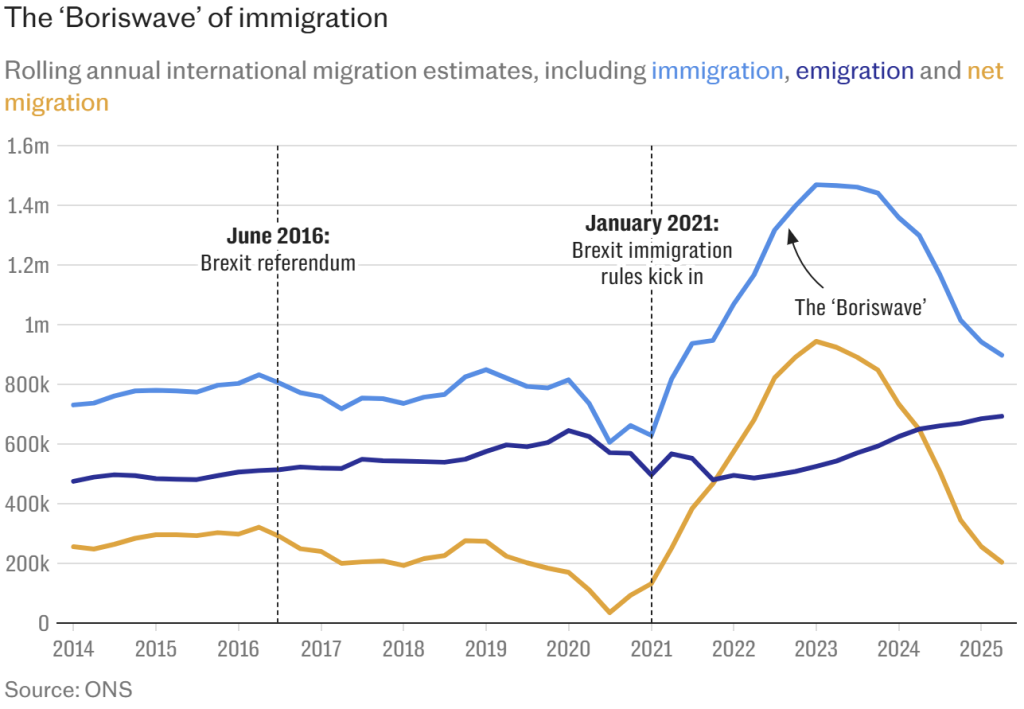
The plan was to increase the time needed to be eligible for ILR from five years to 10. This is an attempt partially to correct the errors of the last Conservative government, which opened the borders to an unprecedented wave of immigration, popularly called the “Boriswave”. In the years between 2021 and 2024, several million people, many of them in low-paid jobs and from developing countries, moved to Britain.
One of the most popular routes was applying to be a care worker, using a special visa which was launched to deal with a recruitment crisis in Britain’s care sector. The root of the crisis is fairly basic: the cost of social care generally falls on local authorities, who lack the funds to pay care workers well, meaning that it is hard to attract and retain them.
The new visa was intended to alleviate this problem temporarily, as migrants from poorer countries are more willing to work for less money. It was poorly designed, however, with no cap on the number of visas that could be issued and the ability to bring dependents. Instead of a few thousand, hundreds of thousands came, some through fraudulent firms. As work migrants, they would all be eligible for ILR within five years.
Without any reform, the Home Office predicts that this will lead to a spike in ILR grants. At that point the “no recourse to public funds” which currently applies to these migrants, would end, and they would become eligible for benefits such as Universal Credit, child benefit, and access to social housing.
The Home Secretary has argued, based on findings from the neutral Migration Advisory Committee, that this could cost British taxpayers up to £10bn, with other estimates rising to £61bn or more. That’s because these low-skill migrants and their families will on average take much more in public services over their lifetime than they contribute through things such as income tax.
Some critics have argued that these figures are overblown, yet even they say it will still cost the taxpayer £600m. Those calculations also rely on assumptions, such as care workers switching to higher-paying work once they get ILR, which won’t necessarily be true for such low-skilled workers.
Similarly, the IPPR think tank pointed out that the £10bn saving would only occur if these migrants were blocked entirely from settlement, rather than just having it delayed. That is of course true but then blocking them from ever settling is the obvious next step, as it means saving taxpayers billions. Even without that, dissuading some from settling would still provide a saving.
The argument against blocking or delaying settlement, made by figures such as Angela Rayner, is that it is unfair to impose such changes retrospectively. Migrants came here under one set of rules and expectations, only to have them changed and be left in a worse situation. No doubt that will be personally unpleasant for many.
However, it is worth pointing out that every government elected in the past few decades has either promised to reduce or strongly control migration. Instead, many have increased it, with the “Boriswave” being a prime example. Why should it be more acceptable to disappoint and mislead British voters than to change the rules for foreign nationals?
That should be a red line for Burnham, if he does become the next prime minister. His predecessor, Keir Starmer, saw a collapse in his poll ratings because the British people lost their trust in him. If Burnham chooses to focus on fairness for migrants over fairness for the British, then he too will risk a loss of trust, with all the consequences that come with that.
Although net migration is down, gross migration remains high, masked by large numbers of EU migrants leaving. Burnham has so far said nothing that suggests he has a plan for how to stop the small boats crossing the English Channel. Abandoning the reforms to ILR will therefore mean he has nothing to offer voters worried about our still historically high levels of mass migration. That would be a mistake for him and for the country.