
The PM-in-waiting risks disaster for the country if he plays to his base

I still fear Burnham will put Boriswave migrants ahead of the British people


14 Jul 2026
This article was first published in The Telegraph.
Will he back immigration reforms or oppose them? That is the question currently facing Andy Burnham, the next Prime Minister, and it is the question which could end up deciding whether his term in office is a success or failure.
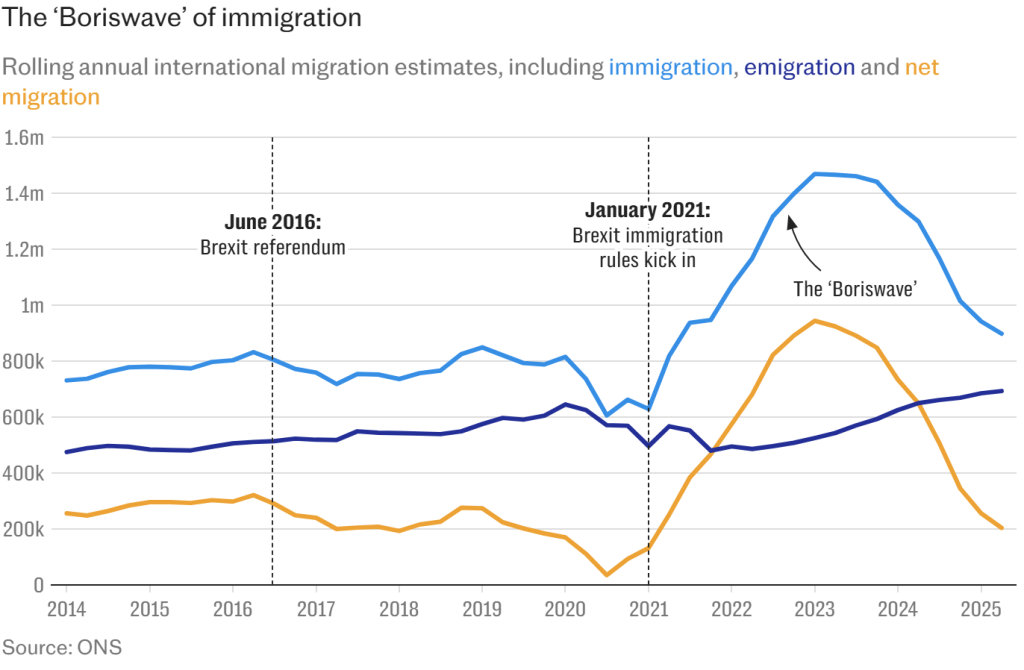
The context is clear. Under the last Conservative government, an unprecedented wave of legal immigration entered the United Kingdom, often called the “Boriswave”. Restrictions in their last year in office were maintained under Labour, which then faced the question as to what to do with the migrants that were already here.
Estimates suggest that in the next few years, around 1.6 million migrants could be eligible for indefinite leave to remain, as permanent residency is known. That will allow them access to public funds, like benefits and pensions. Most are low skilled and low paid, something which prior evidence shows is unlikely to change. Therefore, although predictions vary, they will end up costing the taxpayer billions over the course of their lifetimes.
To tackle that, Labour is planning to shift the number of years of residency required to apply for permanent residency from five years to 10. Unspoken, is the hope that this shift will lead to their visas ending and these migrants choosing to go home.
The problem is equally clear. Labour has historically been a pro-immigration party and many in the party are deeply uncomfortable with additional restrictions. Catherine Atkinson, the Victims Minister, refused three times to back the reforms when asked by GB News, saying that she would wait for the results of a consultation instead.
Now it is being reported that Home Secretary, Shabana Mahmood, is considering watering down her planned reforms by abandoning the effort to move the number of required years of residency from five to 10. Instead, she is said to be planning to limit the ability of those who get permanent residency to access benefits for another three or four years.
Normally a grant of indefinite leave to remain allows a migrant the same access to benefits that a British national enjoys, such as universal credit, disability benefits or tax credits. The shift would still cost British taxpayers billions, however. That’s because most of the costs of the Boriswave to taxpayers will come as they get older, which is likely to be in the next few decades rather than the next few years.
For example, normally you need 30 years of National Insurance contributions to get the full basic State Pension of £241.30 a week. Someone on a low income could pay in far less yet, using pension credit, they could end up with £238 a week.
Such a watering down would therefore fail to please anyone, imposing a new restriction on migrants which would fail to tackle the main costs of the Boriswave. In doing so, it would mean that a future government might have to retroactively change the law in a more radical way. Zia Yusuf of Reform UK has already attacked the plans and said that they will “reverse the Boriswave”.
There is justification for that. While critics have said it is unfair to change the settlement rules for migrants when they came under the expectation that they would get residency after five years, it is more unfair of politicians to promise the British public that they would cut migration only to increase it. When it comes to competing promises, those made to the British public should be honoured first.
Burnham knows that the British public remain furious about immigration. Although the number of illegal migrants has dropped this year, in no small part because tougher rules in Europe mean that fewer reach the French coast to begin with, there is still a huge backlog of asylum claims and asylum seekers in accommodation.
Similarly, legal immigration has dropped, but the gross number remains high, with more than 750,000 people coming to Britain one way or another. Pro-migration advocates want to argue that lower net migration means that there is no issue, but that misunderstands how immigration works. Even if flows have reduced, the stock of migrants who came here in the last few years is still very high. Only several years of low migration will reduce that.
That, presumably, is why Burnham voted for the asylum bill in Parliament on Monday. Although the bill has some problems, such as the introduction of supposedly safe and legal routes, it does introduce new restrictions on the asylum system which would improve it. That was unpopular with more Left-wing Labour MPs, with 14 of them rebelling to vote against it.
Another 80 Labour MPs have written to Burnham, asking that he water down the reforms to legal migration. If he listens to them, he may find his path to Downing Street easier, but he will be harshly judged by the country. The choice is his: play to his base and risk disaster or stand firm and try to win over the public.