
Being at the mercy of immigration policies across two-dozen countries is neither a good plan, nor democratic

Spain’s migrant madness shows the danger of cosying up to the EU


29 Apr 2026
This article was first published in The Telegraph.
Spain’s plan to give residency rights to illegal immigrants demonstrates why getting closer to the European Union on migration would be a disaster.
Pedro Sánchez, the prime minister, plans to offer half a million migrants a one-year visa, which would give them temporary legal status. Already there are suggestions that the true number of eligible illegal immigrants may be even higher, with Spanish think tank Funcas estimating that it may be closer to 840,000.
Although this supposedly progressive approach has won Sánchez plaudits in the New York Times, among others, their praise generally ignores how undemocratic this is. The measure has been pushed through using a royal decree, without any vote in Congress, because a majority of Spaniards oppose the plan.
Although Spain’s economy has nominally been boosted by immigration in recent years, that is partly because it had a particularly bad time during the coronavirus pandemic and partly because of high levels of tourism, as they can utilise low-skilled labour in the hospitality and construction sectors.
During the eight-year period with Sánchez as prime minister, the foreign-born population soared from 12 to 20 per cent.
Many of these are from Latin America, taking advantage of the Democratic Memory Law, which allows those whose ancestors fled Spain during and after the Civil War to apply for citizenship. They may speak Spanish, meaning less cultural friction, but there are still strong limits on the benefits of mass migration.
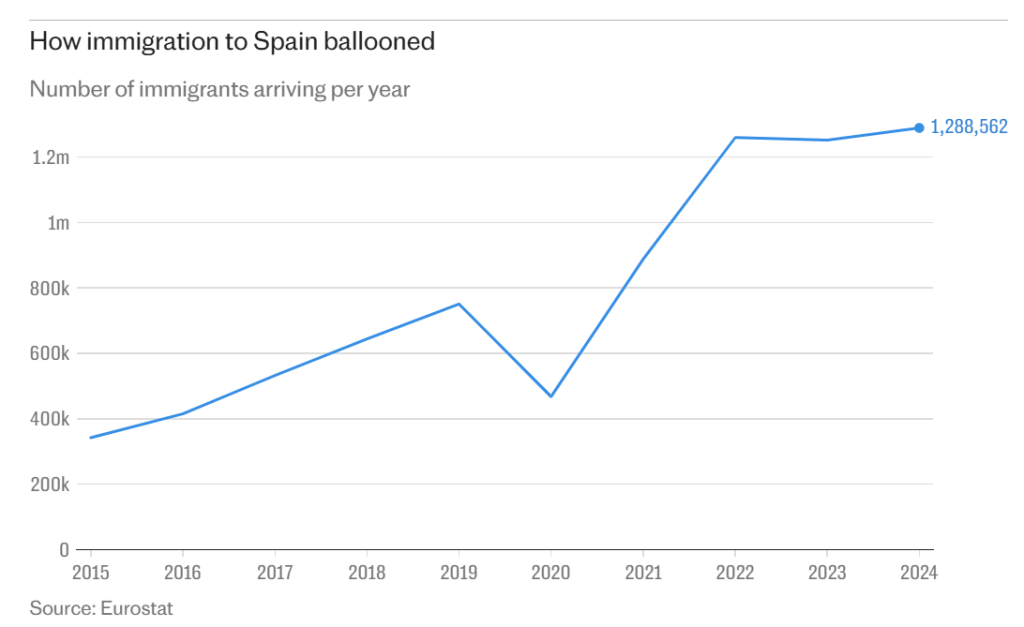
While the economy grew, it did so at a slower level than the population, showing that migrants were mostly in low-wage jobs. That’s little help to the many young unemployed people in Spain and has led to a rise in housing costs. So, although the economy has grown, for many people the impact has been negative.
Regularising migrants will only make that worse. There was an amnesty in Spain in 2005 for around 600,000 illegal immigrants.
The wages of those regularised increased as they were able to access legal employment, but most remained in low-paid work and were reliant on welfare, so the financial impact was probably a net negative for most Spaniards. The need to replicate such an amnesty 20 years on also shows that this is not a sustainable policy. So long as the borders are insecure, amnesties have to be repeated, attracting more illegal immigrants, who can plausibly hope to be regularised in turn.
This shouldn’t just be understood as an ideological policy. As the Spain analyst Jack Davey has noted, such policies boost the anti-immigration party Vox, allowing Sánchez to present himself as the only way to prevent it from getting into power. As he is already reliant on the support of separatist parties to govern Spain, he’s used to this sort of political balancing.
The amnesty is less sweeping than some have realised. Regularisation only lasts for one year (apart from children, who get five years). The main right-wing parties have also said that they will reverse the move. Indeed, it may benefit border control, as it will have a better idea of the size and location of the illegal immigrant population. Nonetheless it demonstrates the risk of intertwining British and European immigration policy, as advocates such as Stella Creasy have argued for.
With the British Government embarking on its EU realignment, there is increasing pressure among the Labour backbenches for further rapprochement, with Creasy arguing that Britain could push for a Swiss-style agreement, allowing free movement so long as migrants can show they are able to support themselves.
There is already a Youth Experience Scheme being negotiated, with the EU pushing for an “emergency brake” rather than a cap on numbers. That would impose political costs on any British government that wanted to do so, unlike a cap. That tough style of negotiating is deliberate, as the EU doesn’t want to offer Britain a favourable deal, as it might lead to other nations deciding they’d like to regain their freedom from Brussels, so long as they can retain the bits of the EU they like.
The EU’s borders are only as strong as their weakest link. Although post-Brexit migration in Britain has swung towards lower-skilled South Asians and Africans, a return to our pre-Brexit migration system wouldn’t help. Since 2004, Eastern European economies have improved, so there is no pool of skilled but cheap migration available.
Indeed, there has been a large increase in migration from outside the EU across its constituent nations, with Germany’s Indian population tripling in the past decade alone. This was already evident before Brexit, with 15 per cent of EU nationals living in England and Wales in 2021 having been born outside the EU, including groups such as the Dutch Somalis.
The amnesty in Spain shows why Britain should be wary of migration deals with the EU. Being at the mercy of immigration policies across two dozen countries is neither a good plan nor democratic. Britain has the freedom to set good immigration policies, it just needs good politicians to do so.