
Britain needs a mixed healthcare system that rewards success and gives patients genuine choice

Waiting for Labour to fix the NHS


29 Sep 2026
This article was first published in The Critic.
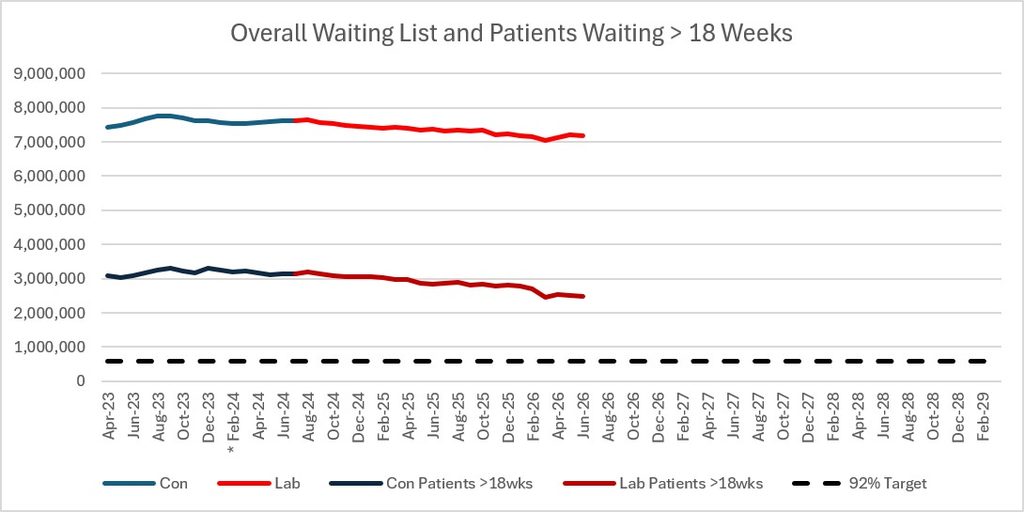
Labour came to office promising to cut NHS waiting lists. It has spent the last two years re-arranging them. In their 2024 manifesto, reducing NHS waiting times was one of six “first steps for change.” Patients, it said, should wait no longer than 18 weeks from referral for consultant-led treatment of non-urgent conditions. The document itself was careful not to name a target date. After the election, the target was stretched across the parliament, with a formal commitment to meet it by March 2029. Even that more leisurely timetable is not being met.
The waiting list is still high and has started to climb again, not go down. The language of “recovery” has been recycled. The programmes have been tweaked. The queues have not gone away. Andy Burnham and the rest of the cabinet would rather talk about anything else as they avoid the big issues facing the country and focus on peripheral topics such as having a pint at a football match.
The NHS is still a state-mandated monopoly. As I know from my extensive experience working in the health service, managers and institutions do not lose custom when they fail. They do not feel the feedback or accountability which drive businesses to improve their operations and output. Until that changes, waiting lists will be managed, not cured. It is time to look again at how healthcare is delivered in Britain.
The NHS remains among the public’s top three concerns, in part because satisfaction has collapsed. Polling now shows a growing willingness to consider alternative models of provision once they are explained, rather than simply more of the same.
The fiscal picture is as stark as the political one. The DHSC budget is £214bn and is set to reach £246bn by 2028/29. Including private care, healthcare spending is already around 11 per cent of GDP. The Office for Budget Responsibility projects that, without substantial policy changes, total public spending could rise from around 45 per cent of GDP in the mid-2020s to over 60 per cent by 2073–74, with government health spending alone heading toward 14.5 per cent. Real-terms NHS funding has risen by about 20 per cent since 2019, yet output has grown by only around 1 per cent a year and a large productivity shortfall is projected by 2028.
Clinical outcomes still lag behind other countries. The United Kingdom spends a similar share of national income to many peers but lags behind them on treatable mortality and has seen life expectancy stall and years lived in good health decrease.
As I detail in research for the Prosperity Institute, healthcare reform needs to be looked at under three headings:
- The Health of the Nation
- Reforming the wider healthcare landscape
- Managing the NHS better
Each of these headings can be underpinned by individual policies.
Health of the Nation is a wider approach to public health. Make enabling most people to finish education, gain employment, get married, and raise children a core mission across the whole government. Replace “life expectancy” with “healthy life expectancy” as the key performance indicator for healthcare.
Reforming the wider healthcare landscape can be done by reintroducing tax relief on medical insurance and by lowering barriers to new entrants who want to provide medical insurance, encouraging mutuals and co-operatives to provide cover. Improve support for small and medium healthcare enterprises to encourage different ownership models among providers. Restore accountability and transparency by bringing all health-related arm’s-length bodies back into the DHSC. We will not bring waiting lists down without the wider involvement of the private sector.
There are many ways NHS management can be improved by more streamlined governance and reduction in bureaucracy. Introduce performance-related pay and incentivise productivity through revising fiscal policy. Undertake local not national pay bargaining and rebuild the NHS clinical workforce through training, recruitment, and retention. The NHS is not a bottomless money pit. Treating it as such has got us into the mess we face today.
These policies will use genuine choice as the engine of improvement and grow a mixed economy of public, private, mutual, and charitable purchasers and providers so that successful organisations can expand and those failing can decline.
The prize is not another plan for the same system, but a financially sustainable system that improves outcomes, returns people to work and restores public confidence without abandoning universal coverage. If countries like Switzerland, Australia and the Netherlands manage it, then there is no reason Britain can’t either. The time for excuses is over.