mail
Screenshot 2026-03-27 111551

The Death of the Fiduciary Duty

Decorative arrow

How ESG Has Ruined Investment Returns for British Pension Savers and Shareholders

Endorsements

“The simplest ideas are often the most powerful. In The Death of the Fiduciary Duty, the Prosperity Institute shows how undermining a simple principle has left ordinary people poorer and led to quite probably the most profound misallocation of capital this century. It is time for legislators to bury the well-meaning but toxic wasteland of ‘ESG’ forever. If the current socialist administration will not, the next must make it a priority.”
Andrew Griffith MP
Shadow Secretary of State for Business and Trade
“Alarm Clock Britain should be able to trust that its pension savings are being invested in a way that will maximise its retirement income. Instead, its money is being used to fund Net Zero. This paper lays bare just how much worse off ESG makes British pension savers. Asset managers should beware of a future government committed to stopping this nonsense.”
Richard Tice MP
Deputy Leader and Business, Trade and Energy Spokesperson for Reform UK

Glossary

  • AGM: Annual general meeting
  • CfD: Contract for difference
  • DEI: Diversity, equity, and inclusion
  • EDI: Equality, diversity, and inclusion
  • ESG: Environment, Social, Governance
  • FCA: Financial Conduct Authority
  • GFANZ: Glasgow Financial Alliance for Net Zero
  • GHG: Greenhouse gas
  • LGIM: Legal & General Investment Management
  • LGPS: Local Government Pension Scheme
  • MSCI: Morgan Stanley Capital Investment
  • NCAA: National Collegiate Athletic Association
  • NIV: New International Version
  • NZAM: Net Zero Asset Managers
  • PCPF: Parliamentary Contributory Pension Fund
  • PPA: Power purchase agreement
  • PRA: Prudential Regulation Authority
  • PRI: Principles for responsible investment
  • SDGs: Sustainable development goals
  • SDR: Sustainability disclosure requirements
  • UN: United Nations
  • WEF: World Economic Forum

About the authors

James Graham is Senior Researcher, Financial Freedoms at the Prosperity Institute. He was written widely on ESG and related issues and led a public campaign against debanking. Prior to working at the institute James worked in finance, first as a project accountant within the defence industry and then as a fund analyst within an investment firm.

Desiree Fixler  is a leading expert in the field of sustainable finance and investment banking with over 25 years of experience. Once a champion of ESG from within, she is now one of its fiercest critics. Renowned for exposing the dark side of Net Zero and DEI, she is a sought-after keynote speaker, media contributor and advisor. She serves as a trusted advisor to financial institutions and regulators, including the UK’s Financial Conduct Authority and the Monetary Authority of Singapore.

Foreword

The biggest financial scam of the last two decades is hiding in plain sight—in your monthly bills and inside your pension. It goes by three letters most people have never heard of: ESG.

Short for Environmental, Social, and Governance, ESG has shattered a fundamental trust: that the people managing your pension and savings are there to protect and grow your money. Instead, they have used it to bankroll political causes—climate activism, diversity targets, Pride campaigns—sacrificing profitability for ideology, often without your knowledge and never with your consent.

This incisive and timely paper calls that what it is: “the death of fiduciary duty.”

Fiduciary duty is not a little technicality. It is a societal principle. If you are entrusted with other people’s money, you have one overriding obligation: to act in their best interests. Yet under ESG, that duty has been blurred and in many cases openly abandoned.

The language of ESG is moral. The reality is mercenary.

ESG was sold as the responsible reform of shareholder capitalism—profitability with a save-the-world agenda. The reality was starkly different. ESG was a marketing scheme to lure investor money with the promise of doing good—at a high fee. It took off as Wall Street’s rebrand after the global financial crisis, when trust in finance had collapsed and the industry needed a moral shield. ESG became that shield. Around it grew a multi-trillion-pound industry of consultants, asset managers, lawyers, ratings agencies, academics, and regulators—all getting rich from a system built on image, not value. Intentions and ambiguous climate disclosures became more important than results or real-world data.

I know—I helped build it. I championed Net Zero and DEI, advised the World Economic Forum, helped found the Net Zero Asset Managers initiative. I believed ESG could align capital with societal good. I was wrong. What I saw from the inside was not responsible capitalism, but its subversion—fraud and enrichment schemes dressed up as virtue.

Once inside the rooms where policy is shaped—regulators, academia, Wall Street, the WEF—I saw a closed loop of cronyism. The question that should govern every investment is simple: “Will this create value?” Under ESG, it became: “Does this fit the political narrative?” When the elite were confronted with data showing ESG underperformance and the damage to British growth, jobs, energy costs, and national security, there was complete indifference. The process, the ideology, their jobs—that was all that mattered, not outcomes.

Milton Friedman understood something the ESG lobby never will: a company focused on its core business—great products, customers, profit—is already doing immense good for society. That is how prosperity is created—wages rise, living standards

improve, and top talent innovates. “Stakeholder capitalism,” as promoted by Klaus Schwab and the World Economic Forum, is not a refinement of capitalism. It is a soft form of central planning—politicised, bureaucratic, and insulated from democratic consent. Force corporations into political causes and you destroy the engine that delivers prosperity.

This paper lays bare what the financial industry does not want told. It is truth-telling backed by deep research and real-world evidence. It shows how pharmaceutical companies have been forced to spend billions planting trees instead of developing cancer drugs. How MPs who vote for higher military spending have their own parliamentary pensions in funds that refuse defence stocks. How supermarkets force struggling farmers into debt for green equipment they do not need, just to tick a carbon box the law does not require. It exposes how ESG’s restriction of fossil fuel investment has driven British energy prices to among the highest in the West. And it traces the self-serving loop: asset managers lobby for ESG rules, regulators deliver them, the costs fleece investors, and activists use these wins to pile pressure on others to fall in line. Nobody is held to account.

Our economics system is rigged. But not by evil capitalists It is warped by bailouts for the rich, central bank money printing, government overreach, and ESG’s central planning of resources, production, and demographics. What Britain needs is a full restoration of fiduciary duty and the only system that delivers prosperity: shareholder primacy capitalism.

I wholeheartedly agree with the author’s call to action starting with legislative change. The Companies Act must be amended to reassert shareholder primacy. The Climate Change Act and its Net Zero mandates must be repealed. The Equality Act must be reformed or repealed. And importantly, the FCA must be pulled back into its proper lane—not a social planner or climate campaigner, but a regulator ensuring that markets are fair disclosure is clear and not misleading.

It is also essential that pension holders start asking simple but fundamental questions: Who manages your pension? What are they investing in? What are they excluding? As this paper makes clear, a 1% gap in annual returns may sound trivial, but over a working life it can compound into the value of a house. ESG is a compounding tax on your retirement. This paper exposes the scam, names the interests behind it, and makes the case for restoring a principle that should never have been surrendered: the savings of ordinary people belong to them.

This paper is vital for the future of Great Britain. Read it. Ask questions. Then act.

Desiree Fixler
Banker, Ex-ESG Insider, and Free Enterprise Activist
March 2026

Executive summary

Britain’s pension savers expect the professionals entrusted with their money to do one thing above all others: maximise their returns. That expectation can no longer be taken for granted.

The fiduciary duty is an ancient obligation to act in the best financial interests of those whom one serves. It is now dead. In its place stands ESG: a framework of Environmental, Social, and Governance factors that has captured Britain’s asset management industry and has ripped off millions of hardworking pension savers.

The roots of the fiduciary duty lie in Roman law, in the pages of Scripture, and in the seventeenth-century financial revolution that made Britain the pre-eminent force in global markets. Its core principle is simple: one entrusted with another’s money must manage it in that person’s best interest—not their own, not the state’s nor the demands of any fashionable ideology. The Companies Act 2006—specifically Section 172—diluted this principle by compelling directors to consider multiple stakeholders, undermining shareholder capitalism.

The environmental component of ESG is the costliest. Every major British asset manager has signed up to Net Zero targets, channelling capital away oil and gas companies and into subsidy-dependent renewables. AstraZeneca whose purpose is literally saving lives has committed over $1 billion to decarbonisation and tree-planting programmes that could be funding lifesaving cancer treatments. The Beatrice Wind Farm, backed by pension capital from Aberdeen, Fidelity and Legal & General, would have recorded a loss of £141.9 million in 2024 were it not for government subsidy. The misallocation of capital is not hypothetical. It is measurable, and pension savers are paying for it.

The social component compounds the damage. Asset managers have imposed diversity hiring mandates on portfolio companies, threatened to withhold capital from those insufficiently progressive, and used their proxy voting power, exercised without informed shareholder consent to drive corporate policy. ESG funds have arbitrarily excluded the defence sector, denying investors significant returns between 2022 and 2025, at a moment when geopolitical signals made such returns foreseeable. The parliamentarians whose own pension fund excludes defence as unethical are the same MPs who publicly demand that Britain rearm.

As for governance, the ‘G,’ it has become the enforcement mechanism for the ‘E’ and the ‘S’, rather than a genuine safeguard of shareholder interests as it should be. FTSE 100 annual reports have grown in length by 46% in five years, growth is driven by the expansion of sustainability reporting. Board meetings are consumed by sustainability discussions at the expense of financial performance. Third-party proxy advisers, accountable to nobody, wield the voting power of tens of trillions of pounds in assets.

Reversing this requires urgent legislative action. This paper makes the following policy recommendations:

  • The Companies Act 2006, specifically Section 172, must be amended to reassert shareholder primacy and to remove the obligation to have regard for multiple stakeholders.
  • The Companies Act should enshrine a fiduciary duty which legally obliges asset managers and pension providers to ensure maximal returns, including for the public sector, whilst allowing private pension savers the freedom to choose less profitable investments with informed consent.
  • The FCA must be directed, via a remit letter from the Chancellor, to confine itself to financial matters, removing the basis for requirements to disclose diversity and environmental performance.
  • The Climate Change Act and Equality Act, which provide the legal cover asset managers hide behind, must be reformed or repealed.
  • The current Pension Schemes Bill must be amended to prohibit public sector pension assets from being invested in subsidy-reliant projects.

Legislation alone will not suffice if the industry remains ideologically captured, however. Shareholders who are the true owners of Britain’s companies must become active participants in their own governance. A 25-year-old saving £150 a month will be £178,000 worse off at retirement if their pension underperforms by just 1% per year—most of the value of an average British house. Such savers must assert themselves to avert major losses in their old age. This report therefore also makes recommendations to shareholders:

  • Look to the successful anti-ESG action of the USA for inspiration and use its techniques to drive change in Britain.
  • Shareholders should attend Annual General Meetings and hold directors accountable by assertive questioning of their ESG strategies, demanding a focus on profitability.
  • Shareholders should individually and collectively use the mechanism of shareholder resolutions to force company directors to defend or denounce ESG policies.

The fiduciary duty was not an abstract legal nicety. It was the promise that your savings would be worked for you. That promise has been broken. It must be restored.

Introduction

Main points

  • The fiduciary duty is an historic, fundamental element of investment, obliging an agent to ensure the best possible, legally obtained returns for their principal
  • ESG has come to dominate the world of finance and business in the twenty-first century, dictating where capital is invested and how companies are run
  • ESG policies have led to widespread poor returns for investors and shareholders, particularly effecting regular pension savers. A 1% difference on pension returns over a working life can compound to the value of a house.

“One of the great mistakes is to judge policies and programs by their intentions rather than their results.” – Milton Friedman

People who save into their pensions and invest their savings expect their investment managers to focus on delivering high returns. This is no longer an assumption that can be taken for granted. In recent years it has become commonplace for financial performance to be seen as only one amongst a range of competing priorities for asset managers, who also see themselves as also tasked with advancing equality, halting climate change, and reducing poverty, amongst other things.

The obligation to maximise returns when managing investments on behalf of another has a name: the fiduciary duty. It is an ancient duty, with a noble history in Britain, and has been part of what made our nation into one of the most influential players in global finance. Yet this duty now lies derelict.

This paper tells the sad story of the death of the fiduciary duty in Britain, the damage this has done, and how we can bring the duty back to life.

It begins by exploring the origins of fiduciary duty, its present-day definition, and if that definition is sufficient.

It details how the interests of savers have been deprioritised by a financial industry, that has enshrined secondary ESG (Environment, Social, and Governance) aims in its investment methodology. It details the impact that this neglect of financial returns has on both the outcomes of the individual saver and the wider economy.

This is particularly relevant to an area of finance which affects almost everyone in the country: pensions. Private pension accounts are now the default for Britain’s workforce due to the coalition Government’s 2012 reforms, which shifted the default of workplace pensions from opt-in to opt-out. The result of this is that, today, the average person living in Britain has around £60,000 in their pension.[1] This represents a remarkable rise since 2012, when the median pension pot was worth just £9,000.[2] Given that public sector pensions remain unfunded, the average private pension is even greater.

Despite their increase in capital ownership, individuals rarely actively manage their investments. This is especially true of workers early in their careers, to whom retirement and the need for pension capital seem to be in the distant future. Yet given their long time horizon and the compounding effect of bad investments, it is younger workers who stand to lose the most from pensions which underperform due to pension managers failing in their fiduciary duty. A 25-year-old saving just £150a month into their pension would be £178,000 worse off by aged 65 if their pension underperformed by 1% a year.[3]

It has been argued by some that pension savers are willing to sacrifice some returns in order to contribute towards environmental goals. Perhaps this is true. However, given the state of financial and pension literacy in Britain it seems unlikely that most pension account holders grasp the long-term impact of pension underperformance.[4] Only 81% of those with pension accounts have ever changed their investment strategy, meaning they are invested according to their provider’s default. 55% of people do not know how their pension is invested; 20% don’t even know if their pension is a Defined Contribution or a Defined Benefit scheme. As such, it seems reasonable to assume that most pension savers have not made an informed decision in relation to the trade-off between ESG and growth. Whilst pension savers should have the option to opt out of growth focused strategies to embrace ESG strategies if they so wish, they should not be required to opt out of ESG funds to embrace growth strategies.

In most cases, individuals’ pensions are outsourced, via their workplace scheme, to large asset managers. When considering the asset management industry and capital availability it is worth bearing in mind that approximately 80% of the money they manage is on behalf of pension schemes, and therefore of current or future pensioners.[5] Their decisions do not impact only the wealthy, as is often the public perception; rather they have a direct impact on most of the population. We almost all have asset managers; most of us simply call them ‘pension providers’.

The large proportion of assets under management, ultimately owned by individual pension savers, is a perfect instance of the ‘principal-agent problem’. This problem—that of a conflict between the principal (underlying shareholder) and the agent (the manager)—has long been a concern of financial theorists. However, the disconnect between both parties has never been so great with a great rise in intermediation leading to the de-prioritisation of the true beneficial owner’s interests.

Basic financial management, taught to trainee accountants and financial analysts, teaches that the role of a company is to maximise the wealth of its owners.[6] When a business is owned by a handful of shareholders, who have a relationship with the managers of that business, this is intuitive. However, in today’s financial landscape, most large companies, certainly most public companies, are beneficially owned by millions of individuals who are often unaware of their ownership. Sainsburys, for example has around 100,000 registered shareholders. Amongst the largest of those shareholders is BlackRock. BlackRock is a custodian, not a true owner, and their shareholding is owned on behalf of the mass of individuals who have their pensions managed by Blackrock. These people are the beneficial owners. Hence a further layer of intermediation exists between the legal and beneficial owners and the company management in the form of at least one investment management company, often several.

Since the early 2000s, large British asset managers have ceased focusing primarily on high returns and shareholder wealth. Instead, they have embraced an approach which integrates ESG factors into their investment decisions. Whilst much of the ideology stretches further back, the formal genesis of ESG can be traced to a 2004-2008 UN initiative, Who Cares Wins.[7] The UN invited several large institutional investors to be part of a working group tasked with determining how to better integrate ESG into financial decision making.

The asset managers involved were the largest in the industry including Goldman Sachs, BNP Paribas, Morgan Stanley, and others. The report concluded that a better consideration of ESG would contribute to better performance and stronger markets, as well as to sustainable development. This logic marked a major shift in attitudes both within and towards business, with wealth creation and the resultant enhancement of resources no longer seen as a good in and of itself.

It is surely no coincidence that the period since the publication of the Who Cares Wins document and the rise of the ESG movement has been a period of stagnation and declining growth.

Defining the fiduciary duty

To properly understand its death, we must first understand what we mean by ‘the fiduciary duty’.

What follows is a summary of conventional definitions, a brief historical overview of the concept’s development, and how it is understood in common parlance.

Meaning of the term

The Oxford English Dictionary defines a fiduciary as “[A] person who holds a position of trust with respect to someone else, a trustee.” This basic definition could be applied to a range of relationships. A parent and a teacher, a police officer and a citizen or a pilot and a passenger.

This paper’s focus is on the fiduciary duty in the financial environment, which is the context in which, prior to its death, the term and concept were usually applied. A definition of fiduciary specific to finance can be found in Barron’s Dictionary of Finance and Investment Terms: “[A] person or legal entity that administers investments for the benefit of others. A fiduciary is legally obligated to safeguard assets in trust in the best interests of those for whom it acts.”[8]

Pension providers, asset managers, and banks continue to assert that they are acting within the bounds of their fiduciary duty. Based on these definitions, we can surmise that this should mean, that these institutions are trusted by those whose money they manage, to act in their best interest.

It is important to note, that they are not necessarily obligated to act in their principal’s best interest generally, but in relation to the specific assets they are managing. A pension manager could plausibly make an argument that various courses of action are in the best interest of the saver as an individual. A sizeable donation from the asset manager to the local police force may reduce crime in the locality of the pension scheme members, for instance. However, asset managers are not entrusted to tackle crime, and seeking to do so would reduce the value of the assets that they have been entrusted to grow.

History of the idea

The concept of fiduciary duty has a long history, with many pointing to the Bible as having some of its earliest examples.

Biblical precedent

In the book of 2 Kings, we are given a precedent in relation to stewardship over public funds.[9] Money which had been given to the temple had not been used for repairs as expected by the Jewish people who had entrusted funds to the priests for that purpose. King Joash (c.836–796 BC) intervenes to instruct the priests not to take any more of the offered money for themselves, but rather to spend it on repairing the damaged temple. In other words, he instructs them to manage the money in a manner that is in keeping with the expectations of those who are entrusting them with said money. The priests duly established a strict accounting system, ensuring that monies were correctly allocated for the intended purposes.[10]

In the New Testament we find a more vivid illustration of what is now understood as a fiduciary duty. Jesus tells the parable of the unjust steward (Luke 16:1-13), in which a rich man has entrusted his money to a steward. Upon the master learning that the steward had been squandering his goods, which he had been entrusted to manage, the master demands an account of his actions and threatens to dismiss him. One of the points taken from the parable is that “Whoever can be trusted with very little can also be trusted with much, and whoever is dishonest with very little will also be dishonest with much” (Luke 16:10 NIV).

Similarly, in the parable of the talents (Matthew 25:14-30), Jesus tells a story of three men each entrusted with a sum of money. When the owner of the money returns, we learn that one of the men buried his portion, another deposited it and collected interest and the third invested it, generating a large return. The one who simply buries it in the ground is castigated and has his wealth taken, whereas those one who invested are praised and given the other servant’s gold.

Whilst parables are allegorical devices, intended to teach spiritual lessons, the examples used cannot be dismissed. I mention them not to suggest that their primary purpose is to teach us about financial management, but to evidence the antiquity and ubiquity of the fiduciary duty throughout history. Jesus used illustrations that would have resonated with his audience as reflective of moral and social norms.[11]

As such we can say that from at least the first century there has been an understanding in Jewish and Christian thought that one entrusted with financial assets has a duty to preserve and increase the value of those assets.

Roman precedent

By the time that the parable of the talents was told, the Roman empire had also instituted a series of principles that have direct parallels to what we now describe as the fiduciary duty.

The earliest codified Roman law, The Twelve Tables, written in the fifth century BC, included ideas aligned to fiduciary thought. On the topic of guardianship this earliest form of Roman law stated that “When a person shall make bond [provide a loan] and conveyance [formally transfer property], according as he has specified with his tongue, so shall be the law.”[12]

In simple terms, this law states that if Person 1 loans money or transfers property to Person 2, then Person 2 is obliged to manage it according to the conditions set by the Person 1. These conditions may include repaying the loan with interest or increasing the value of the property. In twenty-century financial language, we might describe Person 1 as the Principal and Person 2 as the Agent. This provision would later come to be recognised as the basis of Roman fiduciary law.

Around 400 years later, Cicero, writing in De Officiis—meaning ‘On Duties, built on the concept, emphasising the importance of good faith (or trust). trust). “The foundation of justice, moreover, is good faith (fides)—that is, truth and fidelity to promises and agreements.” Cicero applies this to a wide range of vocations and interactions, including conctracts and financial dealings.[13]

This goes beyond the Twelve Tables. Cicero is not simply saying that one doing something (such as managing money) on behalf of another must do as they instruct. He is saying that they must act in good faith. It is not enough for the agent to simply follow the instructions of the principal to the letter; they must also honour the spirit of such agreements.

Financial Revolution

We have established, then, that the fiduciary duty was understood as a moral principle at the very foundation of our Judeo-Christian Western civilisation. Yet the application of the principle was necessarily limited prior to the modern era, given the nature or pre-modern economies. It was with the advent of modernity, and particularly the seventeenth-century Financial Revolution and subsequent financialisaton of the economy, that the fiduciary duty became what we know it as today.

The Financial Revolution was heralded in by the reforms of William of Orange in England following the Glorious Revolution of 1689. In these years Parliament asserted and consolidated its financial authority. Government loans became long-term and stable with the establishment of the Bank of England, which operationalised borrowing in a way that investors could trust. Parliament met more frequently, reassuring the population that this new settlement would endure. These changes created the conditions for Britain to adopt financial innovations that allowed, for the first time, widespread public ownership of financial instruments. Most notable amongst these was stock issuance and the establishment of secondary markets for trading financial instruments.

Over time, fiduciary principles, paired with the financialisaton of the economy, influenced the British legal tradition, where fiduciary duty became a core element of equity law, governing relationships such as trustees and beneficiaries, solicitors and clients, and company directors and shareholders. British law continues to uphold the expectation that fiduciaries act with loyalty, care, and in the best interests of those they serve, underpinning modern financial and legal practice.

ESG has not been subject to significant legal scrutiny in the UK in recent years, although the principles underpinning fiduciary duty have never been formally codified in statute. By contrast, the United States, which shares much of Britain’s legal tradition, has seen numerous legal challenges regarding the incorporation of ESG considerations on fiduciary grounds.

Whilst The Companies Act 2006 does address fiduciary duty, it does so in relation to stakeholders rather than shareholders alone. Section 172 of the Act places a legal duty upon directors to pay due regard to “promote the success of the company,” which is deemed to include all the companies’ “members as a whole,” including employees, suppliers, the community, and the environment This represents a departure from the traditional understanding of fiduciary duty within the context of shareholder capitalism, where the primary obligation was to maximise shareholder value. The law needs to be clarified and shareholder rights reasserted.

What is ESG?

Having summarised the nature and origins of the fiduciary duty, we must now summarise what has killed it: ESG.

Environmental, Social, and Governance (ESG) is a shorthand for a framework created by corporate elites that seeks to encourage companies to go beyond their responsibility to earn profit, and rather to pursue the goals that are viewed as important by the ruling class. This paper will shortly break down each component part.

The ESG acronym has become synonymous with ‘stakeholder capitalism’, an approach to capitalism that views shareholders as only one amongst several groups and interests that the business exists to serve. [14] Its critics have described it as “socialism in sheep’s clothing.” [15]

It subverts the true purpose of a company which is profitability and instead argues that endeavours such as equality, tackling pollution, or stopping climate change should be the goals of asset managers and private companies. This decision has been made without the endorsement of the underlying owners of companies of whom, at least a significant portion will be conservative minded.

ESG has faced significant backlash in the United States in recent years, as it has become understood by Republican lawmakers who have sought to legislate to protect retirement returns. This has led to the usage of the term declining as companies have opted for other, less politically toxic terms to refer to their stakeholder capitalism policies, such as sustainability and corporate responsibility. This has been noted in the US context with the usage of the term ESG dropping in corporate reporting from 40% in 2023, to 25% in 2024. Some reports suggest it has dropped as low as 6% in 2025. [16] Yet by their own admission these companies have often not changed their approach and remain committed to popular tenets of ESG such as Net Zero. A similar trend exists in Britain, with ESG largely being driven out of fashion by regulation that excludes its usage, rather than due to popular backlash. Nonetheless, all these terms essentially refer to the same approach to corporate strategy.

Even prior to the formal introduction of ESG, the normalisation of a stakeholder approach to capitalism was widespread. As noted already, the Companies Act 2006 embedded the notion in primary legislation. That same year the UN published their principles for responsible investment (PRI), which urged signatories to commit to the integration of ESG issues in all investment analysis.[17]

This has remained unchanged and gives asset managers and companies permission to pursue a range of activities other than maximising wealth on behalf of their owners, or ensuring pensioners have an optimal retirement income.

As mentioned, the 2008 Who Cares Wins paper called on governments and regulators to implement ESG regulations. The regulatory state obliged, and in the last ten years we have seen a self reinforcing dynamic play out whereby large asset managers and companies advocate for regulation, regardless of whether there is popular public demand and regardless of whether it will enhance financial returns. The regulations are implemented, companies comply, barriers to entry are raised for new entrants and rather than framing their ESG commitments as a branding exercise companies frame them as a core part of their purpose. The intertwining of regulatory requirements and corporate advocacy has made it difficult to know if the originator of ESG regulations and incentives is private companies or the administrative state.

This dynamic is neatly illustrated by the Glasgow Financial Alliance for Net Zero (GFNAZ) which describes itself as “an independent, private-sector-led initiative focused on mobilizing capital and removing barriers to investment in the global transition.”[18] It was launched in 2021 by Mark Carney who was at the time UN Special Envoy for Climate and by the COP 26 presidency. Whilst the organisation may technically be private-sector-led, its UN mandate creates a dynamic in which few would risk sitting it out. Further, in the UK context, since its establishment, both the government and the FCA have praised the GFANZ as a positive example in statements encouraging asset managers to embrace “Climate Adaptation,”[19] or “Green Finance.”[20] Meanwhile GFANZ has called for the implementation of carbon pricing and stricter carbon reporting requirements. [21] Just one year on from calling for th1ese changes, the FCA introduced its Sustainability Disclosure Requirements (SDR) Regime, the strictest regime of its kind to date in Britain. The publication laying out these new rules cited GFANZ and other similar organisations who cross-pollinate as stakeholders who helped shape their policy formulation.

The SDR rules specifically place much higher burdens upon funds and asset managers claiming to have a sustainability objective and directs them not to invest in certain asset classes. This limits the ability of asset managers to choose what sustainability means to them and their clients and layers on extra costs.

ESG’s effects on investment

Ultimately these regulations and ESG generally will hurt most pension savers.

Proponents of ESG often argue that investors to account for their ethical concerns in their investment portfolio. This may be true, but the reality is that most savers are unaware of what they are being signed up for and are not offered the choice to opt out of ESG. The choice architecture has been designed in such a way as to make it difficult for individuals to avoid ESG products. In most cases the default pension saving option is into an ESG fund. Legal and General for example is the largest British pension manager, serving over 5 million customers. Their default investment strategy for Defined Contribution customers includes a 15% allocation to private markets, with “direct exposure to assets such as affordable housing… and renewable infrastructure.” The remaining 85% is allocated to “ESG and factor-based equity strategies,” which include a Sustainable Focus Equity Strategy, a Climate Action Global Equity fund, and a Technology Sleeve with an ESG overlay. [22] As such, when a saver sacrifices their salary into their pension scheme, they are not simply handing it to a manager to achieve high returns, they are, according to the fund’s own documents, paying to promote improvements in “environmental metrics such as carbon intensity,” and to design “bespoke engagement plans,” to help each investee company accelerate their transition to Net Zero. Further the makeup of their investment portfolio will not ultimately be determined by financial factors, rather by the existence and integrity of investee companies’ climate transition plans.[23]

Whilst climate transition is the most significant popular cause of the moment, this fluctuates over time given the malleable and uncodified nature of ESG.

ESG would be unproblematic as regards the fiduciary duty if, as its advocates claim, it led to enhanced returns for investors. Of course, if this were the case, there would be no need for ESG criteria, as companies deemed environmentally and socially responsible would be self-selecting owing to their financial outperformance. The rise of the category and approach that integrates factors other than financials suggests otherwise.

Seeking to prove that ESG underperforms traditional investment methods will always, rightly be open to critique, and underperformance of ESG funds will no doubt be dismissed by its advocates. Past returns are not an indication of future performance and, as fund managers know well, the time periods selected for comparison and the benchmarks being used make it possible to portray almost any investment category as over or under performing. Indeed, this is why 94% of investment firms have legitimately claimed to be in the top quartile of investment performance—they choose the data to suit their needs and desired outcomes.[24]

We do not need to appeal to data to acknowledge that ESG damages returns. Basic investment principles dictate that when you select investments for reasons other than the fundamentals of the business you will undermine long term performance. Benjamin Graham, considered by many to be the , and the author of The Intelligent Investor, makes this quite clear as he concludes that the “margin of safety,” should be the central concept guiding investors—that is, that the intrinsic value of the company should justify the equity price, and he encourages portfolio diversification, something which is necessarily suppressed by ESG’s exclusion of certain industries.[25]

With that caveat in place, and acknowledging that there are shortcomings of such comparisons, it is nonetheless informative to observe the comparative returns of ESG and non-ESG funds.

Since 2008 there has been a widespread adoption of the ESG model. This was aided by the Great Financial Crash and the need for the financial industry to sanitise its reputation. It has also been driven by the fact that the original authors never intended their recommendations to be optional. In the report they committed to working with regulators to “require a minimum degree of disclosure [from companies] on ESG issues.” Similarly, they urged stock exchanges and accounting bodies to implement and incentivise ESG compliance.

This adds an unavoidable level of complexity to the Principal-Agent problem. As such, the death of the fiduciary duty is directly linked to ESG.

This paper primarily deals with investment managers. However, ESG and the death of the fiduciary duty has also subverted the purpose of many private companies, whose directors were also traditionally understood to be bound by a fiduciary duty to the underlying shareholders.

To access finance, which is controlled by investment managers committed to ESG principles, private companies must themselves now commit to complying with those same ESG principles. This not only reduces returns for shareholders; it also makes markets less efficient as finances are no longer allocated according to capital needs; rather, they are allocated in accordance with ESG frameworks.

Many view this new approach as having reached a head in 2018, when Larry Fink, CEO of Blackrock, sent his annual letter to the CEOs of the companies in which they invest. Blackrock owes most of its success to the rise of passive index investing of which it has been a central provider. This investment approach allows savers to invest in funds that consist of companies selected on a mathematical basis, commonly market capitalisation. This allows for significant lower management fees given managers do not have to spend time analysing and engaging with companies as would traditionally be the case.75% of the time, the passive fund will outperform the active, hence it is good value all round for savers. However, without asking their permission, that 2018 letter from Larry Fink, moved significantly beyond a ‘passive approach.’ He declared that “Governments [are] failing to prepare for the future,” and that as such “Society is demanding that companies, both public and private, serve a social purpose [and that they] not only deliver financial performance, but also show how [they make] a positive contribution to society.”[26] It is unclear how he was assessing the demands of society, and he presented no clear evidence to substantiate the apparent mass demands for companies to have a social purpose. In their 2020 Investment Stewardship Annual Report, Blackrock stated that its shareholders had “voted against management more than 1,500 times for insufficient diversity”.[27]

Whilst Blackrock is an American company, and it is true that the debate on ESG has different contours in the USA and Britain, capital is global in nature. Blackrock manages the pensions of 13 million British pension savers and is amongst the three largest owners of 90% of FTSE 100 companies. [28] As such, this moment marked an acceleration in ESG for Britain.

Whilst Britain does not have any investment managers of BlackRock’s scale, such instructions and messaging from Britain’s asset managers have also become commonplace. For example, a board member of a company which benefits from the investment of a major asset manager which manages around £800bn wrote a letter to the boards of all companies in whom they invest prior to the 2025 AGM season. The letter stated that the asset manager seeks to integrate stakeholder and sustainability considerations into company analysis, investments, and its engagement with companies. Further, it warned investee companies that they would be voted against at their AGMs if they were not sufficiently diverse at board level and if they did not have a Net Zero transition plan in place and being delivered swiftly.

It is important to separate ESG into its component parts, as this paper does.

It will examine each on its merits. This is not an examination of the merits of environmentalism, social programmes, or approaches to good governance. A wide range of views are legitimately held on each. Rather it examines the impact of those things upon investment returns. In addition, it addresses the question of whether it is right and proper for asset managers to pursue these secondary objectives and whether it is possible for them to pursue ESG whilst holding to the fiduciary duty, given its damage to the primary objective of investors, which is, in general, to maximise returns.

Environmental factors have led investment firms to adopt Net Zero targets in their portfolios. Every major asset manager in Britain now has decarbonisation targets which portfolio companies are required to comply with. This results in carbon intensive companies being excluded from investment, or being pressured into decarbonising, regardless of the impact this has on profit margins. Whilst many factors have contributed to the halving of Britain’s industrial output since 2000, this has surely accelerated that process.

Social factors include ‘Diversity, Equity, and Inclusion’ (or ‘Equality, Diversity, and Inclusion’) which has led to affirmative action within companies leading to employees being hired and promoted on the basis of protected characteristics, race, sex, and so on, rather than their potential to add value. In addition, companies and industries are ranked according to their subjective social ethics. This leads to certain industries being punished and routinely excluded from investment, defence being a notable example.

Good governance predates the ESG movement and is a force for good in businesses. However, in its ESG form it often conflates genuine good governance with arbitrary requirements.


E: Environment

Main points

  • Britain’s major asset managers are committed to Net Zero targets, effectively committing Britain’s pensions savers to it as well. Most savers unaware of this and its negative effect on their savings.
  • ESG forces capital toward unprofitable renewable energy investments, causing savers and investors to lose out on the high returns of fossil fuels
  • AstraZeneca currently spends over $1 billion on environmental targets, equivalent to the cost of developing two new highly profitable cancer treatments

The ‘E’ in ESG stands for ‘environment’. This has perhaps become the most ubiquitous and respectable of the three emphases under our consideration. Concerns about climte and pollution are no longer confined to politicians and activists. Consumers are now very familiar with messaging about how the various brands and businesses which they use are helping to save the environment. Our saturation in this view is such that it is hard to imagine a more ‘low status’ opinion to hold in polite society than one which questions our cultural investment in Net Zero and associated policies.

However, environmentalism being introduced to the investment process represents a blatant disregard of the fiduciary duty. It involves investment managers incorporating environmental considerations such as carbon emissions, pollution, and water consumption into their investment decisions.

Most asset managers publicly acknowledge that these considerations form a core part of their investment decision making process. For instance, António Simões the CEO of Legal & General, the largest British pension manager, recently stated: “We can—and must—incorporate climate change and nature considerations into how we invest our capital, how we support clients as an asset manager, and how we operate our business to be more sustainable and able to adapt to a changing world.” [29]

This statement is echoed across almost all British asset managers and is reflected by the mass membership of organisations such as the Institutional Investors Group on Climate Change and the Net Zero Asset Managers initiative (NZAM), both of whom boast Britain’s major asset managers as members. Scottish Widows for example is one of Britain’s largest asset managers. They manage the pensions of 4.5 million individuals with an investment portfolio of £190bn. They are a signed-up member of NZAM.[30] In practice, this means that those with their pension savings managed by Scottish Widows will by default be invested in attempts to achieve Net Zero by 2050.[31]

Further, The Investment Association which speaks as the collective voice of Britain’s asset managers, was the first official partner of NZAM and encourages member organisations to embrace Net Zero decarbonisation by channelling “more capital into investments for climate solutions.”[32]

The basis for any investment decision taken on behalf of underlying investors should be the maximisation of financial returns over the relevant time horizon, as per the fiduciary duty. Instead, the climate alarmist narrative that has dominated Western media in recent years has resulted in asset managers feeling obliged to align themselves and their goals with those of radical environmentalists.

Whilst this has been a conscious choice by asset managers, their actions exist within the prism of environmental regulatory and legislative encouragements. The costs of these decisions are manifold. It is to those costs that we now turn.

Green smuggling

‘Green smuggling’ is a term popularised by Vivek Ramaswamy, founder of Strive Asset management and the 2026 gubernatorial candidate for Ohio.[33]

It describes the practice by which fund managers, including those which are not explicitly ESG, use their control of shares to force portfolio companies to pursue decarbonisation, diverting resources from profit maximisation and suppressing returns.

Royal London Asset Management recently published a Climate Transition Plan, in which their CEO committed to [34]

It goes on to say that,

Companies we invest in should have a credible climate transition plan… [and that if a] company does not have a credible plan for reducing emissions, we will challenge ourselves on whether that investment will deliver the right outcomes for our customers and clients. [If a company does not intend to develop a credible transition plan] we are likely to conclude that continued investment would not offer the outcomes that our customers and clients expect.[35]

Such statements and commitments are common amongst British asset managers and apply not just to investment strategies explicitly labelled as ESG or ‘green’, but across all strategies.

This helps explain why almost every British Public Limited Company, regardless of its purpose, dedicates a huge number of resources to tackling climate change. If they did not do this, they would struggle to access investment—not because of a flaw in their business model, but rather due to arbitrary environmental investing requirements.

This is giving asset managers the power to enforce environmental standards that go beyond those legislated by Parliament, exceeding the democratic mandate for such measures.

For example, the Climate Change Act 2017 legislates that Britain must reach Net Zero by 2050. However, there is no legal requirement for private companies to pursue Net Zero targets. Yet some are moving even faster than the government target. For example Tesco’s 2040 target effectively forces that target forward for the companies in their supply chain or portfolio. Whilst private companies can of course have their own targets independent of government policy, these should not be made at the behest of company directors, often contrary to the interests of their shareholders and motivated by pressure applied by institutional investors.

Similarly, oil and gas extraction remains legal in Britain and each remains an essential element of our energy mix, yet asset managers are making it more difficult for companies in these industries to operate by constricting their capital based on their restrictive investment policies and exclusions, again contrary to shareholder interests.

As Friedman said, it is reasonable for a democratic government to legislate its goals. However, when a private company seeks to go beyond the goals legislated for and to pursue additional policies, it simply illustrates that the advocates of said policies “have failed to persuade a majority of their fellow citizens to be of like mind and that they are seeking to attain by undemocratic procedures what they cannot attain by democratic procedures.” [36]

Equally, whilst the Companies Act 2006 requires directors to “have regard to… the impact of the company’s operations on the community and the environment,” this does not mandate a specific course of action.[37] Yet many directors appear to assume that “regard to,” means neglecting their duty to “promote the success of the company for the benefit of its members as a whole.”[38] Members surely includes shareholders, the owners of the company. Not only do asset managers often go beyond the democratic mandate, but they often influence policy, speaking as the voice of the industry and advocating for regulation that do not benefit their investors, as will be discussed later.

Case study: AstraZeneca

The largest company on the FTSE 100 index is AstraZeneca. It is not a company with an environmental focus. Its raison d’être is delivering lifesaving medicines. At least it used to be.

AstraZeneca’s largest legal shareholder is an asset manager by the name of Wellington Management, which boasts of being a founding member of the Net Zero Asset Managers Alliance, and sees its “net-zero commitment and clients’ investment objectives as inextricably linked.” [39]

In their Annual Report from the year 2000, shortly after their public listing, AstraZeneca described their strategy as “dedicated to the continued discovery, development, manufacturing and marketing of innovative products that add value in the treatment of disease.” There was not a single mention of climate change, environmentalism, or Net Zero. [40]

In comparison, their most recent annual report mentioned climate change 55 times. It talks of the need to deliver “Net Zero sustainable healthcare.” In addition, thirteen pages of its most recent annual report are dedicated to mitigating climate change and pursuing environmentalism.[41]

If this were all simply talk to appease the ESG lobby and please asset managers that would be one thing. However, Astra Zeneca has committed to spend “over $1billion,” to decarbonise and has committed to spending a further $400 million on a forestation programme aiming to plant 200 million trees.[42]

People can reasonably disagree on whether such efforts are necessary or helpful. It is however difficult to argue that such costly efforts are within the remit of a healthcare business, limited by shares and beneficially owned by pension savers hoping for high returns. If AstraZeneca’s shareholders want to donate money to environmental causes, they can do so, perhaps with dividends generated by AstraZeneca. Directors acting on their behalf, without their consent, should not.

AstraZeneca cannot be accused of lacking moral purpose. Whilst all private companies contribute to society through creating jobs and products, their contribution is especially evident: they make drugs that save lives.

It is expensive to develop lifesaving drugs. The estimated average cost of developing a new cancer drug is $648 million.[43] Therefore, the amount AstraZeneca is spending on environmental objectives could be spent developing two new novel cancer treatment drugs. Not only would this be an evident moral good due to improving cancer survival rates, but given that, according to a study published in the Journal of the American Medical Association, an average cancer drug generates revenue returns that are in excess of 700% of R&D spending, it would be a moral good in the company’s fulfilment of the fiduciary duty.[44] But instead, the £1.4bn is spent on decarbonising and planting trees.

It is noteworthy, that despite such significant spending on environmentalism and the de-prioritisation of profits in the process, AstraZeneca is still only considered to have a low-medium ESG risk by the ratings agencies. This is because it is considered to fail on the social front having been criticised over drug pricing and affordability in emerging markets. [45] The ESG lobby simply cannot be satisfied; it expects the pharmaceutical industry to go beyond its basic purpose, taking responsibility for “global health equity,” and “equitable drug distribution and pricing” rather than simply producing novel treatments for disease.[46]

Greenhouse Gas Protocol

The knock-on effect of asset managers forcing their portfolio companies to go Net Zero, at the threat of divestment or withholding capital, is that those portfolio companies then become agents in the same pursuit of top-down green engineering.

In forcing a company to go Net Zero, asset managers do not simply require the individual company in question to decarbonise. They force many related companies to do so as well.

Most asset managers have adopted the ‘. This is a framework for measuring carbon emissions and other greenhouse gases. It was initially developed through a partnership between The World Resources Institute and the World Business Council for Sustainable Development and has become a widely accepted framework. It describes itself as “the only internationally accepted method for companies to account for these types of value chain emissions.” [47]

Under the protocol, a company is not only responsible for its own operational emissions. It is also responsible for the emissions produced by its electricity supplier (Scope 2) and for the emissions produced in its supply chain (Scope 3).

Scope 2 considers whether energy comes from fossil fuels, nuclear, or renewable sources. Scope 3 considers a huge range of indirect emissions contributors ranging from employee commuting to newspaper ink. [48]

Scope 2

Scope 2 renders companies responsible for the emissions of their electricity supplier. This is not compelled by any law and creates major challenges given the fact that Britain’s electricity generation relies heavily on gas generation.[49]

In order to achieve Scope 2 emission reductions, companies are compelled to sign ‘Power Purchase Agreements’ (PPAs) with specific renewable developers. These agreements make the company the sole customer of specific wind or solar farms, purchasing their entire output at a predetermined price. Sainsbury’s now funds eight wind farms via such agreements.[50] All are in the Scottish countryside. Thus, Sainsburys claims to have reduced their Scope two emissions, as technically they are purchasing their power from a renewable source.

Sainsbury’s, and other companies with PPAs in place do not actually consume the electricity produced by the renewables they fund. Rather, each is simply another input into Britain’s electricity grid. The latest wind farm backed by Sainsbury’s is only expected to produce electricity at the equivalent of full capacity approximately a third of the time, requiring gas turbines to be regularly switched on and off, increasing costs and defeating the purpose of emission reduction.[51]

This intermittency—the fluctuation of supply across the grid—impacts consumer bills. Roughly a quarter of a household electricity bill funds electricity network costs, which have rapidly increased alongside intermittency. Wind farms are often paid to switch off when strong winds result in an upsurge in power. These payments are fast approaching £2bn, much of which has been given to corporation backed wind farms.[52]

Scope 3

Scope 3 renders companies responsible for measuring and reducing the emissions produced throughout their supply chain. This burden is most acutely felt by small businesses in the supply chain of large public companies. They are forced by their much larger clients to spend their limited resources measuring their emissions, as well as seeking to reduce those emissions or risk losing major customers.

British supermarket Tesco estimates that 98% of its emissions are in the Scope 3 category, given their natural reliance on a wide range of suppliers. Tesco’s largest shareholder is Fidelity, an asset manager responsible for the pensions of 1.7 million clients in Britain.[53] They are a member of NZAM and are committed to decarbonising their investment portfolio.[54]

To reduce these emissions Tesco has, in partnership with NatWest, arranged financing for 1,500 farmers to help them reduce emissions.[55] What this means in reality is that Tesco is pressuring farmers to go into debt, to fulfil their own corporate Net Zero objectives, inclusive of Scope 3, which is not a statutory requirement.

We do not know the precise amount of debt that Tesco is pushing farmers to take on. However, given that the purpose of the loan includes helping farmers fund “renewable energy sources, such as solar panels and wind turbines, and fossil fuel-free heating or cooling systems, such as heat pumps,” we can assume the amount is substantial. It is likely at least £50,001 per farmer given that this is the minimum amount NatWest lends under its Green Loans scheme.[56] A farmer borrowing this minimum amount, repaying in the minimum of just 5 years, would pay back £6,000 in interest alone (presuming base rate plus 1%). This means that the 1500 farmers are likely paying £9m collectively at a minimum. That is £9m of expense for farmers, created by Tesco out of desire and asset manager pressure, not out of legal need.

The economics of this become even more questionable when we consider the fact that British farmers receive significant amounts of government subsidy—one average £14,500 annually per farm.[57] As such, farmers who have been persuaded to partake in Tesco and NatWest’s Green Loan scheme will spend almost six months’ worth of subsidy simply funding debt interest. They have become a conduit, transferring money from the government to NatWest. This is not what most people imagine farming subsidies, funded by their taxes, would be used for

Farmers in Tesco’s supply chain are also encouraged in how to reduce their emissions.[58] One way in which Tesco seeks to do this involves a trial which alters the feed of cows with supplements that reduce their methane emissions. [59] Tesco claim the trial has been a success and the press coverage has implied that the intention is to assess how this can be rolled out at scale. Yet not only would this make many customers uncomfortable—as illustrated by widespread social media backlash following a recent British trial by a large milk producer[60]—it will add further costs to struggling farmers, who despite successfully rearing cattle for generations are seeing herd numbers decline.[61] The supplement is estimated to increase the cost of feed by up to £70 a year per cow.[62]

Those farmers, who rise early and sleep late, working 365 days a year in rain or shine, should not be forced to jump through hoops to sell their product. If they produce a high-quality product, supermarkets should simply buy it at the market price.

It is not just farmers: every small business now faces pressure to decarbonise from the companies further up the supply chain, who in turn are pressured to do so by asset managers who control vital capital. Such businesses include small but successful outfits such as Pendryn, an exciting Welsh Whiskey venture, and Authentic Curries, a small founder-led food business.[63]

That those asset managers at the top of the tree often do not even brand their funds as Net Zero target funds or ESG as they apply this downward decarbonisation pressure, means that those who may otherwise avoid investing in the fund are not making an informed choice and their investments are weaponised without their consent. The whole process dampens value creation and economic growth as capital is misallocated at every level.

ESG-branded funds

In addition to green smuggling, there is large subset of the investment industry that explicitly markets funds as ‘ESG’. These funds take an active approach to management, screening out companies considered to be non-compliant and demanding ever higher ESG standards from portfolio companies.

As discussed earlier, despite the ability to claim superior performance, actively managed funds underperform passive funds in most cases. Given that the focus of ESG is not financial returns, it should surprise nobody when funds labelled as such perform poorly. Whilst consumers should be able to choose an ESG option if they wish, the reality is that many workplace pension accounts are invested in them by default. Given the limited pension literacy in the UK, it is reasonable to assume this is without informed consumer consent.

Funding the energy transition

The proliferation of ESG funds and their environmental considerations has resulted in a significant increase in private investment into new renewable forms of energy and a reduction of investment in proven hydrocarbon-based forms of energy.

Schroders Capital, for instance, investment in renewables not just through a financial lens but through an environmental one too. Their website ESG pages states that “By investing exclusively in renewable energy and energy transition assets on behalf of clients, our core investment activities have direct positive outcomes for the environment through the replacement of fossil fuel electricity generation and associated greenhouse gas emissions.” [64]

Schroders Capital primarily manages assets on behalf of private clients, including pension funds. In theory, one could claim that their clients may want to invest in renewables and are unconcerned about the impact on returns. The reality is that ‘private clients’ often means pension schemes, over 600 of whom are invested in Schroder’s strategies[65], including the Local Government Pension Scheme who have given Schroders a £500m mandate.[66]

Scottish Widows, one of the largest pension managers in Britain takes a similar view. In 2022 they committed to investing at least £25bn by 2025 in “companies driving decarbonisation,” primarily renewable infrastructure companies.[67]

Public sector pension funds have made similar commitments. The Local Government Pension Scheme is one of the largest pension schemes in Britain, representing over £450 bn of assets managed on behalf of the staff of local authority employees. This is split between eight management pools who manage the assets on behalf of different local authorities. Collectively they control money on behalf of 18,000 local authority employers and of 6.7 million individual pension savers and retirees who rely on their effective delivery of returns.[68] If you visit the websites of these pools, such as Borders to Coast, you will soon encounter images of wind turbines and solar projects.[69] They view investment in renewable energy as a social good.

London CIV, which manages £39bn on behalf of London’s local authorities argue that renewables are a positive impact investment which will help them support the low carbon transition. They acknowledge their responsibility to prioritise the fiduciary duty however claim this must be “underpinned by a responsibility to our clients’ beneficiaries… who demand a just transition.” [70] The suggestion that their clients’ beneficiaries “demand a just transition” is highly questionable – no explanation is given as to how they arrived at such a conclusion. London CIVs clients are the local councils and their beneficiaries are local authority employees. The responsibility of the investment manager should be maximising returns to ensure that pension commitments can be paid. This is surely the chief demand placed upon London CIV’s management of assets.

As a result of their green ideology, including a commitment to carbon neutrality by 2030 which is in itself a disordering of priorities, London CIV now has £1.6bn directly invested renewable infrastructure, around 4% of their assets. A 4% investment allocation to any alternative investment class is significant yet would arguably not be a problem if it was done on the grounds of investment returns. However, the commitments to invest large arbitrary amounts in renewables, and the description of the investment class as an environmental good, makes clear that money is not being allocated based on financial returns. 4% of a multi-billion-pound set of assets is still a very large amount, and we have already noted that seemingly small percentage point losses on pension investments compound into amounts that the average pension saver would see as substantial, if only they were informed.

The impact of ESG overriding the fiduciary duty, encouraging asset managers to invest in renewables, has been to decrease the cost of capital for renewable projects, incentivising and accelerating their construction. [71] This represents a form of malinvestment—an Austrian business cycle theory that distorted incentives lead to a misallocation of investment funds into ultimately unprofitable projects. The excess availability of capital for investment in Net Zero projects, due to the ESG targets of asset managers, has resulted in the cost of capital for ‘green’ projects being 1% lower than that of ‘brown’, non-green specific investment projects.[72]

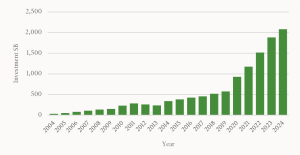
The below graph illustrates the dramatic rise in the availability of capital earmarked for sustainable investments around the world between 2004 and 2024:

Figure 1: Global Investment in Energy Transition, by Sector, 2004-2024. Source: BloombergNEF — Energy Transition Investment Trends 2025 (Abridged report). (link)

These global figures can be broken down further. Britain is the fourth largest market for energy transition investment in the world, behind only China, the EU, and the USA. In 2024, our investment was $65.3bn, equivalent to 17% of the EU’s total $375bn—a wildly disproportionate figure given we are one country compared to the EU’s 27 member states.[73]

The existence of such a deep pool of capital for investment in environmental projects, and the associated decrease in the cost of capital of those projects, paired with government subsidy, has meant that developers of wind and solar farms have been able to advance at pace over the past decade.

However, renewables have in recent years delivered dismal returns for investors. For example, iShares Global clean energy ETF has delivered negative returns of -11% over the last 5 years. Legal & General’s Clean energy ETF has done somewhat better, at least hitting positive figures delivering returns of 16% over 5 years.[74]

Whether -11% or +16%, both pale in comparison to the return of the FTSE 350 Oil & Gas index over the same period which sits at over 140%. This is despite British Oil and Gas companies being subject to a 75% windfall tax for most of that period.

Of course, ESG proponents will identify some renewable investments which have outperformed. Whilst such examples exist they are outliers. Due to the fundamentals underlying renewable finances, outperformance is unsustainable beyond the short term. As Ruper Darwall has written in another recent Prosperity Institute paper, “Producing less with more is the fundamental economic fact about renewables, which explains why having more renewables pushes up costs and makes everyone other than renewables investors worse off.”[75]

Subsidy reliance

It is possible to argue that investment managers choosing renewables were making the best investment decision based on the information at the time. Renewables did have a period of outperformance when they first gained popularity as an investment class and are still considered by many to be of vital importance to our future energy system. This period of outperformance was accompanied by government promises of green jobs and ever more cheap green electricity. Such promises continue, despite a continued lack of delivery. Between 2015 and 2023 between 30-51% of British jobs in oil and gas disappeared, a number potentially as high as 121,000.[76] In 2025 alone, two of Britain’s six remaining oil refineries closed, leaving us with only four.[77] Meanwhile the promised green jobs have been slow to materialise, and most are ultimately downstream of government subsidy, and the productivity of these jobs pales in comparison to that of jobs in the energy-intensive ‘foundational industrial economy’.[78] Similarly, despite continuing to spend billions seeking to achieve ‘clean energy’, on a good day only around 10% of total British energy consumption is generated by such sources. Electricity remains only around 20% of total energy consumption.

However, from the outset renewables as an asset class have relied on taxpayer subsidy for their profitability. Renewables are a rent-seeking business and their ESG motivated investors are simply collecting this rent which is extracted from households either by taxation or levies on energy bills.

For example, the Beatrice Wind Farm off the Scottish coast is the fourth largest offshore windfarm in the world. Its primary investor is SSE Renewables. SSE is a public company with major investors including British pension managers such as Aberdeen, Fidelity, and Legal & General. These firms manage more than £2tn between them, largely on behalf of pension savers. Each of these pension managers is a signatory of the NZAM initiative, committed to Net Zero by 2050 or sooner. Each of them is managing the pension pots of savers who entrust them to prioritise their retirement.

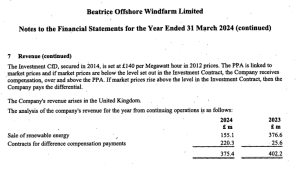
The problem is that, according to Beatrice Wind Farm’s latest financial statements, the majority of its revenue comes from Contract for Difference (CfD) payments—that is, government subsidies. These CfDs lock in a price which the energy provider earns per unit of electricity produced. Under this arrangement, the Low Carbon Contracts Company, a government agency, agrees to pay the energy provider an amount significantly above the market price of electricity for every unit produced. The difference between this agreed CfD price and the market price is the subsidy. The latest round of CfD sales to wind farm developers is set to guarantee an inflation hedged price for electricity of £113 per MWh.[79] This is compared to a current wholesale price of around £75.[80] This subsidy is ultimatley paid for by consumers.

The below snippet from Beatrice’s financial statements breaks the windfarm’s revenue into two categories. The first line shows the revenue generated from selling electricity to the grid, at market prices. The second line shows the revenue generated by CfD subsidy payments. The subsidy payments for 2024 are significantly higher than the energy sales.

In fact, Beatrice’s profit for 2024 was £78.4m.[81]

The Beatrice Wind Farm is one of the country’s largest and its financials are especially clear in differentiating between electricity sales and subsidy revenue. Their example is reflective of many other renewable projects.

Asset managers which invest in these projects are provably not investing in value-creating enterprises, but value-extracting ones. This defies sound investment wisdom, and made the demise of the asset class inevitable from the outset. The dereiction of fiduciary duty is stark, and asset managers are without excuse. Their pursuit of environmental goals has not only delivered poor returns for investors and pension savers, but has also spurned the rise in renewables, which have driven high energy costs for consumers, the damage of which has recently detailed for the Prosperity Institute by Rian Whitton and Rupert Darwall’s recent reports Destroying the Foundations: How Net Zero Could Wreck British Industry for Good and It’s Broke, Fix It: Where British Energy Policy Went Wrong and How to Get It Right.

Other costs of environmentalism

Of all the environmental goals embraced by asset managers, Net Zero ambitions are the most obviously detrimental to the fiduciary duty and shareholder returns, and this is currently under particular scrutiny due to the decisive shift against Net Zero on the British political Right. However, there are other avenues of environmentalism that have been pursued to the detriment of returns which are worth noting.

One area is the crusade against plastics. A notable example of asset managers calling for greater transparency on plastic pollution is the initiative led by a coalition of investors under the banner of the Plastic Solutions Investor Alliance. This group, which includes prominent asset managers such as BlackRock and Legal & General, has engaged with major consumer goods companies to request more detailed disclosures regarding their plastic footprints. They have pressed companies like Nestlé, Unilever, and PepsiCo to publicly report their total volume of plastics produced, recycled, and disposed of, as well as their long-term strategies for reduction and substitution. The clear intention is to shame them into action. It is clearly working, as demonstrated by the fact that Nestlé alone has pledged to invest £1.5bn of shareholder funds “to lead the shift from virgin plastics to food-grade recycled plastics, and to accelerate the development of innovative packaging solutions.”[82]

Additionally, in annual shareholder meetings and through proxy votes, asset managers have supported resolutions that require firms to publish comprehensive data on their use of single-use plastics and packaging waste. For instance, shareholder proposals at McDonald’s and Amazon have specifically demanded better transparency and measurable commitments to plastic reduction. These efforts are part of a broader push within the investment community to hold companies accountable for their environmental impact and encourage a shift towards more sustainable practices, even though doing so incurs additional costs and operational challenges for both companies and their investors. The ultimate owners of the capital, primarily pension savers, are not consulted on whether they are happy to lose out on their returns in order to help portfolio companies meet their environmental targets.

S: Social

Main points

  • There is a widespread insistence from asset managers on disproportionate diversity targets for themselves and their portfolio companies
  • Wealth generation is ignored as a social good in favour of fashionable causes such as the UN’s Sustainable Development Goals
  • Defence investments are excluded from investment, even for public pensions, despite their proven high returns and the government’s public commitment to defence spending

The ‘S’ in ESG stands for ‘social’. Although the E has become the most ubiquitous and widely accepted element of ESG today, the ‘S’ and all that comes with it has repeatedly made headlines and attracted intense public and media scrutiny from all sides.

When corporations throw their weight behind the social causes of the moment—especially consumer brands with high levels of recognition—the public take notice. More often than not, they seem to do so with bafflement and outrage, as the chosen causes of the moment either lack popular support or swiftly lose it as the latest trend fades.

The story of ‘S’ is much the same as that of ‘E’: a dereliction of the fiduciary duty, as asset managers invest their beneficiaries’ hard-earned savings, usually without their informed consent, in projects that are geared not towards maximal returns but to fashionable fads.

DEI and EDI hiring mandates

In the spring of 2020 George Floyd, a 46-year-old African American, died whilst in police custody. The video of his death quickly went viral, sparking riots and protests across the Western world.

Amidst the furore, and anger that followed Floyd’s death, asset managers did not hesitate to respond. Legal & General, who manage the pensions of 3.6 million members, issued a statement saying that:

The horrifying killing of George Floyd and so many others has led many institutional investors to think much more seriously about structural racism and inequality. At LGIM, we believe asset managers must go further – now is the time for action.[83]

They went on to say that:

recent societal tragedies have made clear that we must now expedite our work and that to wait for perfect data is not an option, so we will be engaging more forcefully on companies’ commitments to ethnic diversity and demanding transparent reporting.

Our expectation is that companies set ambitions related to the ethnic composition of their organisation, throughout the workforce, with a particular emphasis at the board level, which generally sets the tone from the top. For companies that fail to meet our transparent and rules-based minimum expectations, there will be voting and investment consequences.”

It is not simply that they imported an American debate and committed to utilise the money they manage to force their portfolio companies to prioritise racial diversity. In the wake of George Floyd’s death, they claimed that their investment teams were “looking to elevate the importance of ethnic diversity in their portfolio construction.”[84]

In other words, LGIM are now seeking to prioritise investment in companies which are ethnically diverse. This is not in the interest of pension savers or LGIM shareholders whose needs are best served by achieving a maximum return.

Approximately 80% of the British population is white.[85] LGIM’s 2020 report on ethnic diversity highlighted of FTSE 100 (Britain’s 100 largest companies) boards have ethnic minority representation. This was an incredibly high proportion, given Britain’s majority white population, especially when adjusted for age and profession.

However, LGIM framed these statistics negatively. They suggest that to correct the problem businesses need to communicate the importance of ethnicity and race. They also say that if a company does not take measurable action to increase their racial diversity, this will be interpreted as a sign the organisation doesn’t care.[86]

Socially engineering highly disproportionate and unrepresentative racial outcomes is not something which underlying investors, the true owners of many companies, have ever indicated that they are about. However, if companies refuse to submit to such social engineering, LGIM and other asset managers, who act as custodians on behalf of the true owners, will withhold vital investment capital from said company.

LGIM have also instituted a goal that 17% of senior and board roles must be held by ethnic minorities by 2027. The most popular catch-all term for these sorts of policies is ‘DEI’, standing for ‘diversity, equity, and inclusion’. This is the term used in the US. In the UK, ‘EDI’, standing for ‘equality, diversity, and inclusion’ is used more often.[87] However, the two are interchangeable, and the ubiquity of American news and culture means that ‘DEI’ has become frequently used throughout the Anglosphere.

As stewards of large amounts of capital, large asset managers have a responsibility to hire the most qualified people, capable of overseeing the highest returns. Similarly, they should seek the best available talent to lead their portfolio companies.

Arbitrary hiring targets are wrong in principle. They are also bad for investors and shareholders. Given that shareholders are ultimately the employers of all company staff, it is reasonable that they should expect the best qualified staff to be employed at all levels. Diversity hiring mandates detract from both the confidence of shareholders and from the satisfaction of talented minorities who cannot be sure their success is due to merit rather than immutable characteristics.

It is also worth noting that the goal posts are constantly moving as asset managers force more socially progressive ideology onto the reporting requirements.

Other social investment metrics

Whilst the DEI element and the hiring mandates are the most obvious and egregious element, there is no definitive definition of what the social considerations are within the ESG framework. This is part of the problem; it leads to an expansive view which results in asset managers mandating diversity trainings, hiring to meet quotas, and investing or divesting based on certain social criteria.

Who Cares Wins gives several examples of social issues that should be taken into consideration. These include workplace health and safety, community relations, human right issues, and perhaps most interestingly “Increasing pressure by civil society to improve performance.”[88]

Given the broadness of the scope, a useful way to establish what firms will strive toward is by looking at the factors the ESG ratings agencies consider and measure when producing their social rankings.

MSCI (Morgan Stanely Capital International) is one of the primary agencies offering ESG ratings to large asset managers and is widely used for ESG benchmarking exercises.

One way in which MSCI measures a company’s ESG credentials is by studying their alignment with the (SDGs).[89] Most of these goals are within the bounds of “social.” For example, they include: No Poverty, Quality Education, Reduced Inequalities, Sustainable Cities and Communities, and Peace, Justice and Strong Institutions. As with the environmental measures previously discussed, many people may see such goals as desirable. But this should not mean that they are the responsibility of asset managers, or their portfolio companies, especially without the informed consent of the principal.

Fidelity, one of Britain’s large asset managers, describes their sustainable investment process as including as assessment of a company’s “positive contribution to… social outcomes.” They do this by assessing the percentage of a company’s revenue that contributes to the fulfilment of the SDGs and investing accordingly. [90] Fidelity would counter this point by highlighting that they have a range of funds and not all of them are “sustainable.” However, such consumer choice points fail to acknowledge that the default investment options tend to be into ESG ‘sustainable funds.’ This is certainly the case with Fidelity whose default investment option is their suite of “Futurewise,” funds. Fidelity proudly asserts that Futurewise has “sustainability fully integrated across the entire strategy.” This includes integrating the UN’s Sustainable Development Goals.[91]

It is worth saying that some high-return companies contribute to SDGs as a consequence of their business model and therefore will be deemed to satisfy the requirements of pension funds. Mastercard for example has delivered stellar returns and is fulfilling SDGs largely because of its business pursuits. Its expansion of services on the African continent lends itself to the expansion of financial , which is considered a key enabler of several SDGs. [92]

However, two points arise from this. First, this outcome is a natural result of their business model which is itself producing healthy returns. Forcing Mastercard to spend time explaining how they are contributing to SDGs and asset managers spending time assessing if this is the case, helps nobody and simply drains shareholder money. Second, it proves that SDGs are a wholly unnecessary imposition. Mastercard is going to be contributing to these goals whether it is required to or not. Investment firms invest in Mastercard based on healthy returns and strong financial performance. A company that consistently generates profits will only be doing so because it is offering a service that people value. This will often unintentionally align with one or several of the SDGs.

However, there are some companies for whom this will not be obvious, or for whom the ESG lobby chooses not to credit with the advancement of SDGs. To take one example, ExxonMobil extracts and provides large quantities of oil and gas. which are necessary to ensure affordable energy. Affordable energy allows for heating and lighting, providing the basic conditions for human flourishing at a reasonable cost. Beyond this, affordable energy generated using ExxonMobil hydrocarbons powers energy-intensive endeavours such as medical research facilities, which are driving progress towardseradicating various diseases. As such ExxonMobil should be viewed as contributing to multiple SDGs. Mastercard could not exist without the ready availability of electricity, made possible by oil and gas companies. Nonetheless, Exxon receives no SDG credit; rather, it is penalised in ESG rankings.

Progressive branding

The most explicit element of the social element of ESG relates to the consumer experience. It is now common for a standard item or service to come with a fashionable ideological or social promotion of one kind or another.

Consider Unilever, one of the world’s largest companies. Its largest shareholder is BlackRock, who were noted earlier for encouraging businesses to pursue a purpose beyond just profit.[93] Unilever owns over 400 brands and is part of The Unstereotype Alliance. As such they use their advertising and branding to “take a stand,” on issues of racial discrimination, social justice and equal rights.”[94] They have boasted that by 2020 60% of their advertising was “strongly progressive.”

One could say that companies are entitled to pursue progressive portrayals if they wish. However, once more, Unilever and many other companies have as their main investors, that is their owners, public shareholders, often via their pension schemes. Given voting patterns it is reasonable to assume that most of those shareholders do not support the promotion of progressive causes and as such the companies should not be pursuing them. Perhaps if companies could make a case that such branding choices were enhancing profitability, there would be a case for them under the fiduciary duty. However, not only are extra costs incurred in the relevant progressive rebranding process, but there are now high-profile cases of business harm being done when the progressive envelope is pushed too far, prompting a negative market reaction.

In April 2023 Bud Light ran an advert in which TikTok influencer, Dylan Mulvaney, a man who self-identifies as a woman (a so-called “trans-woman”) drank a promotional can of Bud Light, celebrating a year of “girlhood” and promoting the NCAA’s annual “March Madness” basketball season.[95] This sparked backlash from conservative America. Bud-Light sales fell by 10% and profits by 28% in the following quarter; the share price of the parent company fell by 30%.[96] Shortly after the controversy Bud Light lost its title and ranking as the most popular beer in America and has never regained its place.[97] It is generally agreed in business schools that sacrificing an existing loyal customer base in pursuit of a smaller speculative customer
base is bad strategy. This seems like a clear case study

Given that there is such a large potential downside in engaging in progressive branding, and that many shareholders are against it, it would seem obvious that companies should not generally engage in it—or at least only do so with the very clear consent of their ultimate investors.

It should be noted that embracing apparent socially progressive values does not guarantee financial damage. There have been examples of short-term upticks in sales following such embraces. Nike sales increased following a 2019 anti-racism commercial and there was no long-term damage to revenue.[98] Nonetheless, if there has been, and continues to be a ‘culture war,’ one would assume that the position of a profit seeking enterprise would generally be one of neutrality, not of picking one side with its associated volatility and the added risk of violating the beliefs underlying shareholders.

Excluded industries

Just as many industries have investment withheld due to environmental criteria, many face the same fate due to social criteria advanced by ESG frameworks.

Schroder’s Sustainable Multi-Factor Equity Fund, for instance, is one of their primary ESG offerings. The fund has adopted a number of social exclusions—that is, sectors in which they will not invest. These include tobacco, gambling, and weapons.[99]

It is possible to piece together an investment case for the exclusion of tobacco and gambling. Both sectors are under pressure with tobacco being squeezed out on public health grounds and gambling companies facing ever tightening regulation from the Gambling Commission. Nonetheless, this very fact should remove the need for them to be arbitrarily excluded, as they will likely be excluded by the normal investment process. If they do not generate returns, rational investors will not invest. The market mechanism will work and they will be denied capital on their own grounds.

However, the exclusion of the weapons industry, which encompasses the defence sector is almost impossible to justify from a fiduciary perspective.

National defence spending is at the core of defence companies’ revenue model and profitability. There has been upward pressure on national defence budgets in Western capitals since at least Trump’s first presidential term. This has only been accelerated since the beginning of the Ukraine war in 2022. Since the beginning of that war, British Defence companies have delivered exceptional investment returns. But these are returns which have been denied to investors in the Schroder Sustainable Multi-Factor Equity Fund, and indeed to most investors in ESG funds. Between 2022 and the end of 2025, Rolls Royce delivered cumulative returns of 717%[100], BAE Systems of 213%,[101] and Babcock of 60% (not inclusive of dividends). [102]

Whilst of course, no investor could have known quite how well these companies would have performed, it is the job of active investors to identify value opportunities, and the positive signals were clear beforehand. A good asset manager with an appropriate brief would have identified the likelihood for good returns on defence investment at this time. Indeed, prior to the war, leading City analysts were highlighting the high probability of outsized returns from the defence sector given geopolitical tensions and the increasing prioritisation of defence budgets. By arbitrarily excluding defence, ESG funds guaranteed that their customers would be, and continue to be, denied these returns.

Admittedly, since the beginning of the Ukraine war, some ESG advocates have pivoted to argue that defence should be included within ESG parameters. But this position is yet to be widely adopted by ESG investment managers beyond increasing rhetorical support, and insofar as it has it simply illustrates the internal incoherence and malleability of ESG as a category.

It is worth acknowledging an individual who is morally opposed to the defence sector, or any other sector, should be able to invest in a way that does not violate their conscience. They should even be able to sacrifice financial returns on this basis, though the role of the state in providing for them does become more complicated if they have chosen trade-offs that have made them poorer in retirement. However, the larger problem is that, in the vast majority of cases, underlying investor (that is, the beneficial shareholder) is not morally opposed to the sectors being excluded but has several layers of intermediation between themselves and the investment decisions, and their asset managers act without their consent and arguably beyond their remit.

This is perhaps best evidenced by the example of Britain’s parliamentary pension scheme, the PCPF (Parliamentary Contributory Pension Fund), which oversees the pension investments for Members of Parliament. All major parties support Britain’s nuclear deterrent and an uplift in military spending. Indeed, the Labour party was elected to government with a pledge to increase military spending. In March 2025, over 100 Labour MPs even wrote an open letter to the financial sector, calling on investment managers to ensure that defence was treated as an ethical investment and not screened out on ESG grounds.[103] Despite this clear support for defence, the parliamentary pension scheme is primarily invested in equities that exclude defence as unethical, including the Schroders Sustainable Equity Fund.[104] If pension scheme members who express public support for defence are being denied investment in it, it is reasonable and true to assume that the same is happening to a significant swathe of the population. Thousands, possibly millions, are being denied returns on investments deemed with which they would have no ethical qualms.

Not only is this bad for pension savers who will find themselves less well off in retirement, it is also demonstrably bad for national security, with defence startups deprived of vital capital and the British military suffering the immense opportunity cost of innovation that simply never happens.[105].

G: Governance

Main points

  • FTSE 100 company annual reports are 46% longer than they were five years ago, largely due to reporting on their own ESG performance
  • Board members who deliver high returns for companies have been regularly pushed out due to failure to meet arbitrary diversity targets
  • ESG advocates pressure companies away from prioritising returns via “active ownership”, often through the use of third party proxy voters

The ‘G’ in ESG stands for ‘governance’.

Good governance is a cornerstone of successful businesses. This principle pre-dates the emergence of ESG and so-called ‘ethical’ investing. Corporate governance has traditionally been understood as ensuring that shareholder rights are protected and that the actions of company directors are in the best interest of its owners, which in the case of publicly listed companies means shareholders, often pension savers. Their interests are typically aligned with the maximisation of returns.

However, this is not what the ‘G’ in ESG means or has ever meant. In the confines of ESG, once asset manager and companies bow to external pressure on environmental and social issues, ‘governance’ become to be the mechanism by which conformity on those issues is enforced. The ‘G’ becomes a means of enforcing the ‘E’ and ‘S’.

Box-ticking and wasted resources

Insofar as the governance element of ESG focuses on the traditional aspects of limiting bad behaviour, ensuring proper divisions of responsibilities and so on, it is not objectionable. However, this does not justify the need for our novel ESG framework, since such standards to hold companies to such governance practices already existed.

ESG encourages a culture of mechanical box ticking, and industry leaders spoken to as part of the research for this paper believe that, due to this, ESG frameworks have actually made governance worse. A common complaint amongst industry leaders is that, at board meetings, the majority of time is spent discussing sustainability and environmental programmes, rather than discussing financials and performance.

In one interview conducted for this report, a partner of a prominent private equity firm described to me a recent experience at a board meeting of a FTSE 250 company. He claimed that the meeting was scheduled for three hours and the first two were dedicated solely to discussions of the company’s environmental impact. It was not until hour three that they turned to financials and other matters.

This anecdote is reflected in the constant expansion of annual reports, which are traditionally seen as a key governance mechanism, allowing shareholders to engage with company performance. FTSE 100 annual reports have grown by eight pages every year for the last five years, increasing in size by 46%. The average length of an annual report now exceeds that of Charles Dickens’ A Tale of Two Cities.[106] Much of this increase has been driven by ESG content. Whilst more content in an annual report may signal improved governance, in reality it is the opposite. It makes governance more impenetrable and the true performance of the company harder to identify.

This proliferation of ESG reporting and discussion evidences how genuine good governance has become subject to environmental and social concerns. This is implied the original UN document Who Cares Wins, which argues that sound corporate governance is a prerequisite to successfully implementing environmental and social considerations. Further, it talks of an effective governance framework as being one which enables a company to successfully implement the report’s recommendations, most of which relate to environmental and social outcomes.[107]

Active ownership

Every share of a company comes with voting power over its actions and direction. This allows asset managers to play an influential role, exercising their proxy voting power, which they wield on behalf of their underlying beneficial owners—again, primarily pension savers. Increasingly, these votes are used to pressure companies into adopting policies such as diversity targets or Net Zero commitments, even when a significant proportion of underlying shareholders or savers may not support these measures. For example, it is now standard practice among the largest asset managers to vote against the re-election of board chairmen if the board is not deemed sufficiently diverse.

In 2021, LGIM voted against Peter Cogwill, the chair of the board at JD Sports Fashion PLC, in part due to the board’s lack of gender diversity, as well as due to distaste over his pay and questions about succession planning.[108] This was despite the company returning a profit that year of £324m, beating profit expectations by a significant £150m despite COVID challenges.[109] Rather than the chairman being rewarded for this, he was punished.

Similarly, LGIM and other large managers have made it clear that companies failing to meet certain climate-related standards, such as setting Net Zero targets, risk shareholder opposition at annual general meetings.[110] These actions illustrate how asset managers, whilst supposedly acting as stewards of pension savings, can drive corporate policy in directions not always aligned with the views of the ultimate owners of capital.

This was clearly demonstrated at BP’s AGM in 2025, where LGIM, Borders to Coast, and other prominent institutional investors exerted significant pressure on BP’s board to maintain its Net Zero commitments, despite the company issuing profit warnings and indicating that such policies would likely threaten its financial performance.[111]

Often it is not even the asset managers themselves who make these proxy voting decisions, although they set policies and parameters. They outsource voting decisions to third parties, meaning that the asset managers who have been entrusted with investors’ money are not making the decision on how companies in which they are invested are being run. One such third party is Glass Lewis, who advise clients that manage over £40tn collectively.[112] The voting decisions they make are informed heavily by the environmental and social commitments and outcomes of the relevant company.[113]

There also exist organisations whose sole purpose is to push companies towards adopting questionable or controversial policies, often presenting these as matters of good governance. For instance, ShareAction is an advocacy group that encourages asset managers to pressure companies on issues such as diversity and climate change, regardless of shareholder interests. They describe themselves as a “leading provider of corporate governance research.” [114] Their ESG aligned proxy voting policy includes a commitment to “support most governance-related shareholder proposals [and] all environmental and social shareholder proposals aimed at enhancing a company’s policies and performance or increasing a company’s disclosures with respect to such issues.” [115]

Such a commitment betrays true good governance, as a traditional approach would examine each proposal on the basis of whether it served shareholder interests. That asset managers would sign themselves up to such an approach illustrates a disregard for the true interests of their investors. It also helps explain how many companies have come to accept increasingly extreme positions on the environment in recent years.

Conclusion and recommendations

In recent years, a feedback loop between regulators and corporate advocacy has intensified. The result? Corporate policy focused on so-called diversity and usually fruitless environmental targets, irrespective of the views of underlying shareholders and often to their financial detriment. Proxy voting and other governance activities by asset managers and pension providers, along with an increasing reliance on third party proxy voters and advocacy groups such as Glass Lewis and ShareAction, has institutionalised the pursuit of such policies and further distanced investment decisions from the true interests of investors, promoting a singular approach to governance and environmental and social issues. All this has hapened without the knowledge and consent of the ultimate owners of the capital.

This trend undermines the foundational principle of the fiduciary duty: that companies should be run in the best interests of their owners and that agents should make investments in the best interests of their principals.

Reversing this shift requires legislative reform, including amending the Companies Act to restore shareholder primacy and limiting regulatory and reporting mandates to financial matters alone. Neither the FCA nor the PRA should be incentivising financial services firms to embrace specific social nor environmental outcomes.

Although they are the victims, if we are to truly resolve these issues, retail shareholders, must become more active, attending AGMs and holding directors accountable for ESG strategies that violate investors’ morals and do not serve profitability. Investors must realise that their investment managers have indulged in a spectacular dereliction of duty. Organised action such as co-filing shareholder resolutions will be a key element of returning to the original model of true corporate governance which prioritises genuine investor priorities, countering the dominance of ESG.

If ESG can be successfully defenestrated, it offers the opportunity for economy wide growth as capital can once more be allocated based on growth opportunities rather than environmental and social optics. This will benefit all British pension savers, making them significantly wealthier in retirement. It will also benefit the British economy and society overall, as capital will be directed to sectors which currently lose out on investment due to faddish restrictions, most notably defence, an industry whose success benefits the entire British nation by servicing our armed forces. In addition, the renewable industry which is destabilising Britain’s energy market will be denied the private capital it currently receives due to ESG policies. Either it will learn to stand on its own two feet and be forced into longer overdue viability, or, more likely, it will accelerate its decline, returning Britain to energy realism.

A restoration and assertion of the fiduciary duty in British law is a necessary, natural, and moral step for all who wish to see a return of prosperity to Britain.

Policy recommendations

  • Reversing ESG is dependent on the dual repeal or major reform of the Climate Change Act and Equality Act. Without doing so asset managers will continue to claim that they are simply aligning their internal policies with government policy. Whilst this is not a legal argument it does intuitively make sense to many. In addition, these pieces of legislation create incentives for asset managers to insulate against lawfare. If a company is concerned about legal risks flowing out of the Climate Change Act or the Equality Act, the natural pre-emptive action is to signal your environmental and equality credentials in advance, giving you a strong legal defence. We must remove these incentives. .
  • The Companies Act 2006, specifically Section 172, must also be amended to reflect the primacy of shareholders as the legal owners of companies.
  • A fiduciary duty should be adopted within a revised Companies Act in relation to asset managers and pension providers. This will allow investors a clear mechanism to launch legal challenges when ESG is prioritised over long term returns.
    • Under the recommended legislation a fiduciary would mean any person who, with respect to a defined benefit or defined contribution pension plan or a publicly marketed investment product, exercises investment decision making control or influence.
    • Under the legislation fiduciaries would be bound to invest solely in the financial interest of beneficiaries.
    • Exceptions will be permitted in relation to private sector pensions only if underlying beneficiaries consent, in full knowledge of the de-prioritisation of their financial returns in favour of ESG or other factors.
    • Fiduciaries acting on behalf of public sector pensions will be required to act solely in their beneficiaries’ best financial interests with no exceptions.
    • Fiduciaries will be restricted from exercising ownership voting rights except in a manner directly in the best financial interest of scheme members. In general this will mean abstaining from proxy votes and ending the use of proxy advisory firms.
  • The Chancellor should use their remit letter to the FCA to narrowly define their scope to purely financial matters. They should make explicit that environmental and diversity issues are beyond scope. This should result in the FCA repealing multiple non-financial reporting requirements and regimes, such as the Sustainability Disclosure Regime and carbon reporting requirements.
  • To limit mission creep and to reduce the risk of future reversals, the scope of the FCA should be clearly limited and defined by amending the Financial Services and Markets Act 2000.
  • The upcoming Pension Schemes Bill should be amended to restrict the investment of any public sector assets or pensions into assets reliant on government subsidy. This would send a strong signal of intent, disincentivising rent-seeking behaviour.
  • A wide range of regulatory repeals should be introduced by various regulators via the appropriate mechanisms. A detailed list of such repeals can be found in the Appendix.

Shareholder action

Policy action may not be enough if corporates are ideologically captured to the extent that they choose to self-impose ESG rules. As such a more active culture must be created among retail shareholders in exercising their rights as owners of publicly listed companies.

  • British shareholders should look for inspiration to the successful tactics of anti-ESG action of the USA which raised the salience of this issue and paired with effective policy helped reverse it
  • Shareholders should attend the Annual General Meetings of and hold directors accountable by assertive questioning of their ESG strategies. They should demand a focus on profitability. This would help counterbalance the dominance of third party proxy advisors who dominate AGMs.
  • Shareholders should use the mechanism of shareholder resolutions to force company directors to defend or denounce ESG policies. A shareholder who controls 5% of a company can propose a resolution. Alternatively, 100 shareholders holding an average of £100 par value each can co-file a resolution. High net worth co-filers and a coordinating organisation are needed to make this possible at scale.

Appendix: ESG Regulations for Repeal

Regime Regulator Legislation Entities in Scope & What is Required Repeal Mechanism
Streamlined Energy & Carbon Reporting (SECR) Companies House / DBT Companies Act 2006; SI 2018/1155 (Companies (Directors’ Report) and LLP (Energy and Carbon Report) Regulations 2018) Quoted companies — meaning any UK-incorporated company whose equity is officially listed on a recognised investment exchange must report regardless of size. Larger unquoted companies and LLPs are also caught if they meet two of three thresholds: more than 250 employees, turnover above £36m, or a balance sheet above £18m; those using less than 40,000 kWh annually are exempt. What is required depends on the type of company: quoted companies must disclose global energy use and Scope 1 and 2 emissions with an intensity metric and year-on-year comparatives; unquoted companies and LLPs report UK energy and emissions only. Statutory instrument under Companies Act 2006 (Secretary of State power to amend directors’ report content — no primary legislation required)
   
Climate-Related Financial Disclosures (CRFD) DBT / Companies House; FRC Companies Act 2006, ss.414CA–CB (inserted by SI 2022/31) The regime encompasses UK companies whose securities are admitted to trading on a UK regulated market and which have more than 500 employees, together with large private companies that exceed both £500m turnover and 500 employees. Large LLPs at the same dual thresholds are also in scope, as are qualifying banks and insurers. AIM is not a UK regulated market, though AIM-listed companies may still be caught if they satisfy the private company thresholds. What is required is a set of TCFD-aligned disclosures in the strategic report: governance arrangements, strategy and scenario analysis, risk management processes, and metrics including mandatory Scope 1 and 2 emissions. Scope 3 is required if the company considers it appropriate. Statutory instrument under Companies Act 2006 (Secretary of State power — no primary legislation required to amend or repeal)
   
FCA Listing Rules — TCFD Disclosures  ⚠ Proposed replacement by UK SRS from 1 Jan 2027 FCA FSMA 2000, s.73A; FCA Listing Rules (historic references: LR 9.8.6R(8) and LR 14.3.27R; now reflected in the UK Listing Rules (UKLR) following the 2024 Listing Reform) All commercial companies with equity listed on the LSE Main Market — covering FTSE 100, 250 and SmallCap issuers as well as overseas companies with a primary or secondary London listing — must comply. AIM is excluded. Companies must include a statement in their annual financial report confirming whether TCFD-aligned disclosures have been made across all four pillars — governance, strategy, risk management, and metrics and targets. Where they have not, the company must identify which recommendations it has not followed and explain why. The rules are due to be replaced by the UK Sustainability Reporting Standards from 1 January 2027. Remit letter from the Chancellor and amending FSMA 2000.
   
FCA SDR — Anti-Greenwashing Rule FCA FSMA 2000, s.137A; FCA PS23/16; ESG Sourcebook ESG 4; Consumer Duty (PRIN 12) The rule applies to any FCA-authorised firm that makes sustainability-related claims — it operates by conduct rather than status, so it applies the moment a firm makes such a claim, regardless of size or sector. Every sustainability-related claim about a financial product or service must be clear, fair and not misleading, consistent with the product’s actual sustainability profile, and backed by evidence the firm can produce on request. This covers all client-facing communications: marketing materials, websites, prospectuses and any other documents in which sustainability is invoked. Remit letter from the Chancellor and amending FSMA 2000.)
   
FCA SDR — Investment Labels & Naming Rules FCA FSMA 2000, s.137A; FCA PS23/16; ESG Sourcebook Ch.5 There are two distinct obligations here. The labelling regime is voluntary: UK-authorised asset managers may apply one of four labels — Sustainability Focus, Improvers, Impact or Mixed Goals — to their UK-domiciled retail funds, provided at least 70% of assets are aligned with the relevant sustainability objective and the required consumer-facing, pre-contractual and annual disclosures are made. The naming rules, however, are mandatory: any FCA-authorised firm is restricted from using terms such as ESG, green, sustainable, responsible, climate, impact or ethical in fund names or marketing unless the product meets the relevant conditions and disclosures. Holding a label is one way to satisfy this, but not the only route. Remit letter from the Chancellor and amending FSMA 2000.
   
FCA — Asset Manager & Owner TCFD Disclosures FCA FSMA 2000, s.137A; FCA PS21/24, PS22/3; ESG Sourcebook Ch.3 FCA-authorised investment managers, life insurers and FCA-regulated pension providers with assets under management above £5bn — measured on a three-year rolling average — are in scope. The threshold was applied in two phases: firms above £50bn came in first in June 2022, with those above £5bn following in June 2023, bringing in several hundred firms. Each in-scope firm must publish an entity-level TCFD report covering governance, strategy, risk management and appropriate climate-related metrics including GHG emissions. Portfolio-level reports are required for each fund or mandate, covering absolute emissions, carbon footprint, scenario analysis and stewardship and voting activity. Remit letter from the Chancellor and amending FSMA 2000.
   
Pension Schemes Act 2021 — Trustee TCFD The Pensions Regulator (TPR) Pension Schemes Act 2021, s.41; SI 2021/839 (Occupational Pension Schemes (Climate Change Governance and Reporting) Regulations 2021) Trustees of large UK occupational pension schemes — both defined benefit and defined contribution — are required to produce annual TCFD-aligned climate reports. Schemes above £5bn have been in scope since October 2021, covering funds such as USS, BT Pension, Railpen and Nest; those above £1bn followed in October 2022. DWP is actively considering extending the threshold to £500m. The report must be published on the scheme website within seven months of the scheme year end and cover governance, strategy with at least two climate scenarios — one consistent with a temperature rise of 2°C or lower — risk management, and appropriate climate metrics including GHG emissions. Non-compliance is subject to TPR enforcement. Statutory instrument under Pension Schemes Act 2021, s.41 (DWP power — no primary legislation required to amend thresholds, metrics or reporting obligations)
   
Pension Trustees — ESG Governance (SIP / IS) TPR Pensions Act 1995; Occupational Pension Schemes (Investment) Regulations 2005 (SI 2005/3378, as amended by SI 2018/988 and SI 2021/597); TPR General Code of Practice (March 2024) Most UK occupational pension schemes are required to maintain a Statement of Investment Principles, with the specific disclosure and publication obligations varying by scheme size. The SIP must set out the scheme’s approach to financially material ESG factors including climate, along with its stewardship and voting policy. Separately, trustees must publish an Implementation Statement each year explaining how the SIP was acted upon in practice — covering engagement activity, voting decisions and how ESG considerations were integrated into investment choices. The March 2024 TPR General Code makes clear that climate change is a financially material risk. Statutory instrument under Pensions Act 1995 (for SIP/IS content requirements); TPR can update the General Code without primary legislation or SI
   
Equality Act 2010 — Anti-Discrimination, Harassment & Equal Pay EHRC / Employment Tribunals / Courts Equality Act 2010 (consolidating Sex Discrimination Act 1975, Race Relations Act 1976, DDA 1995 and six others) The Equality Act 2010 applies to every employer in Great Britain — there is no minimum size — as well as all service providers, public authorities and educational institutions. It prohibits direct and indirect discrimination, harassment and victimisation on the basis of any of the nine protected characteristics: age, disability, gender reassignment, marriage and civil partnership, pregnancy and maternity, race, religion or belief, sex, and sexual orientation. Employers must make reasonable adjustments for disabled people in both employment and service delivery. The equal pay provisions at sections 65 to 80 require that men and women receive equal pay for equal work. Public authorities are additionally subject to the Public Sector Equality Duty under section 149, which requires them to have due regard to advancing equality of opportunity and fostering good relations across all characteristics. Primary legislation (Act of Parliament) required to amend or repeal substantive rights; some procedural elements (e.g. specific PSED duties in England) can be amended by statutory instrument under the 2010 Act
   
Gender Pay Gap Reporting EHRC / Government Equalities Office Equality Act 2010, s.78; SI 2017/172 (private/voluntary sector); SI 2017/353 (public sector) Every employer in Great Britain with 250 or more employees on the relevant snapshot date — 5 April for private and voluntary sector employers, 31 March for public sector bodies — must publish six pay gap metrics annually. These cover the mean and median hourly pay gap between men and women, the mean and median bonus gap, the proportion of men and women receiving a bonus, and the distribution of men and women across four pay quartiles. The figures must be published on both the government’s reporting service and the employer’s own website, accompanied by a written accuracy statement signed by a director. Around 10,000 employers are in scope, covering all large listed companies, major banks, retailers and professional services firms, as well as NHS trusts, local authorities and universities. No action plan is currently required by law. Statutory instrument under Equality Act 2010, s.78 (no primary legislation required to amend metrics, thresholds or reporting obligations)
   
FCA Listing Rules — Board & Executive Diversity Disclosure FCA FSMA 2000, s.73A; UK Listing Rules; FCA PS22/3 All commercial issuers with equity listed on the FCA Official List — whether premium or standard, and regardless of where they are incorporated — must comply. This covers UK and overseas companies on the LSE Main Market; AIM companies, OEICs and shell companies are excluded. There are two obligations. First, companies must comply or explain against three board-level targets: at least 40% of board members should be women; at least one senior board role — chair, chief executive, chief financial officer or senior independent director — should be held by a woman; and at least one board member should be from an ethnic minority background. Second, companies must publish standardised numerical data on the gender and ethnicity of each board member, senior position holder and member of the executive committee. These are transparency and accountability measures, not mandatory quotas. Remit letter from the Chancellor and amending FSMA 2000.
   
UK Corporate Governance Code 2024 — D&I Provisions FRC UK Corporate Governance Code 2024 (comply-or-explain under UK Listing Rules); Companies Act 2006, s.172 The Code applies to all companies with a premium listing on the FCA Official List, regardless of where they are incorporated — the obligation flows from the Listing Rules rather than company law. AIM companies, standard listed issuers and investment trusts are excluded. On diversity and inclusion, the Code requires the board to set and disclose an annual diversity policy with clear objectives and reported outcomes, to describe its approach to workforce D&I including any targets and initiatives, to embed diversity into succession planning, and to ensure that triennial external board evaluations cover D&I. The Code operates on a comply-or-explain basis and has no direct statutory force; its teeth come through the Listing Rules and the scrutiny of institutional shareholders and proxy advisers. Remit letter from the Chancellor and amending FSMA 2000. The code is downstream of FCA listing rules.
   
Parker Review — Ethnic Diversity on Boards (Voluntary) Parker Review Committee No statutory basis — voluntary initiative; referenced in FCA PS22/3 and monitored by IVIS The Parker Review is a voluntary initiative with targets for ethnic minority representation on boards. FTSE 100 companies were expected to have at least one director from an ethnic minority background by 2021; the same target applied to FTSE 250 companies by 2024. For FTSE 350 companies more broadly, there are targets for ethnic minority representation in senior leadership — executive committees and their direct reports — by 2027. Although there is no statutory basis, the targets are referenced in FCA PS22/3 and progress is monitored by IVIS, the Investment Association’s proxy advisory service, which may recommend voting against nomination committee chairs at non-compliant companies. No formal mechanism — voluntary initiative with no legal or regulatory force; Parker Review Committee can amend or withdraw targets by resolution; FCA could remove references in PS22/3 via Policy Statement
   
FTSE Women Leaders Review (Formerly Hampton-Alexander Review; voluntary) FTSE Women Leaders Review Committee No statutory basis — voluntary; targets underpin FCA PS22/3 comply-or-explain listing rules The FTSE Women Leaders Review — which succeeded the Hampton-Alexander Review — sets voluntary targets for female representation across the FTSE 350. The headline target is 40% women on boards and in executive committees and their direct reports by the end of 2025. Companies outside the FTSE 350 are not formally in scope but may choose to report voluntarily. Progress is tracked annually by the Review, and IVIS, ISS and Glass Lewis may all recommend voting against nomination committee chairs at FTSE 350 companies that fall short of the 40% target or have no woman in a senior board role. The targets directly underpin the FCA’s comply-or-explain listing rules on gender representation. Remit letter from the Chancellor and amending FSMA 2000. The targets are referenced in the FCA’s listing rules.
   
Disability Confident Scheme (Voluntary / quasi-mandatory for Govt. contractors) DWP No statutory basis for the scheme; Equality Act 2010 underpins disability employment duties; Government procurement frameworks create quasi-mandatory effect Participation in the scheme is voluntary and open to employers of any size, across three levels: Committed, Employer and Leader. In practice, Level 2 (Employer) status has become effectively mandatory for businesses wishing to bid for certain UK Government contracts, giving the scheme a degree of quasi-regulatory force for government suppliers. Employers at all levels commit to inclusive recruitment practices and to offering interviews to disabled candidates who meet the minimum criteria for a role — this is a scheme commitment rather than a legally enforceable obligation. Level 3 Leader status carries an additional expectation of public reporting on disability employment. DWP is considering strengthening the scheme’s requirements in parallel with the Equality (Race and Disability) Bill. Ministerial decision, no legislation required. Issue instruction to civil service.
   
Energy Savings Opportunity Scheme (ESOS) Environment Agency SI 2014/1643 (Energy Savings Opportunity Scheme Regulations 2014, as amended by SI 2023/1388) ESOS applies to large UK undertakings, assessed on a group basis: any group with 250 or more employees, or that meets both the turnover threshold (above EUR 50m) and the balance sheet threshold (above EUR 43m), is in scope. UK subsidiaries of overseas groups are assessed by reference to the wider group. SMEs are exempt. Every four years, in-scope organisations must carry out a comprehensive energy audit covering at least 90% of total energy consumption across buildings, transport and industrial processes. The audit must identify cost-effective opportunities to improve energy efficiency, and the findings must be submitted to the Environment Agency. Failure to comply can result in civil penalties of up to £50,000 plus ongoing daily penalties. Statutory instrument under the Energy Act 2011 (Secretary of State power — no primary legislation required to amend or repeal)
   
UK Emissions Trading Scheme (UK ETS) Environment Agency (England); SEPA (Scotland); NRW (Wales); DAERA (NI); DESNZ Greenhouse Gas Emissions Trading Scheme Order 2020 (SI 2020/1265, as amended); Environment Act 1995 and Climate Change Act 2008 (enabling powers) The UK ETS applies to operators of energy-intensive industrial installations above specified thresholds — covering power generation above 20MW thermal, oil refineries, steel and metals production, cement, lime, glass and ceramics, chemicals, paper and pulp, and commercial aviation within the UK. Around 800 to 1,000 UK installations are in scope, along with aviation operators. Businesses outside these regulated sectors are not covered regardless of their size or emissions. Each year, operators must monitor and report their verified GHG emissions and surrender sufficient UK Allowances to cover them by 30 April. Allowances can be bought at government auction or on the secondary market. The total number of allowances issued declines each year in line with the UK’s net zero trajectory. Operators that fail to surrender enough allowances face a penalty of £100 per tonne of excess emissions and must still make good the shortfall. Statutory instrument under the Climate Change Act 2008 and Environment Act 1995 (Secretary of State power); abolition of the scheme would require primary legislation given the Climate Change Act 2008 net zero target framework
   
Modern Slavery Act 2015 — Transparency in Supply Chains (s.54) Home Office Modern Slavery Act 2015, s.54; Home Office statutory guidance (updated 2017) Any commercial organisation that supplies goods or services in the UK, carries on business here, and has an annual global turnover of £36m or more must publish an annual slavery and human trafficking statement. The threshold is applied at group level, so turnover of group members may be aggregated. The obligation catches UK-incorporated and overseas companies alike, and in practice extends to virtually all large retailers, manufacturers, financial institutions, hospitality businesses and professional services firms operating in the UK. The statement must be approved by the board and signed by a director, and must be published on the organisation’s website with a link from the homepage. It must address at least one of six specified areas: the organisation’s structure and supply chains; its policies in relation to slavery and trafficking; due diligence processes; the parts of the business and supply chains where risk has been identified and steps taken; the key performance indicators used; and staff training. There is no requirement to demonstrate year-on-year improvement, though the Home Office guidance encourages it. Primary legislation required to repeal s.54; the £36m threshold and statement content requirements could be amended by statutory instrument under powers in the 2015 Act

Bibliography

[1] Sam Walker, “Average pension pot by age”, Money Week, n.d., accessed 6 February 2026. (link)

[2]  Office for National Statistics, “Chapter 6: Private pension wealth, Wealth in Great Britain, 2012 to 2014, 18 December 2015. (link)

[3] Based on 8% vs 9% annualised returns. 8% delivers a total future investment value of £523,651. (9% delivers a total future investment value of £702,198. (monthly compound frequency)

[4] “Aviva study reveals critical knowledge gap about UK pensions”, Aviva, 22 April 2025. (link)

[5] The Investment Association, “Investment Management Survey 2022-23”, ch. 4 UK Institutional Market, October 2023. (link)

[6] S.P. Kothari, “Why Shareholder Wealth Maximization Despite Other Objectives”, Harvard Law School Forum on Corporate Governance, 23 May 2018. (link)

[7] The Global Compact, Who Cares Wins: Connecting Financial Markets to a Changing World, 2004. (link)

[8] Thomas P. Fitch, Dictionary of Banking Terms, 2nd ed. (New York: Barron’s, 1990), 244.

[9] Chaim Saiman, “Fiduciary Principles in Classical Jewish Law” in The Oxford Handbook of Fiduciary Law, ed. Evan J. Criddle, Paul B. Miller, Robert H. Sitkoff (Oxford: Oxford University Press, 2019), Chaim Saiman, 560.

[10] The renowned seventeenth century biblical commentator Matthew Henry summarised the significance of the financial meaning of this passage: “such a reputation [the temple workmen] got for honesty that there was no occasion to examine their bills or audit their accounts. Let all that are entrusted with public money, or public work, learn hence to deal faithfully, as those that know God will reckon with them, whether men do or no. Those that think it is no sin to cheat the government, cheat the country, or cheat the church, will be of another mind when God shall set their sins in order before them…. [Let us] whence we may learn, in all our expenses to give that the preference which is most needful, and, in dealing for the public, to deal as we would for ourselves” Matthew Henry’s Complete Commentary on the Bible. (link)

[11] Stephen M. Bainbridge, “The Parable of the Talents”, Law and Economics Research Paper Series, no. 16-10, 2 June 2016. (link)

[12] “The Twelve Tables” in Ancient Roman Statutes, trans. Allan Chester Johnson, Paul Robinson Coleman-Norton, Frank Card Bourne (Austin: University of Texas Press, 1961). (link)

[13] Cicero, De Officiis I.23

[14] Klaus Schwab and Peter Vanham, “What is stakeholder capitalism?”, World Economic Forum, n.d. (link)

[15] Andrew Pudzer, A Tyranny for the Good of Its Victims: The Ugly Truth About Stakeholder Capitalism (New York: Encounter Books, 2024), 2.

[16] “ESG Being Dropped From Corporate Sustainability Report Titles”, Carrier Management, 29 April 2025. (link)

[17] United Nations, “Secretary-General launches ‘principles for responsible investment’ backed by world’s largest investors”, press release, 27 April 2006. (link)

[18] Glasgow Financial Alliance for Net Zero, n.d. (link)

[19] FCA, “The Financial Conduct Authority’s Adaptation Report”, January 2025. (link)

[20] HM Government, “Mobilising green investment: 2023 green finance strategy”, GOV.UK, 11 April 2023. (link).

[21] GFANZ, “Call to Action: One Year On”, 2022. (link)

[22] Legal & General, “L&G sets Lifetime Advantage Funds as new default strategy for contract-based DC clients”, 17 December 2024. (link)

[23] Legal & General, “L&G Climate Action Global Equity Fund, n.d. (link)

[24] Moira O’Neill, “Beware of wealth managers quoting data”, Financial Times, 17 Augustu 2023. (link)

[25] Benjamin Graham, The Intelligent Investor: The Definitive Book on Value Investing, 3rd ed., (New York: Harper Business, 2024), 505.

[26] BlackRock, “A Sense of Purpose: Larry Fink’s Annual Letter to CEOs”, 2018. (link)

[27] BlackRock, Annual Stewardship Report 2020, September 2020, 10. (link)

[28] BlackRock, “BlackRock in the UK”. (link)

[29] Legal & General, “Climate and nature report 2024” (2024), 2. (link).

[30] CFA Society United Kingdom, “Case study: Implementing responsible investing at Scottish Widows”, n.d. (link)

[31] Scottish Widows, “Investments”, n.d. (link)

[32] The Investment Association, “Our Position on Climate Change”, n.d. (link)

[33] John Crabb, “Forget greenwashing, the real problem is ‘greensmuggling’”, Global Capital, 14 October 2022. (link)

[34] Royal London, Climate Transition Plan, 26 June 2025. (link)

[35] Royal London, “Climate Transition Plan”, 26 June 2025, 1. (link)

[36] Milton Friedman, “A Friedman doctrine—The Social Responsibility of Business Is to increase Its Profits”, The New York Times, 13 September 1970. (link)

[37] Companies Act 2006, 172.1.d. (link)

[38] Companies Act 2006, 172.1.

[39] Wellington Management, “Building a solid foundation: The latest steps in our net-zero journey”, n.d. (link)

[40] AstraZeneca, “Annual Report & Form 20-F 2000”, 2001, 7. (link)

[41] AstraZeneca, “What science can do: Annual Report and Form 20-F Information 2024”, 2025. (link)

[42] AstraZeneca, “Climate change”, May 2025. (link)

[43] Vinay Prasnad and Sham Mailankody, “Research and Development Spending to Bring a Single Cancer Drug to Market and Revenues After Approval”, JAMA Internal Medicine, 177(11):1569–1575. doi:10.1001/jamainternmed.2017.3601. (link)

[44] Prasnad and Mailankody, “Research and Development”.

[45] KnowESG, “AstraZeneca PLC: ESG & Sustainability Profile”, n.d. (link)

[46] Iman Zalinyan, “The ESG Dilemma in the Pharmaceutical Industry: Balancing Innovation, Ethics, and Sustainability”, RSM, n.d. (link)

[47] Greenhouse Gas Protocol, “Scope 3 Calculation Guidance”, n.d. (link)

[48] Green Element Group, “Carbon Footprint: Simplifying Scope 1, 2 & 3”, 26 October 2018. (link)

[49] IEA, “United Kingdom”, n.d. (link)

[50] Stephen Jones, “Sainsbury’s opens eighth wind farm site in renewable energy push”, The Grocer, 15 October 2024. (link)

[51] J Sainsbury PLC, “Wind in the sails: Eighth wind farm now helping to power Sainsbury’s”, 16 October 2024. (link)

[52] Jonathan Brocklebank, “Wind farms funded by Amazon and Tesco help at £1.5bn to YOUR bill”, The Daily Mail, 22 March 2024. (link)

[53] Fidelity International, “Why invest with us”, 30 September 2025. (link)

[54] Fidelity International, “Our net zero commitment”, n.d. (link)

[55] Tesco, “Tesco and NatWest join forces to help farmers reduce costs and decarbonise”, 28 March 2024. (link)

[56] NatWest, “Finance Options for your Ambitions” n.d. (link)

[57] Total farming subsidy in the UK is £3.025 million, the total number of farms is 209,000, hence an average subsidy per farm of £14,500. See Department for Environment, Food & Rural Affairs, “Total income from farming in the UK in 2024”, 5 June 2025. (link)

[58] Tesco, “Making a positive impact: Tesco PLC Sustainability Report 2024/25”, 2025,12. (link)

[59] Tesco, “Agriculture”, n.d. (link)

[60] Siân Yates, “Controversy erupts over Bovaer feed additive trial in UK dairy industry”, Foodbev, 6 December 2024. (link)

[61] ADHB, “England’s cattle and sheep populations his record lows: Beef and lamb market update”, Thursday 4 September 2025. (link)

[62] Green Alliance, “English farmers are at risk of being left behind in tackling methane emissions”, briefing, August 2024. (link)

[63] Business New Wales, “Collaboration Tackles Carbon Emissions in Wales’ Food & Drink Industry”, 20 March 2025. (link)

[64] Schroders Capital, “ESG”, n.d. (link)

[65] Schroders, “Our UK clients”, n.d. (link).

[66] This reference is technically in relation to Schroders as opposed to Schroders Capital (the private asset management arm); however, it seems reasonable to assume that most if not all of these will be invested by Schroders in capital strategies. See Schroders, “Schroders Capital awarded £500 million private equity mandate by Wales Pension Partnership. (link)

[67] Fatima Benkhaled, “Scottish Widows to invest in companies driving decarbonisation”, Pensions Expert, 3 February 2022. (link)

[68] LGPS, “Facts and figures”, n.d. (link)

[69] Border to Coast, “Homepage”, n.d. (link)

[70] London CIV, “London CIV Climate Change Policy”, n.d. (link)

[71] Columbia Business School, “One Key Corporate Challenge to Going Green: Rethinking the Cost of Capital”, press release, 25 June 2025. (link)

[72] Niels Joachim Gormsen, Kilian Huber, and Sangmin S. Oh, “Climate Capitalists”, SSRN, 22 February 2023, 2. (link)

[73] BloombergNEF, Global Investment in Energy Transition, by Sector, 2004-2024 (Abridged report), 30 January 2025. (link)

[74] iShares Global Clean Energy ETF (link); Legal & General, “L&G Clean Energy Units ETF”, n.d. (link)

[75] Rupert Darwall, It’s Broke, Fix It: Where British Energy Policy Went Wrong and How to Get It Right (London: Prosperity Institute, 2026), 9. (liznk)

[76] UK Parliament, “Debate on transitional support for North Sea oil and gas workers”, research briefing, 22 April 2025. (link)

[77] Rian Chad Whitton, Destroying the Foundations: How Net Zero Could Wreck British Industry for Good (London: Prosperity Institute, 2025), 29.

[78] Whitton, Destroying the Foundations, 8.

[79] Department for Energy Security and Net Zero, “Contracts for Difference (CfD) Allocation Round 7: results”, 14 January 2026. (link)

[80] Trading Economics, “United Kingdom Electricity Price”, accessed 11 February 2025. (link)

[81] Companies House, “Beatrice Offshore Windfarm Limited: Annual Report and Financial Statements for the Year Ended 31 March 2024”, posted 24 September 2024, 15. (link)

[82] Nestlé, “What is Nestlé doing to tackle packaging waste?”, n.d. (link)

[83] Legal & General, “Ethnic diversity: Financially material, social imperative”, 2020, 3. (link)

[84]Legal & General, “Ethnic diversity”, 9.

[85] GOV.UK, “Population of England and Wales”, 22 December 2022. (link)

[86] Legal & General, “Ethnic diversity”, 6.

[87] Paradigm, “What is DEI? The Meaning of Equity and Inclusion in the UK”, 26 January 2026. (link)

[88] Who Cares Wins, 6

[89] United Nations, “The 17 Goals”, n.d. (link)

[90] Fidelity International, “Sustainable Investing Principles”, July 2024, 16. (link)

[91] Fidelity, “Together we can be more FutureWise”, 2025, 3, 9. (link)

[92] UNCDF, “Financial Inclusion and the SDGs”, n.d. (link)

[93] https://uk.investing.com/equities/unilever-ord-ownership

[94] https://www.unilever.com/sustainability/equity-diversity-and-inclusion/transforming-our-brands-transforming-our-advertising/#:~:text=issues%20such%20as%20racial%20discrimination%2C%20equal%20rights%20and%20social%20justice.

[95] “Dylan Mulvaney Bud Light Commercial Original”, YouTube, 14 April 2023. (link)

[96] Sarah Taaffe-Maguire, “Dylan Mulvaney: Bud Light beer takes sales hit after backlash over ad campaign featuring transgender influencer”, Sky News, 3 August 2023. (link)

[97] Danielle Kaye, “Michelob Ultra becomes best-selling beer in the US”, BBC, September 2025. (link)

[98] Soo Yun, “Nike sales booming after Colin Kaepernick ad, invalidating critics”, ABC News, 21 December 2018. (link)

[99]  Schroders, “Schroder Sustainable Multi-Factor Equity Fund”, March 2025. (link)

[100]  Rolls Royce, “Share price”, accessed 11 February 2026. (link)

[101] BAE Systems, “Share price monitor”, accessed 11 February 2026. (link)

[102] Babcock, “Share Price Centre”, accessed 11 February 2026. (link)

[103] Sylvia Pfeifer, “Class UK defence investments as ethical, Labour MPs urge banks”, Financial Times, 6 March 2025. (link)

[104] James Graham, “Parliamentary pensions’ punishment of defence” The Critic, 15 April 2025. (link)

[105] James Graham, “How pensions are disarming Britain”, The Critic, 5 January 2026. (link)

[106] Quoted Companies Alliances, “The never-ending story of annual reports”, n.d. (link)

[107] Fidelity International, “What are the main approaches to ESG?”, n.d. (link)

[108] Sam Chambers and Jill Treanor, “JD Sports blasted over ‘inappropriate’ bonuses for chairman Peter Cogwill”, The Times, 13 June 2021. (link)

[109] Sarah Butler, “JD Sports owner’s profits soar thanks to US shoppers spending stimulus checks”, The Guardian, 14 September 2021. (link)

[110] Legal & General, “How we’re working toward our net zero emissions target”, 3 July 2023. (link)

[111] Rachel Millard, “BP faces shareholder backlash over U-turn on green strategy”, Financial Times, 11 April 2025. (link)

[112] Glass Lewis, “About us”, n.d.(link)

[113] Glass Lewis, “ESG Profile Methodology”, n.d. (link)

[114] Glass Lewis, “About us”.

[115] Glass Lewis, “Thematic Policies Overview”. (link)

 

Download Report