mail
Screenshot 2026-09-15 at 13.56.11

Making Space for Justice

Decorative arrow

A Plan to Solve the Prison Capacity Crisis

Glossary

Term Definition
Closed estate


The higher-security prison estate (Categories A, B, and C), where prisoners are held under varying levels of restriction and supervision.


Crowding / Overcrowding


A prison is considered ‘crowded’ when it holds more prisoners than its Certified Normal Accommodation (CNA), the number of prisoners it was designed to hold. Overcrowding typically results in prisoners sharing cells intended for fewer occupants.


Custody time limit


The maximum period a defendant may be held on remand before their trial must begin. The standard limit is approximately five months, though this may be extended by a court in certain circumstances.


Licence


The period after release from prison during which an offender remains subject to supervision and conditions set by the probation service. Breach of licence conditions can result in recall to custody.


Non-custodial sentence


A punishment that does not involve imprisonment, such as a community order, a fine, or a suspended sentence.


Open estate


The collection of Category D (open) prisons, where prisoners with lower security requirements are held and may be permitted temporary release.


Recall


The return of a released prisoner to custody, either due to reoffending or for non-compliance with the conditions of their licence, such as failing to maintain contact with a probation officer or failing to reside at an agreed address.


Remand


The detention of a person in custody before their trial or sentencing. Remand prisoners have not been convicted and are awaiting court proceedings.


Standard determinate sentence


A fixed-length prison sentence comprising a custodial period served in prison and a licence period served in the community under supervision.


Suspended sentence


A custodial sentence that is not immediately served; the offender remains in the community on the condition that they do not reoffend or breach specified requirements. Under the Sentencing Act 2026, there is a legal presumption that all sentences of 12 months or less should be suspended.


Acronyms

Acronym


Expansion


ECHR


European Convention on Human Rights


FNO


Foreign National Offender


HMCIP / HMIP


HM Chief Inspector of Prisons / HM Inspectorate of Prisons


HMPPS


HM Prison and Probation Service


MoJ


Ministry of Justice


NAO


National Audit Office


P-NOMIS


Prison National Offender Management Information System


PAC


Public Accounts Committee


RDC


Rapid Deployment Cell


SDS


Standard Determinate Sentence


Categories of prison

Category


Description


Category A


High security prisons.


Category B


Local or training prisons. Hold prisoners locally (sentenced or on remand), while training prisons hold long-term and high-security prisoners.


Category C


Training and resettlement prisons, holding the greatest number of prisoners in the system.


Category D


Open prisons. Minimum security, allow eligible prisoners to spend time away from the prison on licence.


Women and young offenders


Women are categorised and held in open or closed conditions according to risk. Young Offender Institutions house prisoners aged 18–21.


About the author

Alexander Baker is a Senior Researcher at the Prosperity Institute. He previously worked in Parliament for the Chair of the Foreign Affairs Committee, focussing on foreign policy, national resilience, and security legislation.

He holds degrees from University College London and the University of Oxford.

Endorsements

“This new Prosperity Institute report articulates a vital reality we can no longer ignore: Britain lacks the prison capacity it needs. Being able to send dangerous criminals to prison underpins our entire justice system – prison works by punishing and by incapacitating so the public can be protected.

Criminals are currently being handed soft sentences because there is not enough space to incarcerate them, and existing prisoners are dangerously being released early. This creates a ripple effect throughout the whole system: probation services are overwhelmed, confidence in the police and justice system is weakened, criminals are free to walk the streets and are able to reoffend repeatedly. Prisons themselves, meanwhile, have become increasingly ineffective as they constantly operate at breaking point.

Prison works – to punish, deter, and keep dangerous criminals away from the law-abiding public. We need to expand our prison estate to ensure we have the capacity to uphold law and order and protect our citizens.”

—Rt. Hon. Nick Timothy CBE MP, Shadow Secretary of State for Justice and Shadow Lord Chancellor

“When people know that prisons are full and the threat of incarceration minimal, criminals are emboldened and policing is undermined. It is no wonder the public feel rules are optional for the criminals and thugs who make the lives of the law-abiding majority a misery.

The Labour Government think the only way to address this issue is by releasing dangerous criminals after as little as one-sixth of their sentence and scrabbling around for space in laundry rooms. Their plans to build new prisons are nowhere to be seen.

This new Prosperity Institute report shows the kind of ambitious yet practical thinking needed to solve the capacity crisis. As the report suggests, we must expedite the return of foreign national offenders to their home countries and end the madness of the ECHR which puts the rights of prisoners over those of the British public.”

—Rt. Hon. Chris Philp MP, Shadow Home Secretary

“This timely report by the Prosperity Institute reminds us that the prison system is in a state of crisis and verging on collapse. Building more prisons is essential for public safety, as well as to improve the morale and conditions for our tireless prison staff.

The repercussions of the capacity crisis are damaging the ability of the police and the courts to enforce the law. Building more spaces will help the police tackle crime across the country as well as the proliferation of drugs and organised crime groups operating across the prison estate.

The early release of prisoners is a political choice, and the wrong one. This paper sets out an alternative for keeping dangerous criminals behind bars.”

—Rupert Matthews, Reform UK Police and Crime Commissioner for Leicester, Leicestershire and Rutland

Executive summary

There is a tendency in criminal justice policy to treat the prison system as a separate issue, to be managed or reformed in isolation from the rest of the justice apparatus. However, the evidence of the past decade suggests that prison capacity, and the chronic lack of it, functions as a fault line running beneath every other element of the criminal justice system. When under pressure, everything above it shifts. Successful reform of the criminal justice system is therefore predicated on expanding prison capacity.

In the summer of 2024, prisons across England and Wales experienced a capacity crisis that came dangerously close to overwhelming them.[1] Prisons were operating at occupancy rates of 99 per cent, and at one stage there were fewer than 100 places available for adult males.

As a result, the recently elected Labour Government was forced to implement emergency measures, including the use of early release.[2] While the nation was treated to media coverage of convicts popping champagne and celebrating their early release, the impact of the measures was negligible as the newly created capacity quickly depleted. [3] The issue has continued to grab headlines into 2026 and in the early days of Andy Burnham’s premiership.[4]

In response to the crisis the Government has announced a prison building programme, with the aim of delivering 14,000 new or restored places across the prison estate by 2031.[5] While the investment is welcome, estimates suggest that the new capacity will match the expected prison population by the end of the decade. An incoming government will therefore face the same capacity questions as the last, as well as the possibility of another crisis.

England and Wales are running out of prison places at enormous cost to public safety, the rule of law, and public finances. The lack of capacity affects sentencing policy and judicial discretion, breaking the relationship between the moral harm that criminal law seeks to prohibit and the duration of incarceration for the criminal. This also creates injustice where individuals who are ultimately acquitted are kept on remand for longer periods of time, because the state does not have the capacity to absorb a guilty verdict.

Ultimately, prison capacity is the backstop to all other forms of punishment, as the entire credibility of non-custodial options rests on the possibility of imprisonment for breach of conditions.

An incoming government should seek to lift prisons out of a state of permanent crisis management by committing to an ambitious but achievable goal of 20,000 new prison places over a parliamentary term, on top of the existing expansion commitments.

The total cost of such a programme is expected to be £15bn. This paper sets out the type of facilities required to address short- and long-term capacity pressures, ways to overcome the planning and other regulatory obstacles that have impaired previous development programmes, suitable site locations, and financing options.

For a government intent on serious reform, managing the immediate capacity crisis and building out the prison estate will be central to fixing the criminal justice system.

Immediate priorities

  • Make prison expansion a Ministry of Justice (MoJ) priority and plan for capacity shocks pre‑election. Publicly state the approach to emergency release such as maximising open estate use and temporarily re‑categorising medium‑risk prisoners.
  • Expedite the deportation of foreign national offenders (FNOs), accelerating removals under the Early Removal Scheme, backed by a FNO cost-recovery mechanism that incentivises either payment or rapid repatriation.
  • Convert general purpose buildings into prisons. Identify/acquire off-estate sites (e.g., campuses/training facilities) and contract providers to deliver an initial 500 new prison spaces to serve as proof of concept.
  • Expand existing prisons. Stand up a rapid capacity taskforce to identify prisons ready for expansion. The target should be 5,000 places within two years.
  • Start site surveys. Commission and publish a national land audit within six months to identify suitable sites for new prisons on Crown land. Use the Urgent Crown Development route by default to speed up the process.
  • If emergency release is unavoidable, ensure the probation service has sufficient resources to manage the process effectively and reduce the recall rate.

Longer-term programme

  • Introduce a Prison Building Act in the first King’s Speech designating possible sites for new prisons, limiting planning challenge exposure, and requiring milestone reporting.
  • Commit to at least six new prisons (1,500–2,500 places each) with applications submitted by 2030 to enable openings towards the end of the parliamentary term.
  • Adopt a new utilisation target of no more than 88 per cent of usable operational capacity across the estate. This target should trigger automatic review of the capacity programme if breached.
  • Create a dedicated Prison Workforce Development Fund to ensure sufficient recruitment of prison and probation officers alongside prison building and launch a probation workforce programme to manage a larger prison population.
  • Publish a National Policy Statement on prison infrastructure and introduce a Compulsory Acquisition (Prison Infrastructure) power.
  • Publish a land acquisition plan with 10 prospective prison sites to shortlist five for Crown Development by 2030.
  • Develop a capital plan to allocate £15bn for the prison building programme at the first Spending Review and protect it from capital-to-revenue raids via a ring-fenced reserve.
  • Create cost offsets by developing a Prison Infrastructure Programme to attract private capital for prison building in exchange for prison operation and maintenance contracts.
  • Accelerate procurement by codifying prison capacity shortages as a qualifying circumstance for direct award (Procurement Act 2023) and/or delegate call-off authority at defined capacity thresholds to the Justice Secretary to allow faster prison building with fewer Treasury hurdles.

Section 1. The capacity crisis

Main points

  • A lack of capacity has forced the Government to manage the prison population through the greater use of early release schemes. Such measures produce little lasting additional capacity due to poor prisoner management and high recall rates.
  • Official data on the number of prisoners across the prison estate is collected in a haphazard manner, making it harder for policymakers to gauge demand, especially in times of crisis.
  • The Government could attempt to avoid releasing prisoners by temporarily reclassifying offenders to different category prisons, but the construction of more spaces is essential for the long-term sustainability of the prison estate.

In September 2024, 1,889 prisoners were released from prison early after the Government introduced measures stipulating that offenders serving a standard determinate sentence (SDS) could be released after having served 40 per cent of their sentence.[6] This ‘Tranche 1’ group comprised of prisoners serving sentences of less than five years, subject to eligibility criteria.[7] A month later, 1,223 ‘Tranche 2’ prisoners were released under the same measures, comprising prisoners who were serving sentences of five years or more.

So, what prompted these emergency releases? In the autumn of 2024, the then-recently elected Labour Government announced that it had inherited “a prison system at the point of crisis”. The Justice Secretary, Shabana Mahmood, informed Parliament that the adult male prison estate had been running at 99 per cent capacity for 18 months, and that the system “was at risk of imminent collapse”.[8]

Figure 1 Prison capacity and population 2011–2026 (May)


Under these circumstances, the Government legislated to reduce the automatic release point to enable prisoners to be released on licence after having served 40 per cent of their sentence, down from 50 per cent.[9]

In the summer of 2024, England and Wales’s prison estate was operating at near total capacity. In July, there were 87,479 people in prison, leaving only 1,383 spare places. The decision to introduce the emergency measures allowed for a temporary expansion of prison capacity for the remainder of the year, which coincided with the issuing of hundreds of arrests during the Southport riots. However, despite the number of prisoners released, the overall prison population barely moved.

The additional capacity created by the emergency releases was quickly nullified by a sharp rise in recall admissions of recently released prisoners, which rose by 27 per cent in 2024 compared to the previous year.[10] This did not necessarily indicate high levels of recidivism on the part of those recently released, as recall includes non-compliance with release conditions. Of all recalls in the year to September 2024 more than three-quarters involved non-compliance, such as a failure to keep in touch or a failure to reside at an agreed address, as released prisoners struggled to secure stable accommodation and community support services struggled with the influx of new cases.

While the Justice Secretary indicated that the measure would be a “temporary change”[11], 48,931 prisoners ended up being released under this scheme between September 2024 to 2025.[12] Under the Government’s recent Sentencing Act 2026, SDS40 has been replaced with a new ‘earned progression model’ that moves the automatic release point for most standard determinate sentences even earlier to 33 per cent, conditional on good behaviour.[13] This helps to explain the decline in population numbers beginning in 2026. In addition, the Sentencing Act introduced a legal presumption that all custodial sentences of 12 months or less would be suspended sentences, leading to a reduction in the number of people going to prison for committing these types of offences.[14]

While the Government has alleviated the immediate capacity pressures faced in 2024–25, the measures used have shown themselves to be unsustainable. Moreover, the Government has mainly managed capacity shortages by reducing the time prisoners spend serving sentences in prison, as well as by reducing the number of custodial sentences issued for certain offences. Government policy continues to favour greater use of non-custodial remedies to ease pressure on prisons, despite the challenges this presents to public confidence in the criminal justice system.

Physical capacity and poor prison management

Any paper looking at the capacity crisis across the prison estate must also contend with the fact that poor leadership, staffing shortages, and mismanagement at the individual prison level, HM Prison and Probation Service (HMPPS), and in the MoJ have all contributed to the problem. Prisons are not passive entities solely overwhelmed by overcapacity but are actively managed (or mismanaged). Increases in leadership failures catalogued by HM Chief Inspector of Prisons are attributable to several causes but are all leading to declining managerial capacity.[15]

Institutional failures across the prison estate imply that expanding prison capacity will not, on its own, be enough. Or worse, that any additional capacity created will be quickly and inefficiently absorbed by the current system.

However, attempting to implement leadership, management, and workforce reforms in an institution constantly operating at near maximum capacity is difficult to impossible, given the imperatives to prioritise daily management over cultural or strategic reform. This view informed the Government’s recent Independent Review of Prison Capacity, which stated that officials across the prison system argued “strategic change was almost impossible when so much of the focus of the organisation was on crisis management and firefighting”.[16]

Reform of the prison estate requires addressing both the capacity crisis and the declining performance of the officials and staff that oversee it. However, implementing management and cultural change depends on some level of capacity leeway within the system, which makes the creation of additional capacity a prerequisite for the former. While related, these two challenges are analytically different.

This paper focuses predominantly on the physical capacity crisis and the need to create more prison spaces. The Prosperity Institute will publish a more detailed paper on prison management, culture, and building out the prison management workforce in the next year.

The data dilemma

One difficulty with managing prison capacity is the quality and integrity of the prisons data. The NAO’s examination of the prisons estate in 2024 contained the unusual caveat that the body had not “audited the accuracy or completeness of the data used” by HMPPS, signalling the auditor’s limited confidence in the base assessments.[17] The NAO has also been critical of the MoJ’s ability to project future supply and demand across the prison estate, noting that in 2023 the department switched from single ‘central’ prison population projections to bands based on ‘low’, ‘central’ and ‘high’, reflecting increased uncertainty.[18]

This is in part, because monthly population statistics reflect a single-day snapshot of a population that fluctuates, meaning that by the time statistics are centrally compiled by the MoJ, numbers can be out of date by a significant number of places. This issue is compounded by the administrative concepts used to measure capacity. Discrepancies between the base number of ‘Certified Normal Accommodation’ (the prison service’s aspirational standard for decent accommodation) and the more realistic Operational Capacity metric, which aims to measure the actual number of housed prisoners, can lead to cells being counted twice, distorting the number of places available.

Moreover, it has been heavily implied that much of the recording of capacity, release dates, and transfer orders still takes place by hand[19], with discrepancies in usage of the Prison National Offender Management Information System (P-NOMIS). Given the existence of platforms that can manage live population tracking, it is inexcusable that HMPPS is unable to record or publish figures beyond a monthly snapshot. It should consider looking at other systems for best practice. For example, the Irish Prison Service is capable of publishing a daily count of its prison population, which includes custody and capacity figures, level of remands, and numbers on temporary release.[20] The Scottish government was also able to do this until 2015, when the data sharing agreement between them and the Scottish Prison Service broke down.[21] Nevertheless, the Scottish Prison Service is still able to publish weekly prison figures.

This leaves policymakers in a difficult position. The MoJ’s published prison statistics remain the only viable source for analysing the current and projected prison population, with the caveat that the figures could be inaccurate to a significant figure. Poor data makes it especially challenging for crisis planning, especially for incoming governments if ministers are suddenly informed that official statistics are inaccurate. While policy planning needs to make use of the official data for lack of a better alternative, it would be wise to assume that the MoJ’s increased uncertainty over population statistics and tendency to over-estimate supply means that the capacity crisis is worse than public records suggest.

Managing another capacity crisis

The incoming government in 2024 was left with few good options and was forced into implementing the emergency release of a substantial number of prisoners. A future government entering office should consider the likelihood of a repeat scenario in the run up to a general election and prepare contingency plans accordingly.

The Annual Statement on Prison Capacity, which is now a statutory requirement under the Sentencing Act 2026, provides a published baseline against which an incoming government can calibrate its position before it takes office, while the MoJ’s monthly prison figures also provide useful insight into capacity levels.

Figure 2 Prison capacity and projected demand 2026–2032

Opposition parties should commit publicly to their approach to prison capacity, putting pressure on the incumbent government to outline the operational state of the prison estate during the election period. This may include announcing whether they intend to use any emergency release mechanism, and under what conditions. The 2024 experience illustrates the operational cost of ambiguity, as the system survived the summer partly because it was known that SDS40 was due to be implemented.

An incoming government that is honest about its position before it takes office and signals its intended response would give prison governors, probation services, and the courts system valuable time to prepare should it look like emergency measures may be required to manage capacity.

On taking office, an incoming government facing such a crisis should exhaust every option before looking at emergency releases. These include the maximum use of the open estate and temporary re-categorisation of lower-risk prisoners into open establishments, freeing closed estate places, as well as the accelerated removal of foreign national offenders under the Early Removal Scheme, with urgent diplomatic engagement with the top ten states of origin about repatriation. The Government may also wish to consider the immediate purchase of facilities that may be suitable for housing prisoners long-term to create additional capacity for prisoners with lower security requirements, such as those serving in category C or D prisons.

Where a government concludes that some form of release is necessary to prevent systemic failure, it should be legislated for once with a fixed end date for releases. Probation services should be notified of any release scheme as early as possible to avoid the high recall rates which ate into the headroom that was trying to be freed in 2024.

Given MoJ requirements to release prison capacity statistics, an incoming government should have some advance notice of a likely capacity crisis akin to the one seen in 2024. By putting pressure on the incumbent government to act and preparing contingency measures, it may be able to avoid a similar scenario.

Section 2. The ‘prisons theory of everything’

Main points

  • Building more prison spaces sits at the heart of improving Britain’s criminal justice system, as capacity affects the operational realities of policing and the courts.
  • One-fifth of the prison population consists of people on remand, who are presumed to be innocent as they have not yet been tried. In some cases, they are forced to share cells with convicted criminals due to overcrowding. Approximately 6.4 per cent of the entire prison population have been held on remand for more than 5 months.
  • Operating permanently at near-full capacity damages a prison’s ability to operate properly, look after prisoner safety, or combat radicalisation. It makes it more difficult for prisons to cooperate with other parts of the justice system effectively, such as delivering prisoners to court hearings in a timely manner.

A functional criminal justice system relies on an effective prison system. When prisons start to operate at near capacity or higher, the effects are felt across the whole justice system. Courts issue more non-custodial sentences and delay trials until spaces become available, contributing to the court backlog. Likewise, the deterrent of arrest becomes less effective, as both the police and public become increasingly aware of the fact that the perpetrators of many public order and property crimes will not face imprisonment.[22] This problem is particularly corrosive to public confidence in the criminal justice system, and partially contributes to the phenomenon where the public perception of lawlessness is increasing, even though severe violent and victim-based crimes have decreased significantly over the past thirty years.[23]

The prison system operates as though near-capacity is the norm. Almost a quarter of prisoners are in crowded accommodation, meaning they are sharing cells designed to hold fewer people.[24] This is the legacy of an estate that has consistently been asked to accommodate more prisoners than it was designed to hold. The prison operating margin— the gap between total spaces and the usable maximum that can be safely occupied—has been steadily squeezed, dropping from around 2,000 places in the early 2010s to just 1,350 in November 2023, and recovering only partially to 1,640 in July 2025, still just 1.8 per cent of total capacity.[25]

Effects on the justice system

One of the most direct and damaging effects is on remand. A fifth of all prisoners in England and Wales are currently on remand, with over 17,000 people awaiting trial or sentencing. This group has grown so large almost entirely because the Crown Court backlog has made it impossible to get them before a judge in a timely manner, with the remand population growing by 96 per cent between March 2019 and March 2025.[26] Given estimates that 30–40 per cent of remand prisoners are ultimately either acquitted or receive a non-custodial sentence, a substantial portion of the most-needed places in the prison estate are being consumed by people who will not ultimately be imprisoned at all.[27] Recent figures show that 32 per cent of the remand population had been held beyond the custody time limit of five months, and in 5 per cent of cases for more than two years.[28] This is deeply corrosive to the English understanding of justice and undermines the very concept of habeas corpus—the protection against arbitrary detention.

This heavily impacts on the court case backlog. Courts cannot list cases faster than they can be resolved and cannot resolve cases faster than defendants can be produced from prison. Producing defendants from prison is more difficult in overcrowded conditions with a reduced number of escorts available, and when the logistical burden of managing a vast remand population overwhelms ordinary operational routines. The Crown Court backlog, which in recent years exceeded 80,000 cases is in part a prison infrastructure problem and cannot be properly addressed without considering capacity in the prison estate.

The same pressure that distorts remand policy also affects sentencing policy. When prisons near capacity, the political and operational incentive to reduce the number of people being sent to them becomes significant. The current government’s response to near-crisis conditions in 2024 illustrates this. As such, sentencing policy becomes secondary to crisis management decisions made on the basis of infrastructure constraints, rather than reflecting a coherent view about the appropriate level of punishment for given offences.

As discussed above, the SDS40 release demonstrated all the deficiencies of capacity-driven sentencing. The reduction in the total prison population was only 3.5 per cent from August to December 2024, and that modest reduction was almost entirely wiped out by March 2025, largely because of the sharp rise in recalls to custody. The planning for community support and accommodation that should have preceded those releases was disrupted by the rushed timeline, contributing to the high recall rate which consumed the temporarily created headroom.[29]

Some have argued that the capacity crisis can be resolved by consistently sentencing fewer people to prison. The Government published an independent sentencing review in May 2025 which recommended measures including (a) restricting short sentences of under 12 months to exceptional circumstances; (b) expanding suspended sentences to cover terms of up to three years; and (c) introducing an ‘earned progression’ model under which well-behaved prisoners would be released after a third of their sentence.[30] The review estimated these measures would reduce the prison population by around 9,800 by 2028 relative to projected levels under SDS40. The Government has accepted almost all the proposals and is legislating through the Sentencing Act to enact these changes. But even if fully implemented on schedule, by May 2029 there will be around 2,000 more people in prison than in September 2025, and demand is projected to outstrip supply until at least late 2027.[31] The earned progression model itself carries significant risk, as the number of additional days added to sentences through prison adjudications was up 56 per cent year-on-year in 2024, a trend that, if continued, would rapidly diminish the places freed up by earlier release.[32]

More importantly, sentences should be designed around the requirements of justice not prison space, while keeping public protection and proportionality to the offence in mind. If capacity determines sentencing, the criminal justice system is effectively allowing its own infrastructure failures to define the outer limit of punishments that courts can impose. A system that cannot reliably send someone to prison when a court has determined that prison is the appropriate punishment has broken down.

Effects on policing

It is likely that capacity constraints are increasingly influencing operational policing decisions, especially in cases where large-scale public disorder is liable to occur. At the lower end of the disorder spectrum, this dynamic was arguably visible in the policing approach to the recent youth organised disorder in Clapham and elsewhere[33] and to intra-community tensions over the Europa League Aston Villa–Maccabi Tel Aviv fixture in Birmingham in November last year.[34] In each instance officers appeared to exhaust every available tactic to de-escalate and disperse rather than arrest, despite evidence of serious criminality in plain sight. Acutely aware that local custody suites were already stretched and calculating that detaining large numbers of individuals risked exposing just how little headroom remained, there is clearly a police concern that should capacity constraints become widely known among protestors, it could embolden further disorder.

This contrasts with the post-Southport response in the summer of 2024[35], which showed just how much extraordinary machinery had to be activated to make mass arrest viable at all. With over 1,511 arrests made and hundreds more suspects identified, police were required to reactivate Operation Early Dawn to keep defendants in police custody rather than in remand, court cases were deferred, prison maintenance projects were paused, and over 500 additional prison places were made available through emergency releases.[36] Meanwhile, reports of community groups, particularly in predominantly Muslim neighbourhoods across England, organising their own street patrols were tolerated by police by necessity, effectively outsourcing order maintenance to manage the numbers flowing into a broken custody pipeline.[37]

Prisoner safety and radicalisation

There are further systemic costs to prison management. Recent data shows a 24 per cent increase in self-harm incidents and a 27 per cent rise in assault incidents in the twelve months to March 2024, with self-harm at its highest level since the recording time series began in 2004.[38] Deaths in custody in the twelve months to June 2025 were up 30 per cent on the previous year, rising from 308 to 401, the second-highest twelve-month period on record.[39] HM Chief Inspector of Prisons (HMCIP) has reported that in many establishments prisoners receive barely two hours out of cell per day, and in its annual report described the ingress of illegal drugs as “destabilising prisons across England and Wales,” with uncontrolled levels of criminality that hard-pressed and often inexperienced staff were unable to contain.[40] Incidents at height were up 9 per cent year-on-year in 2024–25 and 38 per cent higher than 2019–20, while barricade incidents rose 7 per cent to the highest level on record.[41] A prison estate at near-permanent capacity cannot meaningfully rehabilitate, manage violence, provide healthcare, run consistent regimes, or give governors the operational flexibility to address failing establishments.

There is also evidence that overcrowding in prisons is linked to extremism and radicalisation.[42] Capacity constraints make it more difficult for prisons to manage extremism, including the separation of dangerous and charismatic prisoners from those susceptible to radicalisation. There are currently 266 persons in custody for terror-related offences while only 28 spaces exist in separation centres designed to hold those who cannot be held in a general prison.[43] The process for managing prisoners arrested for terror-related offences becomes more difficult to operationalise given overcrowding constraints. [44]

Prison overcrowding prevents every other part of the criminal justice system from functioning properly. It overrides sentencing policy by making capacity rather than culpability the binding constraint, while undermining the purpose of remand by filling the available estate with prisoners who may never be convicted. It also poses serious risks to public safety and trust by accelerating releases and generating the recall spiral that immediately recreates the pressure it was meant to relieve.

The Government must recognise that expanding prison capacity lies at the heart of the issues affecting the British criminal justice system. The MoJ should make expanding the prison estate a departmental priority.

This would make the state less reliant on emergency release schemes as a standing capacity management tool. Where temporary relief is needed, it should come from rapid deployment of additional cells within existing perimeters rather than from curtailing the sentences that courts have imposed.

The recall cycle should be addressed at its root rather than managed through release policy. The 30 per cent vacancy rate for qualified probation officers as of June 2025 is directly contributing to the recall rates that undermine every early release measure.[45] A workforce programme for probation, including accelerated training pathways and improved pay for newly qualified officers, should be treated as an important part of managing capacity.

Section 3. Building capacity

Main points

  • The next government should aim to build 20,000 new places on top of existing commitments over the next parliamentary term.
  • Delivery should come from the construction of new prisons as well as rapid expansion of existing sites.
  • Additionally, acquiring and refurbishing additional facilities from outside the conventional prison estate would enable the MoJ to create new spaces quickly and at significantly less cost.

The current Government has committed to 14,000 new or refurbished prison spaces by 2031, of which 2,900 had been delivered by the end of 2025.[46] The National Audit Office suggests that the Government is unlikely to meet this target, as poor project management and a lack of prioritisation has pushed back completion dates for new prisons as well as the ‘rapid’ houseblock developments.[47] Between now and the end of the decade prisons are expected to remain dangerously close to capacity and may in practice operate above total usable capacity for extended periods, eating into the ‘operating margin’ required for their proper functioning. [48] Even with the Sentencing Act 2026 reforms fully in place, the MoJ’s own impact assessment suggests there will be 2,000 more people in prison by 2029.[49] The assessment that the Act will reduce demand by 7,500 places by 2028 is also optimistic, given the assumptions placed on an under-resourced and understaffed probation service. While the Government’s plans represent a significant investment in capacity, they still leave the system short of where it needs to be for the criminal justice system to function without permanent emergency measures.

Moving away from a system on a permanent emergency footing requires a larger expansion of the prison estate. The next government should commit to creating 20,000 new prison places over the next parliamentary term. This should be understood as an additional tranche on top of the incumbent government’s goal to create 14,000 new places.

This new aim would deliver the headroom required for the better functioning of the prison estate. A usable operational capacity of around 120,000 would allow prison governors to run safer and more effective prison regimes, anticipate future demand and allow Britain’s criminal justice system to return to deterring and punishing crime rather than pursuing non-custodial sentences as a matter of necessity.

Failing to match supply of prison places with expected demand has been a problem for successive governments over at least the last 20 years.[50] The NAO has consistently criticised over-optimistic plans for how fast additional spaces can be delivered, particularly from building new prisons, while the prison expansion programme has been repeatedly beset with planning delays, and spiralling costs.[51]

To address this, a new programme should distinguish between what can be delivered quickly and what requires longer lead times. The two categories should be planned and funded separately, even if announced together.

Rapid delivery

The rapid delivery element of the programme should focus on three things.

First, the immediate expansion of existing prisons through new houseblocks. Several establishments already have planning permission for additional buildings, and a standard houseblock delivering 60 to 120 places can be constructed within twelve to eighteen months on an existing site with existing infrastructure, staffing pipelines, and utility connections. The Government’s current programme includes some of this, but the pace and scale should be dramatically accelerated.

Second, Rapid Deployment Cells (RDCs)—prefabricated modular cells capable of being erected within the perimeter of an existing prison—provide fast capacity at lower cost and should be pursued. With a fifteen-year lifespan, RDCs should be prioritised in lower category prisons as a way of expanding capacity for less dangerous offenders. A further tranche should be procured as a temporary measure to hold population levels stable while permanent capacity is being developed.

Third, while the MoJ is already examining the repurposing of buildings currently in Crown ownership such as former military establishments, or redundant court complexes with secure custody facilities, it should consider looking at additional property options held by other departments or the private sector.

Additional facilities could be used to ease capacity while addressing some of the specific consequences that overcrowding has had on the management of the prison system. For example, some British higher education institutions are selling off accommodation, or in some cases, entire campus facilities, as part of restructuring schemes.[52] The MoJ could consider purchasing such sites with the aim of converting them into facilities focused on specific parts of the prison population, such as the remand population. For example, Nottingham University is in the process of selling its Castle Meadow campus at a greatly reduced price,[53] making acquisition and conversion costs substantially lower than the construction of new facilities from scratch.

Additional infrastructure, such as former university conference centres, corporate management colleges, and NHS training facilities come to market regularly at £5–20m. If such sites could house approximately 200 prisoners, they would be significantly cheaper than the £120m price tag of a new-build prison equivalent.[54] A standing acquisition programme could monitor and bid for suitable sites, particularly those with residential accommodation of 100–300 rooms on suburban or edge-of-town freehold sites. For example, College Court Conference Centre on the outskirts of Leicester would likely fall within the price range, providing potential for between 100–200 places for lower category prisoners or acting as a separate facility for prisoners on remand.[55] Similarly, The Royal School in Haslemere, a now defunct boarding school formerly accommodating 350, is on the market for £8m. In each instance, repurposed facilities could be quickly expanded using RDCs alongside the existing infrastructure.[56]

Repurposing facilities for usage as prisons and detention facilities is being made significantly more cost effective with the advent of scalable modular housing technology, some of which is already in use within the prison estate.[57] The rapid procurement of sites hosting infrastructure previously suited to different purposes either by the MoJ directly or via a third-party provider would signal to modular facility manufacturers demand for their service and invite proposals as to how best to reconfigure the land for detention purposes.

Expanding the acquisition of discounted university facilities with no obvious buyer with the intent of refitting for remand populations would also allow the MoJ to create specific facilities for remand prisoners, reducing the number of remand prisoners in contact with the general prison population.

Long-term delivery

These rapid delivery measures would sit alongside longer-term plans for the construction of new prisons. The experience of HMP Millsike, which received outline planning permission in September 2019, full planning permission in November 2021, and opened in April 2025, represents a typical timeline: around five to six years from initial permission to opening.[58] For a programme beginning at the outset of the next parliamentary term, prisons entering the planning system in 2029 and 2030 will not open until 2033 at the earliest. Decisions made at the start of the parliamentary term will determine whether new prisons are open in the mid-2030s, and to a great extent the success of next government’s record on law and order.

Prison construction and management programmes have emphasised the importance of geographic proximity between offenders and the areas from which they originate or have family residing. While there is evidence that moving offenders further away has a deleterious effect on behaviour and rehabilitation, geography should only inform the choosing of new sites as a secondary consideration. Distance can be mitigated through measures such as increased digital communication or transport support. Ultimately, the creation of extra capacity would provide the prison estate with the slack needed to pay more attention to accommodating prisoners in closer proximity to their homes and family.

A credible programme must also address the consistent pattern of capital budgets being raided for day-to-day spending. The Sunak Government transferred over £800m of planned prison capital spending to day-to-day budgets in 2023–24 alone, and the Labour Government transferred a further £695m in 2024–25.[59] A new programme could consider being ring-fenced against precisely this kind of erosion, or look at alternative financing arrangements, discussed later in this paper.

Recommendations

  • The next government should commit in its first King’s Speech to a Prison Building Act that establishes the 20,000-place programme, setting out designated new prison sites, protections against planning challenges and requiring parliamentary reporting on delivery against milestones.
  • A rapid capacity taskforce should be established with the goal of establishing existing prison sites capable of absorbing new houseblocks and RDCs and initiating planning applications immediately within the first 100 days of the parliamentary term. An interim target of 5,000 additional places from houseblocks and rapid deployment cells within two years of the start of the parliamentary term should be set and publicly reported against. New capacity could be used to ensure that the growing remand population is housed separately from the general population.
  • The capacity taskforce should also identify additional sites outside the prison estate to acquire and convert into prison facilities, contracting the services of modular facilities providers to expedite the build process. A fast-track programme might seek to establish 500 places within a year, to demonstrate proof of concept and allow for more detailed cost-effective studies to follow.
  • The programme should commit to a minimum of six new-build prison sites, each of 1,500–2,500 places, with applications submitted no later than 2030 to achieve openings in the 2033–34 window.
  • The MoJ should establish a dedicated Prison Workforce Development Fund, scaling up officer training capacity to ensure that new establishments can be staffed from opening day. The experience of recent new-builds, where staff recruitment has lagged significantly behind construction, has created unsafe operating conditions in the critical early years of operation.
  • The Government should formally adopt a target utilisation rate of no more than 88 per cent of usable operational capacity across the estate, enshrined in the annual prison capacity statement which the Lord Chancellor committed to publish. This target should trigger automatic review of the capacity programme if breached, preventing the gradual normalisation of overcrowding that has characterised every previous period of capacity crisis.

Section 4. Regulatory obstacles

Main points

  • Planning remains one of the biggest obstacles to constructing new prisons quickly, though the Government’s unwillingness to prioritise construction is also responsible for delays. Existing routes could speed up the development process.
  • The European Convention on Human Rights also makes it more difficult to construct new prisons, imposing additional legal and regulatory costs on the process.
  • The MoJ’s internal business case preparation can also make it difficult for the department to obtain approval for its spending plans, as they tend to underestimate construction cost.

Creating new prison facilities will face legal and procedural obstacles, many of which have been historically responsible for delivering far fewer prison places than promised, later than announced, and at greater cost.

Planning reform

The primary legal constraint on rapid prison construction is the English planning system. The Town and Country Planning Act 1990, as amended, creates a statutory framework in which development decisions require public consultation, Environmental Impact Assessments, and, for major developments, detailed examination through the Development Consent Order or planning inquiry process. An Environmental Impact Assessment is triggered frequently for prison development under the Town and Country Planning (Environmental Impact Assessment) Regulations 2017, requiring impact assessments on everything ranging from ecology to air quality and socioeconomic considerations. These processes can be conducted in parallel, but they cannot be bypassed and the legal risk created by inadequate environmental assessment is a judicial review, which can stop construction even after planning has been granted, as the Government has found to its detriment on multiple occasions.[60]

The Government has committed, as part of its 10-Year Prison Capacity Strategy published in December 2024, to secure streamlined planning permission for new prisons through the Crown Development Route.[61] Introduced by section 109 of the Levelling-up and Regeneration Act 2023, this mechanism allows the Secretary of State to be the relevant authority for planning decisions on Crown land. However, even within the Crown Development framework, planning applications are liable to be challenged, including on the interpretation of the “national importance” of the project, ultra vires, or on human rights or environmental grounds. Needless to say, the powers have thus far not been put to use: since the introduction of the new mechanism in May 2025, no planning applications for prison construction have been submitted under either the Crown Development Route or the Urgent Crown Development route as of February 2026.[62]

Challenges to the “national importance” of the prisons programme may be addressed through a National Policy Statement on prison building. This would provide a legally robust basis for the Government’s decisions that would be substantially harder to challenge in judicial review than a case-by-case exercise of discretion, as well as signal to local authorities and environmental bodies the settled framework within which objections will be weighed. The absence of such a statement remains an additional legal vulnerability in the current programme.

ECHR obstacles

Human rights law also has the potential to delay prison development. Article 6 of the European Convention on Human Rights (ECHR), which guarantees the right to a fair hearing, is engaged by planning processes in which affected parties have procedural rights to participate in decisions that affect their interests. The Crown Development Route preserves these procedural rights[63], meaning that parties who consider their Article 6 rights have been inadequately respected in that process retain the right to seek judicial review of the decision, and this risk is not eliminated by the route’s use.

Article 8 of the ECHR, the right to private and family life is relevant to prison location decisions in a way that creates ongoing litigation risk. Imprisoning someone very far from their home community can, in certain circumstances, engage Article 8 even if the general decision to imprison is lawful.[64] This does not mean remote prisons are unlawful, as courts have been deferential to operational judgment, but it does mean that a programme creating large clusters of capacity in areas geographically remote from the prisoner population could generate Article 8 challenges that, even if unsuccessful, impose significant administrative and legal costs.

Planning challenges represent a major obstacle to the prison expansion programme. The MoJ has historically struggled to spend its full capital allocation due to planning setbacks, meaning that money nominally allocated to prison building has repeatedly been redirected for use elsewhere.[65] Overcoming these legal and regulatory obstacles to development is essential for the rapid expansion of prison capacity.

Procurement controls

Alongside planning, the slow pace of public procurement is responsible for delays in the construction of new facilities. The Rapid Deployment Cell programme provides a good example of this. RDCs represent the fastest available supply-side tool but, under the MoJ’s own estimate, endorsed by the Infrastructure and Projects Authority, they still possess a minimum lead time of 67 to 75 weeks from contract signature to first prisoner.[66] RDC tranches originally scheduled for completion in December 2022 were still unfinished by early 2026, with delays further compounded by the administration of ISG, a single contractor awarded responsibility for approximately 3,500 prison places across 13 projects.[67]

While the current procurement framework for modular prison capacity used for RDCs does include pre-vetting and call-off procedures designed to accelerate the process[68], MoJ prerequisites to using it are a source of delay. For example, business case preparation and approval, internal specification exercises, and additional engagement with the Treasury are all required before a contract can be put to tender. However, the department itself attempts to bypass these requirements to speed up the procurement process, for example by basing full business case costs on estimates taken at an earlier stage than it would normally do to speed up approvals.[69] Rather than requiring the Government to devise methods to bypass its own procurement requirements, the process could be streamlined to account for the urgent need to create new prison capacity.

Recommendations

  • The Government should publish a National Policy Statement on prison infrastructure, setting out the Government’s assessment of the need for new prison capacity and the policy framework within which the Secretary of State will determine Crown Development Route applications.
  • The Government should use the Urgent Crown Development route as the standard planning pathway for all new prison construction on Crown land from the start of the next parliamentary term. This planning route was introduced in May 2025 but remains underutilised.
  • The Government should introduce a Compulsory Acquisition (Prison Infrastructure) Order power in the Prison Building Act, modelled on the compulsory acquisition powers available for other nationally important infrastructure, allowing faster land acquisition with a streamlined compensation process for sites not already in public ownership.
  • To accelerate the procurement process, the lack of prison capacity could be codified as a qualifying circumstance for direct award under the Procurement Act 2023, which already permits this route in cases of extreme urgency where a need cannot reasonably have been anticipated. The Justice Secretary could also be granted powers to enter call-off procurement agreements on projects up to a certain value without the need for a fresh business case, when the prison population passes a threshold close to maximum capacity.
  • The Government should also withdraw from the ECHR and repeal the HRA 1998 to ensure that a prison building programme approved by Parliament does not face undue challenges on human rights grounds.[70]

Section 5. Where to build

Main points

  • The MoJ should revive previous site selection exercises it has conducted and relax site criteria to speed up new prison development.
  • While political support can help expedite planning decisions, it does not guarantee a faster process, meaning that legislation should be used to overcome planning objections.

Managing site selection is as important as the commitment to build. The MoJ’s independent capacity review identified planning delays and environmental regulations as having been major causes of cost overrun and delay in the current programme.[71]

The primary determinant of whether a new prison can be delivered on time and on budget is the planning environment. The Government’s broader intention to allow the Housing Secretary to override local objections to prison building has so far been exercised on an ad hoc basis rather than through a settled statutory framework. In December 2024, the Deputy Prime Minister approved a new prison adjacent to HMP Garth in Lancashire after more than three years in the planning system, overruling the local planning inspector. However, this decision was challenged in court, with the High Court finally dismissing the challenge in mid-2025. Ministers have similarly overridden local authority refusals in Leicestershire and Buckinghamshire, though political support, while helpful, does not guarantee expedited planning approval.[72] The periodic exercising of existing call-in powers does not provide the speed or consistency needed to underpin a 20,000-place programme.

Site location needs to also be considered. Former industrial sites, Ministry of Defence land, and large agricultural parcels on the urban fringe of medium-sized towns are the most promising categories. Large areas of former defence estate in the East Midlands, Yorkshire, the North West, and parts of the South West have been identified in previous government land reviews as potentially suitable, and these should be the starting point for any new site search. The Government’s 10-Year Prison Capacity Strategy stated an ambition to acquire new land for potential future prisons “should further prison builds be required” but made no commitment to publish a formal land acquisition plan and identified no specific sites.[73] Converting this commitment into a formal land acquisition plan would give policymakers, developers, and communities greater clarity on the aims and requirements of the building programme.

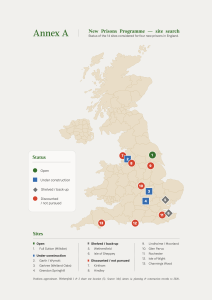
However, we know that the HMPPS has conducted site searches in the past. As part of the Johnson government’s New Prisons Programme in 2019, the prison service oversaw a public sector site search, identifying 14 sites that the MoJ already owned. While 10 of these were discounted, some of the justifications behind this included not being in preferred locations or already had planned expansions.[74] Given the urgency of expanding the prison estate, these options should be revisited with site criteria relaxed to accommodate more options.

Staffing and connectivity

Staff availability is another important factor that has received insufficient attention in previous programmes. A new prison of 1,500 places requires something in the region of 700 to 900 full-time staff.[75] New sites would benefit from being situated within or near medium-sized urban centres with working-age populations of at least 150,000 to 200,000 within a 30-minute commute. Towns like Doncaster, Wakefield, Peterborough, Preston, Swindon, Newport, and Gloucester, which have existing prison infrastructure, supply chains, and labour market familiarity with custodial employment, represent the locations in which new establishments could be staffed far more quickly than remoter alternatives.

Clustering new establishments near existing prisons also means that training facilities, healthcare contracts, and management expertise can be shared with a new establishment during its critical first years of operation, reducing the risk of the chaotic early conditions that have afflicted several previous new-builds.

Prisons rely on regular vehicle movements for prisoner transport, deliveries, staff commuting, and court escorts. Sites without good access to A-road or motorway networks impose significant ongoing operational costs and increase the difficulties of moving prisoners between establishments.

Recommendations

  • The MoJ should commission an immediate, national land audit jointly with the Ministry of Defence, the Crown Estate, and Homes England, with an explicit brief to identify sites of 20 hectares or more in Crown or public ownership that could be made available for prison development within two years. This audit should be completed and published within six months of the start of the next parliamentary term.
  • A dedicated Prison Sites Unit should be established within the MoJ’s estates directorate, with planning lawyers embedded from the outset of the programme. The history of the current programme demonstrates that the MoJ does not have sufficient in-house specialist capacity to manage complex applications without heavy reliance on external advisers brought in at high cost once problems emerge.
  • The MoJ should publish a land acquisition/site selection plan with at least ten prospective sites identified within the first year, and five shortlisted for Crown Development Route applications by 2030. Progress may be reported through the annual capacity statement mechanism that the Sentencing Act 2026 has now placed on a statutory footing.
  • The MoJ should publish a geographical distribution target for the 20,000-place programme that identifies the biggest disparities in regional development costs, such as land, labour, and logistics. It should prioritise development in areas where these costs are lower.

Section 6. Financing

Main points

  • Using current government estimates, building 20,000 new spaces could cost £15bn over a parliamentary term.
  • While expensive, this is significantly cheaper than relying on existing emergency contingency plans, such as maintaining degraded prison cells or temporarily using police holding cells.
  • Alternative ways to raise capital could be planned with greater involvement of the private sector, in return for business involvement in prison management.

Building 20,000 new prison places represents one of the largest capital commitments in the history of the English prison estate. Though the costs are significant, they pale in comparison to the full systemic costs of the current capacity crisis, including the economic and societal costs of an inadequate criminal justice system.

Estimating programme cost

Estimating programme cost can be inferred by the individual cost of a prison space. In 2024 the NAO found that cost per place across the current prison expansion portfolio has varied from £200,000 to between £610,000 and £840,000 depending on programme type, site conditions, delivery timeline, and inflationary pressures.[76] The Government’s previous 20,000-place programme in 2021 was originally forecast to cost £5.2bn, doubling to between £9.4bn and £10.1bn, reflecting high inflation, planning delays, insufficient risk management, and the premium cost of urgent delivery.[77] The Independent Review of Prison Capacity estimated a cost of £600,000 per place for the Government’s prison building programme.[78]

Applying the Independent Review’s implied rate of £600,000 per place to a 20,000-place programme produces a central construction cost estimate of £12bn. This figure should be treated as a planning floor, given the consistent lesson of every previous prison building programme is that costs have risen substantially above initial estimates due to inflation, site suitability problems, planning delays, and contractor failures, most recently the collapse of ISG in September 2024, which was due to provide 3,634 places and whose administration caused significant further disruption and cost.[79] A responsible planning estimate should therefore incorporate a contingency of at least 20 to 25 per cent above the central estimate, producing a total programme cost in the range of £14.5bn to £15bn. Spread across a five-year parliamentary term, this implies additional capital spending of approximately £2.5bn to £3bn per year above the Government’s existing commitments.

The Government’s existing prison capital budget has been at historic highs since the Johnson Government tripled it from 2020–21 onwards, reaching £2.3bn in 2023–24. Capital spending is expected to rise steadily from 2024–25 to 2026–27, before beginning to decline from 2026–27 onwards.[80] The additional commitment required by this programme would therefore need to reverse that declining trajectory. This is a significant fiscal ask and would require politicians and policymakers to resist the capital-to-revenue transfers that have repeatedly cannibalised prison building budgets.

Alternative ways of raising capital

Amidst the current financial climate and the state of the public finances, it is likely that an incoming Government will be forced to make deeply contentious decisions about the allocation of public funds. This paper has already argued that investing in prison capacity is essential to addressing the issues facing the British criminal justice system, not to mention the fact that the tangible costs of crime to the British economy amount to around £170bn or 6.5 per cent of GDP.[81]

Nevertheless, the additional capital costs called for by such a prison construction programme are substantial and may require the Government to consider additional financial instruments to raise funds or offset building costs.

FNO cost recovery

One way to recover costs may be through FNOs housed across the prison estate. As of June 2025, approximately 10,800 foreign nationals were held in prisons in England and Wales, representing 12 per cent of the total prison population and drawn from 168 different countries.[82] At the current programme cost estimate of £600,000 per place, those prisoners represent a notional capital liability of just under £6.5bn, roughly equivalent to half of the 20,000-place programme, in addition to an annual running cost of approximately £401m at the current average direct cost per prison place of £37,128.[83] The Government should establish a formal Foreign National Offender Cost Recovery mechanism, under which the sending state is charged the full capital cost per place, indexed to construction cost inflation for every one of its nationals held in an English prison beyond an agreed threshold period. The mechanism is designed to operate as an incentive as countries would either pay the capital levy or accept the repatriation of their nationals under a prisoner transfer agreement, freeing the places the levy was designed to fund. Either outcome is beneficial to the prison estate.

The levy could be structured and enforced through several channels depending on the nature of the bilateral relationship. For countries in receipt of Official Development Assistance (ODA) from the United Kingdom, the most direct mechanism would be to set off outstanding costs against the ODA budget allocated to that country. For European countries (Albania, Poland, Romania, and Lithuania account for more than a quarter of foreign nationals), diplomatic pressure presenting a capital invoice could be used, with a re-evaluation of trade or defence commitments in case of refusal of payment.

Private enterprise

Additionally, the Government may want to invite private enterprise to support the construction of new prisons as a more cost-effective way of investing in crime prevention. According to the British Retail Consortium, retailers have spent over £5bn on crime prevention and mitigation.[84] A Prison Infrastructure Compact with business may allow the Government to raise additional funds for construction, as it would provide retailers with long-term solutions for reducing the impact of crime on their businesses. It is, of course, deeply regrettable that the state has been unable to maintain a sufficient level of public order, to an extent in which private enterprise might be asked to lend considerable support to the construction of basic public infrastructure. However, such a Compact could include a structured arrangement under which technology and data companies with relevant capabilities in prison management, offender monitoring, and justice analytics contribute capital to the construction of new establishments in exchange for long-term, performance-linked contracts to deploy their products across the facilities they help to fund.

Under this model, a private consortium could finance and construct prison capacity at its own expense, reducing reliance on the taxpayer to fund upfront costs and the public procurement delays that have repeatedly caused the government’s own building programme to slip. In exchange, the consortium would receive a long-term availability payment, paid only once the facility is operational and maintained to agreed standards, alongside potential services contracts covering facilities management, technology, and rehabilitation provision.

Opportunity costs

It is also important to consider opportunity costs. The NAO notes that the cost of maintaining an existing cell ranges from £8,600 to £12,700 per place, compared to around £220,000 to build a new one. This figure may encourage maintenance over new construction, but ignores the systemic costs of operating an overcrowded, degraded estate.[85] Operation Safeguard, the Government’s contingency plan allowing the temporary use of police cells to hold adult male prisoners, cost HMPPS £70m by January 2025.[86] This single emergency measure, across a period of roughly two years, consumed a sum equivalent to the construction cost of several hundred permanent prison places, and a system with adequate headroom would not need it. The MoJ has never published a comprehensive analysis of the total cost of the current capacity crisis across the whole criminal justice system covering courts, police custody, probation, and the cascading costs of the recall cycle, and doing so would allow the Treasury to make better capital allocation decisions with a clearer picture of the opportunity cost of underinvestment.

Disposal of outdated prisons

The Government could also explore a managed disposal programme for the oldest and least fit-for-purpose establishments in the Victorian estate, which are expensive to run, poorly designed for modern purposes, and in several cases situated on land of significant development value in central urban locations. Proceeds from disposal, timed to coincide with new capacity coming online, would generate capital receipts that could fund a material proportion of the new-build programme. This requires coordinated planning between MoJ estates, the Treasury, and local planning authorities to ensure that disposals occur at the optimal point in the new-build pipeline rather than being driven by short-term budget pressures.

Recommendations

  • An incoming Government should plan to allocate £15bn for the prison development programme. This should be announced at the first Spending Review and should form the basis for the capital allocation to the 20,000-place programme.
  • The Prison Building Act recommended above should include a provision establishing a Prison Infrastructure Compact as a ring-fenced capital reserve, explicitly protected against transfer to day-to-day revenue spending. The fund should aim to raise money through the private investment options outlined above, such as allowing firms to invest in capital costs in return for longer-term services contracts, or as a way of investing in crime reduction facilities in general.
  • The Government should seek to extract financial concessions for its continued hosting of FNOs across the prison estate. The Foreign National Offender Cost Recovery mechanism puts pressure on foreign Governments to accept their nationals or support the construction of new prison spaces via levy, both of which ease capacity constraints across the estate.
  • A Prison Infrastructure Programme should be established to attract private capital for prison building in exchange for prison operation and maintenance contracts.
  • Disposal of costly, outdated Victorian facilities should be explored to reduce long-term costs and offset immediate costs with the proceeds from sale.

Section 7. Conclusion

The current Government is unlikely to meet its commitments to expanding the prison estate over the course of this Parliament, which is likely to lead to acute capacity pressures for the foreseeable future. As we have seen, current policy seeks to mitigate this pressure by managing prison demand, either through commuted prison sentences or early release schemes, as well as increasing the use of non-custodial sentences for increasing types of offences.

As a result, the prison system will continue to operate in a state of near-maximum capacity, which brings with it many of the adverse impacts observable across the criminal justice system. A sizeable expansion of the prison estate would make it easier for prison governors to improve the operational functioning of the estate, improve the effectiveness of non-custodial sentences, help to reduce the judicial backlog, and improve the police’s ability to enforce the law.

All the above is central to public confidence in the justice system. Expanding the prison estate is an expensive investment requiring public resources, though reforms to planning and procurement, and greater regard for unconventional property acquisitions may make it possible to rapidly increase available capacity.

Without reform, it is likely that any new government will find themselves in the position of the Labour Government in the summer of 2024: forced to release thousands of prisoners to manage severe supply constraints.

Annex A

Bibliography

Bakht, Shayma. “‘We’re Not a Gang,’ Say Masked Muslims Patrolling Streets of Birmingham”. The Times, 9 August 2024. https://www.thetimes.com/uk/crime/article/were-not-a-gang-say-masked-muslims-patrolling-streets-of-birmingham-723w2dc0p.

Bootle, Roger, David Spencer, Ben Sweetman, and James Vitali. The Costs of Crime — And How to Reduce Them. London: Policy Exchange, 2025. https://policyexchange.org.uk/publication/the-costs-of-crime-and-how-to-reduce-them/.

British Retail Consortium. BRC Crime Report 2026. 2026. https://brc.org.uk/news-and-events/news/operations/2026/ungated/brc-crime-report-2026/.

Calver, Tom. “Is the UK getting more lawless? We examined the crime data”. The Times, 10 June 2025. https://www.thetimes.com/uk/crime/article/news-statistics-home-office-303lq7l7v.

Criminal Justice Act 2003 (Requisite and Minimum Custodial Periods) Order 2024, SI 2024/844. https://www.legislation.gov.uk/ukdsi/2024/9780348262476.

Government Commercial Agency. “RM6184: Offsite Construction Solutions”. Accessed 28 August 2026. https://www.gca.gov.uk/agreements/RM6184

HC Deb, 25 July 2024, vol. 752, col. 832, https://hansard.parliament.uk/Commons/2024-07-25/debates/67B4BB95-71F5-44D9-8C99-2AA55FF68A31/CriminalLaw#contribution-5E030E51-B1C7-4744-86E1-1CD657462621.

HM Chief Inspector of Prisons for England and Wales. “Annual Report 2023–24”. HC 218. 10 September 2024. https://www.gov.uk/government/publications/hm-chief-inspector-of-prisons-annual-report-2023-to-2024.

HM Chief Inspector of Prisons for England and Wales. Annual Report 2024–25. London: HM Inspectorate of Prisons, 2025. https://hmiprisons.justiceinspectorates.gov.uk/hmipris_reports/annual-report-2024-25/.

HM Inspectorate of Prisons. “Separation Centres — Decent Care but More Engagement and Progression Needed”. News release. Accessed 28 August 2026. https://hmiprisons.justiceinspectorates.gov.uk/news/separation-centres-decent-care-but-more-engagement-and-progression-needed/.

Home Office. “Detention General Instructions”. GOV.UK. Accessed 28 August 2026. https://www.gov.uk/Government/publications/offender-management/detention-general-instructions-accessible#:~:text=Home%20Office%20staff%20must%20be,new%20information%20that%20is%20obtained.

House of Commons Home Affairs Committee. Maccabi Tel Aviv Fan Ban. Fifth Report of Session 2024–26, HC 1553. London: House of Commons, 22 February 2026. https://publications.parliament.uk/pa/cm5901/cmselect/cmhaff/1553/report.html.

House of Commons Library. “Tackling Extremism in Prisons”. Research briefing CDP-2025-0126. Accessed 28 August 2026. https://commonslibrary.parliament.uk/research-briefings/cdp-2025-0126/.

House of Commons Library. “UK Prison Population Statistics”. Last updated 6 February 2026. https://commonslibrary.parliament.uk/research-briefings/sn04334/.

House of Commons Library. Prisoners Released in Error. Research Briefing CBP-10825. London: House of Commons Library, 2026. https://commonslibrary.parliament.uk/research-briefings/cbp-10825/.

House of Commons Public Accounts Committee. Crown Court Backlogs. HC 348. Session 2024–26. London: House of Commons. https://publications.parliament.uk/pa/cm5901/cmselect/cmpubacc/348/report.html#:~:text=4.,beyond%20their%20custody%20time%20limits.

House of Commons Public Accounts Committee. Prison Estate Capacity. HC 366. Session 2024–26. London: House of Commons. https://publications.parliament.uk/pa/cm5901/cmselect/cmpubacc/366/report.html.

House of Lords Library. “Government Plans to Ease Prison Capacity Pressure and Manage the Needs of Vulnerable Prisoners”. 9 September 2024. https://lordslibrary.parliament.uk/government-plans-to-ease-prison-capacity-pressure-and-manage-the-needs-of-vulnerable-prisoners/#:~:text=In%20addition%20to%20the%20new,they%20are%20summoned%20to%20court.

Inside Time. “New Prison Seeks 700 Staff”. 21 August 2024. https://insidetime.org/newsround/new-prison-seeks-700-staff/.

Institute for Government. “Performance Tracker 2025: Prisons”. 2025. https://www.instituteforgovernment.org.uk/publication/performance-tracker-2025/criminal-justice/prisons.

Irish Prison Service. “Daily Prisoner Population”. Accessed 22 July 2026. https://www.irishprisons.ie/information-centre/statistics-information/2015-daily-prisoner-population/.

Jeram, James. “Are Record Shoplifting Rates Exposing a Broken Deterrence Model?” Peel Solutions Hub, 20 August 2025. https://hub.peelsolutions.co.uk/blog/are-record-shoplifting-rates-exposing-a-broken-deterrence-model.

Knight Frank. “The Royal School, Farnham Lane, Haslemere, Surrey, GU27”. Property listing. Accessed 24 August 2026. https://www.knightfrank.co.uk/properties/residential/for-sale/the-royal-school-farnham-lane-haslemere-surrey-gu27/dvl012502500.

La Corte, Maria Laura and Cassia Rowland. “How will the new prison early release scheme work?” Institute for Government, 6 August 2026. https://www.instituteforgovernment.org.uk/explainer/prison-early-release-scheme.

Mahmood, Shabana. “Written Statement: SDS40 and Prison Capacity”. HCWS156, 22 October 2024. https://questions-statements.parliament.uk/written-statements/detail/2024-10-22/hcws156.

Ministry of Justice and HM Prison and Probation Service. “Standard Determinate Sentence (SDS40) Release Data: September 2024 to September 2025”. Transparency data, 29 January 2026. https://www.gov.uk/government/publications/standard-determinate-sentence-sds40-release-data-september-2024-to-september-2025.

Ministry of Justice and HM Prison and Probation Service. “Standard Determinate Sentences (SDS40) Tranche Release Data”. Transparency data, 7 November 2024. https://www.gov.uk/government/publications/standard-determinate-sentences-sds40-tranche-release-data.

Ministry of Justice. “HM Prison and Probation Service Workforce [Quarterly Statistics]”. GOV.UK. Accessed 28 August 2026. https://www.gov.uk/government/statistics/hm-prison-and-probation-service-workforce-quarterly-june-2025.

Ministry of Justice. “HMPPS Annual Digest: April 2024 to March 2025”. National statistics. GOV.UK. Accessed 28 August 2026. https://www.gov.uk/government/statistics/hmpps-annual-digest-april-2024-to-march-2025.

Ministry of Justice. “Needs Case, Annex A: Site Search Process”. Planning appeal evidence, HMP Gartree, Harborough District Council. https://www.harborough.gov.uk/download/downloads/id/7465/e2_needs_case_annex_a.pdf.

Ministry of Justice. “Offender Management Statistics Quarterly: January to March 2025”. National statistics. GOV.UK. Accessed 28 August 2026. https://www.gov.uk/government/statistics/offender-management-statistics-quarterly-january-to-march-2025/offender-management-statistics-quarterly-january-to-march-2025.

Ministry of Justice. “Offender Management Statistics Quarterly: October to December 2024”. National statistics. GOV.UK, 24 April 2025. https://www.gov.uk/government/statistics/offender-management-statistics-quarterly-october-to-december-2024.

Ministry of Justice. “Prison Building Boom to Make Streets Safer”. Press release. GOV.UK. Accessed 28 August 2026. https://www.gov.uk/government/news/prison-building-boom-to-make-streets-safer.

Ministry of Justice. “Prison Population Projections 2024 to 2029”. National statistics. GOV.UK, 5 December 2024. https://www.gov.uk/government/statistics/prison-population-projections-2024-to-2029.

Ministry of Justice. “Prison Population Projections: 2025 to 2030”. GOV.UK, 4 December 2025. https://www.gov.uk/government/statistics/prison-population-projections-2025-to-2030/prison-population-projections-2025-to-2030–2#total-prison-population-projection-and-custody-type-breakdown.

Ministry of Justice. “Response to the Independent Review of Separation Centres”. GOV.UK. Accessed 28 August 2026. https://www.gov.uk/government/publications/response-to-the-independent-review-of-separation-centres.

Ministry of Justice. “Safety in Custody: Quarterly Update to March 2025”. National statistics, 31 July 2025. https://www.gov.uk/government/statistics/safety-in-custody-quarterly-update-to-march-2025.

Ministry of Justice. “Sentencing Bill 2025”. Policy paper and factsheets. GOV.UK. Accessed 28 August 2026. https://www.gov.uk/government/publications/sentencing-bill-2025.

Ministry of Justice. “Thousands of New Prison Places to Be Built to Keep Streets Safe”. Press release, 11 December 2024. https://www.gov.uk/government/news/thousands-of-new-prison-places-to-be-built-to-keep-streets-safe.

Ministry of Justice. 10-Year Prison Capacity Strategy. Policy paper, 11 December 2024. https://www.gov.uk/Government/publications/10-year-prison-capacity-strategy.

Ministry of Justice. Independent Prison Capacity Review: Final Report. 5 August 2025. https://www.gov.uk/government/publications/independent-prison-capacity-review-final-report.

National Audit Office. Increasing the Capacity of the Prison Estate to Meet Demand. 4 December 2024. https://www.nao.org.uk/reports/increasing-the-capacity-of-the-prison-estate-to-meet-demand/.

National Police Chiefs’ Council. “Update on Violent Disorder Arrests and Charges”. News release, September 20 2024. https://news.npcc.police.uk/releases/update-on-violent-disorder-arrests-and-charges

Office for Statistics Regulation. Assessment of Compliance with the Code of Practice for Statistics: Scottish Prison Population Statistics. London: Office for Statistics Regulation, 2023. https://osr.statisticsauthority.gov.uk/publications/assessment-of-compliance-with-the-code-of-practice-for-statistics-scottish-prison-population-statistics/pages/2/.

Packer, Helen. “Can New Universities Save Left-Behind Towns and Cities?” Times Higher Education. 4 February 2026. https://www.timeshighereducation.com/news/can-new-universities-save-left-behind-towns-and-cities.

Pemberton, Ashley and Jamie Barlow. “Corks Pop, Bubbly Flows for Prisoners”. Nottingham Post, 10 September 2024. https://www.nottinghampost.com/news/nottingham-news/gallery/corks-pop-bubbly-flows-prisoners-9543775.

Pennycook, Matthew. “Written Statement: Crown Development”. HCWS454. 13 February 2025. https://questions-statements.parliament.uk/written-statements/detail/2025-02-13/hcws454

Planning Inspectorate. “Find Crown Development Applications”. Accessed 28 August 2026. https://find-crown-development.planninginspectorate.gov.uk/applications.

Premier Modular. “Justice”. Accessed 28 August 22026. https://www.premiermodular.co.uk/sectors/justice/.

Pridmore, Oliver. “Update on University of Nottingham’s Sale of ‘Vanity Project’ £80m Campus”. Nottingham Post. 3 December 2025. https://www.nottinghampost.com/news/nottingham-news/update-university-nottinghams-sale-vanity-10682559

Richardson, Hannah. “University hotel and conference centre goes on sale”. BBC, 21 June 2025. https://www.bbc.co.uk/news/articles/c0m8zxr99yko.

Russell Webster. “10 New Prison Facts from the Winter 2024/5 Bromley Briefing”. Russell Webster, 14 February 2025. https://www.russellwebster.com/10-new-prison-facts-from-the-winter-2024-5-bromley-briefing/.

Sentencing Act 2026. https://www.legislation.gov.uk/ukpga/2026/2/contents/enacted

Sentencing Council. “Amendments to Sentencing Guidelines Following the Sentencing Act 2026”. 20 March 2026. https://sentencingcouncil.org.uk/latest/amendments-to-sentencing-guidelines-following-the-sentencing-act-2026/.

Shannon, Damien. Leaving the European Convention on Human Rights: A Draft Bill. London: Prosperity Institute, 2026. https://www.prosperity.com/media-publications/leaving-the-european-convention-on-human-rights/.

Simpson, Douglas and Jordan Farrell. “Families and Shops Terrorised by Feral Youths as High Street Stormed”. The Sun, 28 March 2026. https://www.thesun.co.uk/news/38693563/families-shops-feral-youths-high-street-stormed/.

Spencer, David. Build Baby Build: A New Generation of Prisons. London: Policy Exchange. 2025. https://policyexchange.org.uk/publication/build-baby-build/.

References

[1] This paper focuses on prisons in England and Wales, as prisons are a devolved matter in Scotland and Northern Ireland. Around 90% of British prison places are in England and Wales.

[2] HC Deb, 25 July 2024, vol. [752], col. [832] (Criminal Law debate). (link)

[3] Ashley Pembertion and Jamie Barlow, “Corks Pop, Bubbly Flows for Prisoners”, Nottingham Post, 10 September 2024. (link)

[4] Maria Laura La Corte and Cassia Rowland, “How will the new prison early release scheme work?” Institute for Government, 6 August 2026. (link)

[5] Ministry of Justice, “Thousands of New Prison Places to Be Built to Keep Streets Safe,” press release, 11 December 2024. (link)

[6] Ministry of Justice and HM Prison and Probation Service, “Standard Determinate Sentences (SDS40) Tranche Release Data,” transparency data, 7 November 2024. (link)

[7] Sentences excluded from the measures included SDS with a two-thirds release point, sexual offences, violent offences for over four years, national security offences, stalking and offences related to domestic abuse.

[8] Shabana Mahmood, “Written Statement: SDS40 and Prison Capacity” (HCWS156), 22 October 2024. (link)

[9] The Criminal Justice Act 2003 (Requisite and Minimum Custodial Periods) Order 2024, SI 2024/844. (link)

[10] Russell Webster, “10 New Prison Facts from the Winter 2024/5 Bromley Briefing,” Russell Webster (blog), 14 February 2025. (link)

[11] Mahmood, HCWS156.

[12] Ministry of Justice and HM Prison and Probation Service, “Standard Determinate Sentence (SDS40) Release Data: September 2024 to September 2025,” transparency data, 29 January 2026. (link)

[13] Sentencing Act 2026, c. 2. (link)

[14] Sentencing Council, “Amendments to Sentencing Guidelines Following the Sentencing Act 2026.” March 20, 2026. (link)

[15] HM Chief Inspector of Prisons for England and Wales. “Annual Report 2023–24”. HC 218. 10 September 2024. (link)

[16] Anne Owers, Independent Review of Prison Capacity (London: Ministry of Justice, 2025), (link)

[17] National Audit Office, Increasing the Capacity of the Prison Estate to Meet Demand, 4 December 2024. (link)

[18] National Audit Office, Increasing the Capacity of the Prison Estate to Meet Demand.

[19] House of Commons Library, Prisoners Released in Error, Research Briefing CBP-10825 (London: House of Commons Library, 2026). (link)

[20] Irish Prison Service, “Daily Prisoner Population,” accessed July 22, 2026. (link)

[21] Office for Statistics Regulation. Assessment of Compliance with the Code of Practice for Statistics: Scottish Prison Population Statistics. London: Office for Statistics Regulation, 2023. (link)

[22] James Jeram, “Are Record Shoplifting Rates Exposing a Broken Deterrence Model?”, Peel Solutions Hub, 20 August 2025. (link)

[23] Tom Calver, “Is the UK getting more lawless? We examined the crime data”, The Times, 10 June 2025. (link)

[24] Institute for Government, “Performance Tracker 2025: Prisons,” 2025. (link)

[25] Ministry of Justice, Independent Prison Capacity Review: Final Report, 5 August 2025. (link)

[26] Ministry of Justice, “Offender Management Statistics Quarterly: January to March 2025,” national statistics, GOV.UK, accessed 28 August 2026. (link)

[27] Institute for Government, “Performance Tracker 2025: Prisons.”

[28] House of Commons Public Accounts Committee, “Crown Court Backlogs”, HC 348 (2024–26). (link)

[29] Institute for Government, “Performance Tracker 2025: Prisons”

[30] Ministry of Justice, “Independent Sentencing Review: Final Report and Proposals for Reform, part 2”, 22 May 2025. (link)

[31] Ministry of Justice, “Prison Population Projections 2024 to 2029,” national statistics, GOV.UK, 5 Decembre 2024. (link)

[32] Ministry of Justice, “Offender Management Statistics Quarterly: October to December 2024,” national statistics, GOV.UK, 24 April 2025. (link)

[33] Douglas Simpson and Jordan Farrell, “Families and Shops Terrorised by Feral Youths as High Street Stormed,” The Sun, 28 March 2026. (link)

[34] House of Commons Home Affairs Committee, Maccabi Tel Aviv Fan Ban (Football Policing), 5th Report, HC 1553 (2024–26), 22 February 2026. (link)

[35] National Police Chiefs’ Council, “Update on Violent Disorder Arrests and Charges,” news release, 20 September 2024. (link)

[36] House of Lords Library, “Government Plans to Ease Prison Capacity Pressure and Manage the Needs of Vulnerable Prisoners” (section on bail and remand), 9 September 2024. (link)

[37] Shayma Bakht, “’We’re Not a Gang,’ Say Masked Muslims Patrolling Streets of Birmingham”, The Times, 9 August 2024. (link)

[38] House of Lords Library, “Government Plans to Ease Prison Capacity Pressure”.

[39] Ministry of Justice, “Safety in Custody: Quarterly Update to March 2025,” national statistics, 31 July 2025. (link)

[40] HM Chief Inspector of Prisons for England and Wales, Annual Report 2024–25 (London: HMIP, 2025). (link)

[41] Ministry of Justice, “HMPPS Annual Digest: April 2024 to March 2025,” national statistics, GOV.UK, accessed 28 August 2026. (link)

[42] House of Commons Library, “Tackling Extremism in Prisons,”. (link)

[43] HM Inspectorate of Prisons, “Separation Centres — Decent Care but More Engagement and Progression Needed,” news release, accessed 28 August 2026. (link)

[44] Ministry of Justice, “Response to the Independent Review of Separation Centres,” GOV.UK, accessed 28 August 2026. (link)

[45] Ministry of Justice, “HM Prison and Probation Service Workforce [Quarterly Statistics],” GOV.UK, accessed 28 August 2026. (link)

[46] Ministry of Justice, “Prison Building Boom to Make Streets Safer,” press release, GOV.UK, accessed 28 August 2026. (link)

[47] National Audit Office, Increasing the Capacity of the Prison Estate to Meet Demand.

[48] Ministry of Justice, “Prison Population Projections: 2025 to 2030,” GOV.UK, December 4, 2025, (link)

[49] Ministry of Justice, “Sentencing Bill 2025,” policy paper and factsheets, GOV.UK, accessed 28 August 2026. (link)

[50] Ministry of Justice, Independent Prison Capacity Review: Final Report. (link)

[51] National Audit Office, Increasing the Capacity of the Prison Estate to Meet Demand. 4 December 2024. (link)

[52] Helen Packer, “Can New Universities Save Left-Behind Towns and Cities?,” Times Higher Education, 4 February 2026. (link)

[53] Oliver Pridmore, “Update on University of Nottingham’s Sale of ‘Vanity Project’ £80m Campus”, Nottingham Post, 3 December 2025. (link)

[54] Assuming a £600,000 cost per place for new-build prison capacity. As per the Government’s independent review. Ministry of Justice, Independent Prison Capacity Review: Final Report, August 2025. (link)

[55] Hannah Richardson, “University hotel and conference centre goes on sale”, BBC, 21 June 2025. (link)

[56] Knight Frank, “The Royal School, Farnham Lane, Haslemere, Surrey, GU27,” property listing, accessed 24 August 2026. (link)

[57] Examples of modular construction providers in the justice sector: Algeco, “Justice,” accessed 28 August 2026, (link), Premier Modular, “Justice,” accessed 28 August 2026, (link), Elite Systems, “Modular Buildings — Custodial,” accessed 28 August 2026, (link).

[58]Ministry of Justice, Independent Prison Capacity Review: Final Report.

[59] Institute for Government, “Performance Tracker 2025: Prisons.”

[60] Ministry of Justice, Independent Prison Capacity Review: Final Report.

[61] Ministry of Justice, 10-Year Prison Capacity Strategy, policy paper, 11 December 2024. (link)

[62] Planning Inspectorate, “Find Crown Development Applications,” accessed 28 August 2026, (link) and Ministry of Justice, “Crown Development and Urgent Crown Development Applications and Decisions,” GOV.UK, accessed 28 August 2026. (link)

[63] Matthew Pennycook, “Written Statement: Crown Development”, HCWS454, 13 February 2025. (link)

[64] Home Office, “Detention General Instructions,” GOV.UK, accessed 28 August 2026. (link)

[65] NAO, Increasing the Capacity of the Prison Estate to Meet Demand.

[66] Ministry of Justice, Independent Prison Capacity Review: Final Report.

[67] House of Commons Public Accounts Committee, Prison Estate Capacity, HC 366 (2024–26). (link)

[68] Government Commercial Agency, “RM6184: Offsite Construction Solutions,” accessed 28 August 2026. (link)

[69] National Audit Office, Increasing the Capacity of the Prison Estate to Meet Demand.

[70] The Prosperity Institute has published a draft Bill for ECHR withdrawal and HRA 1998 repeal. See Damien Shannon, Leaving the European Convention on Human Rights: A Draft Bill (London: Prosperity Institute, 2026). (link)

[71] Ministry of Justice, Independent Prison Capacity Review: Final Report.

[72] David Spencer, Build Baby Build: A New Generation of Prisons (London: Policy Exchange, 2025), 37. (link)

[73] Ministry of Justice, 10-Year Prison Capacity Strategy.

[74] Ministry of Justice, “Needs Case, Annex A: Site Search Process,” planning appeal evidence, HMP Gartree, Harborough District Council, (link)

[75] Inside Time, “New Prison Seeks 700 Staff,” 21 August 2024. (link)

[76] National Audit Office, Increasing the Capacity of the Prison Estate to Meet Demand.

[77] Ministry of Justice, Independent Prison Capacity Review: Final Report.

[78] Ministry of Justice, Independent Prison Capacity Review: Final Report.

[79] NAO, Increasing the Capacity of the Prison Estate.

[80] Institute for Government, “Performance Tracker 2025: Prisons.”

[81] Roger Bootle, David Spencer, Ben Sweetman, and James Vitali, The Costs of Crime — And How to Reduce Them (London: Policy Exchange, 2025). (link)

[82] House of Commons Library, “UK Prison Population Statistics,” last updated 6 February 2026. (link)

[83] House of Commons Library, “UK Prison Population Statistics,”.

[84] British Retail Consortium, BRC Crime Report 2026. (link)

[85] NAO, Increasing the Capacity of the Prison Estate to Meet Demand.

[86] Public Accounts Committee, Prison Estate Capacity.

Download Report